“Once the invisible glue that bound the Union…

German policy is now being dictated by less idealistic priorities rooted firmly by national interests.”
“Once the invisible glue that bound the Union…
German policy is now being dictated by less idealistic priorities rooted firmly by national interests.”
Actually, it’s their currency that has a cold at the moment.

Germany’s Finance Minister Wolfgang Schaeuble told the Bundestag on March 16 that the country may have to consider ordering “intelligence agencies to set up surveillance of who is getting together with whom for which kinds of speculative processes, and where” to protect the euro.
Not only are Germans good at exporting expensive weapon systems, they’re also top-notch torture instrument exporters.

Or at least that’s what Amnesty International thinks they are. Of course Amnesty International also thinks that cold spinach is a torture instrument. Having to eat it, I mean. Which I guess it is, come to think of it. But still.
Nur sieben europäische Länder halten sich dem Amnesty Bericht zufolge an ihre Verpflichtung, Exporte derartiger Gegenstände öffentlich zu machen.
Still. But it looks like we’re not going to be getting it anymore. Here in Berlin, I mean. When it comes to cheap rent.
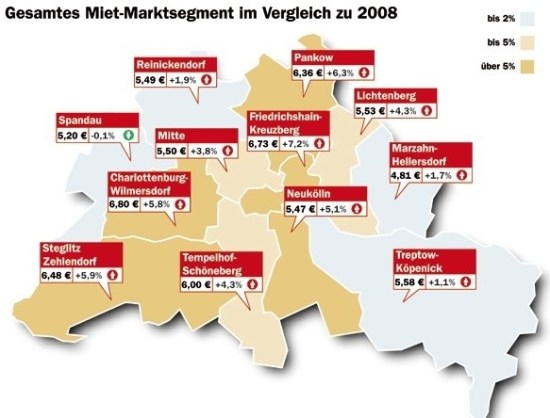
The average rent for new rentals has gone up nearly 5 percent since 2008, in some of the angesagte (hot) districts nearly 7 percent.
So much for finding your cheap ecologicial, I mean economical niche in Berlin, I guess. Although it’s still WAY cheaper to live here than in other German cities or gar (even) in “real” cities like London, Paris, New York, etc. And it will probably stay that way for a while yet, maybe, I hope.
This trend will continue, however, the smart guys say. There are ever more renters out there looking for apartments in a stagnant market – and only about 13 percent of Berliners actually own their own. Ich bin ein Berliner, they must be thinking, but I don’t necessarily want to own a piece of it.
Dieser Trend wird anhalten, so der Marktbericht, den die GSW am Donnerstag vorstellte. Denn in Berlin konkurrieren immer mehr Haushalte um die stagnierende Zahl der Mietwohnungen – und Wohneigentum leistet sich nur eine Minderheit (13 Prozent).
You know how it is, the best thing to do with good advice is to pass it on.

And that’s just what Germany’s Bild newspaper did during a lecturing session to Greece the other day. The newspaper basically called on the Greeks to adopt something they called “a more Germanic work ethic” in an open letter to Greek prime minister Papandreou.
What a joke. This is hilarious. This is hilarious because the Germanic work ethic is a hilarious myth.
My favorite lecture claim here? The one about Germans working until they’re 67. Ha, ha, ha. Every German knows that this is a big fat lie. But hey, if it makes you feel good to believe in such Märchen (fairy tales), whatever.
Anyway, you go Greece. Actually what I mean is that you’d better get going while the going’s good.
Germans tell Greeks to rise earlier and work harder to avoid financial crisis
Pissed off about a Focus magazine cover depicting Venus de Milo (some old Greek actress or something) flipping off the rest of Europe (meaning Germany) and carrying the title “Crooks in the Euro Family”, the Greek Consumer Association has called for the boycott of German goods which nobody in Greece can afford to buy right now anyway.

The Greeks are a little touchy these days because their government/state/civilization is on the verge of bankruptcy or something (like join the club already). The Germans are a little touchy these days because the Germans are always a little touchy.
Die Verfälschung einer Statue der griechischen Geschichte, Schönheit und Zivilisation, die aus einer Zeit stammt, wo sie (die Deutschen) Bananen auf Bäumen gegessen haben, ist unverzeihlich und nicht hinnehmbar.”
“That’s right, and the sexagenarian shock rocker’s got a hammer. He calmly smashes out the Plexiglas face part of the spaceman’s helmet. Fruit juice drains out, problem solved.”

Mr. Cooper’s success as a pitchman is doubly surprising because the stringy-haired 62-year-old takes over as Saturn spokesman from a sexy female cyborg who looked like the kind of adolescent-boy fantasy who turns up so often in Mr. Cooper’s songs.
Oh boy, another non-issue that nobody here is ever going to tackle.

People are all up in arms here about a comment made yesterday by FDP boss/foreign minister Guido Westerwelle. They’re upset because he pointed out that nearly 60 percent of Germany’s federal budget is spent on Sozialausgaben (welfare/social-security payments) and that the whole damned system needs to be properly addressed and debated.
So why is everybody so upset? That’s easy: It’s because early 60 percent of Germany’s federal budget is spent on Sozialausgaben (welfare/social-security payments) and the whole damned system needs to be addressed and debated.
It’s just that they don’t like to be reminded of this, you see. This “debate” he’s talking about should have started some thiry years ago, of course (think, say, of what Bill Clinton did to welfare in the 90s). But it won’t be debated in Germany now either.
And this is just a proposed debate, mind you. Imagine the uproar if somebody here ever actually tried to change anything.
„Wir dürfen nicht zulassen, dass der, der arbeitet, der Dumme ist.”
Not unless you live in Germay maybe. Strange. Right in the middle of the latest craze around here these daze (a host of informants are selling stolen data about tax evaders to the German state), a court has ordered a Liechtenstein bank to pay over seven million Euros to a German tax evader “for not informing him on time” that his data had been stolen – thus opening him up to said informants, get it? I know, I don’t get it either, but things are complicated here.

“Had the claimant been informed of the theft in due time, he would have had the option of self-indictment and not have been obliged to pay a EUR7.3 million fine.”
Fair is fair, I guess, or all is fair in love and tax evasion. Or something else maybe. Damn, these Germans and their ill-gotten gains. And this rampant lawlessness seems to be getting out of hand everywhere these days. The next thing you know pensioners will start kidnapping their financial advisers…
The data was stolen and sold on to the German intelligence service by a former employee of former LGT unit LGT Treuhand AG.
It’s much more like “skullduggery,” “backstabbing” and “dealing in stolen goods.”

And it’s legal too, of course, even when the information obtained was done so by “less than legal” means.

