Finanzmarktstabilisierungsgesetzverfassungsbeschwerde

Say that word ten times real fast. Hurts, don’t it? But what does it mean, you ask? I’ll tell you what it means. Or at least I’ll try to tell you what it means. This is important, I think. This could be our way out. Out of the financial crisis, I mean.


Don't bank on this one


Finanzmarktstabilisierungsgesetzverfassungsbeschwerde means that some poor lady who invested with Lehmann Brothers a while back is going to take her “case” to the German supreme court and try and get her money back based on the premise that if the banks get bailed out, then why not her.


Of course her mom probably never told her that just because little Jimmy or a bunch of big honkin’ banks jump off the bridge by making unsound investments doesn’t mean that she has to do the same damned thing. I’m just sayin’.


And now that I’ve re-read what I just wrote I’m not at all sure what’s worse, Finanzmarktstabilisierungsgesetzverfassungsbeschwerde (the word) or my attempt to explain what it means.


„Finanzhilfen für notleidende Kreditinstitute – nicht aber für Privatpersonen?“

Recht haben wollen

Aber richtig sein (but is it right?). This sounds familiar somehow. Like, where’s the money? That’s what a German ex-Hypo Real Estate boss is wondering. No, not the millions and billions (I mix those up these days for some reason) that the soon-to-be-bankrupt bank burned up over years of mismanagement (he was a boss dude, remember?), it’s all about his million or two or three euro salary and benefits that he believes he still has coming to him, legally. And perhaps he does, legally. After all, he was fired from a well-paid job you know and it’s hard to find steady work as a banker these days.


I've got a wife and a kid to feed or something.


Ah, the days of wine and roses, or of corporate or even personal responsibility, if you prefer. There was a time when people had a sense of accountability for their actions, or at least a sense of decency, or at least I believe there used to be a time like that. I’m starting to wonder, though. Doesn’t the saying go that the more things change the more they stay the same? If so, then where has all that sense of accountability gone? It’s blowing in the wind or something. Or everybody has gone out of their senses.


„Der mittlerweile entlassene Institutsleiter Georg Funke will gerichtlich prüfen lassen, ob sein Vertrag weiter gilt.“

Volltreffer!

Talk about being right on the mark. Everybody is trying to get a piece of this new consumer incentive plan for old cars (Abwrackprämie) over here in Germany these days. The government shells out 2,500 euros to anybody who trades in his old wreck for a new, more environmentally friendly one, I mean new one. German consumer confidence is way up at the moment, primarily because of this.


 Konsum until you drop.


But this is another one of those only-in-Germany kind of things, folks. The wreck you trade in here to get the money has to be at least nine years old! That’s right, nine (not nein). Only German cars live that long, of course, so it’s basically a subsidy for the German car industry. And they’re selling their smaller models like hotcakes at the moment, despite all of the economic doom.


By the way, you can’t trade the ones in you torch first, though, no matter how old they are.


„Die Verbraucher in Deutschland haben trotz der schwersten Rezession seit dem Zweiten Weltkrieg mehr Lust zum Einkaufen.“

Crisis, crisis and a little more crisis, to go

When will it end? VW just set a new record in sales, the German stock market just made another billion, the energy giant RWE beat it’s 2008 profit goals admirably, Axel Springer publishing (Bild) has never made more money, Sixt is expecting a booming 2009, it just goes on and on and on, people.


 Ho hum, another record.


Stop the world I want to get off or something. When are we ever going to see a little light at the end of the economic tunnel? Before we all roll over and die, I mean.


PS: Speaking of cars (even if VW didn’t actually invent them), Germany still loves you anyway, Mr. President. Noch (for now).

Black must one work

When you “work black” over here in Germany you’re working without paying any of those ridiculously high German Abgaben (taxes, social security and pension costs and who knows what else). You know, instead of hiring a painter to paint your apartment and give you a proper bill, you hire him or somebody else on the side and pay half?


 Talk about dirt cheap.


Well, every once in a while German government and media types pretend like this is a bad thing and get upset for a few days and talk about how, this time, for example, 30 billion Euros in revenue is being funneled away from the state due to this dreadfully immoral Schwarzarbeit (black work) stuff and everyone should stop doing it right now this minute honest and seriously we really mean it this time, folks. You know, be better people and all that?


The problem is that nobody here will even consider stopping hiring and working black, not as long as the German state isn’t prepared to reduce these high Abgaben of theirs, at least when it comes to work like this. And a reduction like this, of course, as everybody knows, is out of the question. Why, nobody knows. It just is.


A third of all Germans employ people this way, according to a recent survey. And the interesting thing, I find, is just who is doing the hiring. Some 39 percent of those hiring Schwarzarbeiter are retirees. The next biggist group with 28 percent is the childless DINK couple kind of people kind of group. But apparently only 18 percent of families with kids have the money to cheat the government out of, well, the money. They’ve given it all up by already having paid those Abgaben somewhere else, it seems.


„Allerdings plagt vier von fünf Bundesbürgern laut Umfrage keinerlei schlechtes Gewissen, wenn sie Schwarzarbeiter beschäftigen.“

Low point, high point, what’s the point?

Germany’s Ifo-Barometer is pointing south bigtime. After asking 1035 experts about the world’s economic climate (not that other one), they dropped its rating (a credit rating, so-to-speak) from 67 to 45 index points, the lowest its been in, well, quite a long time.


 Are these the good old days again or something?


At the same time, however, German investor confidence has just jumped to its highest level since 2007, this according to a place called the Zew Institute. “By the middle of 2009, the economy is likely to improve again. A sign of hope – no more, no less,” one analyst said.


High, low, more, less, Hauptsache (the main thing) is that everybody stays on the same sheet of music, right?


“Still, the gathering clouds have a silver lining.”

Star quality

That’s what the Mercedes-Benz star used to have. Well sure, it still does, I suppose. Although with a net loss of 1.93 billion dollars last quarter, it’s suddenly not shining like it used to. That’s 65% less profit for 2008 as a whole and, needless to say, worse than anyone here had forecast.


 Buddy, have you got a Daimler?


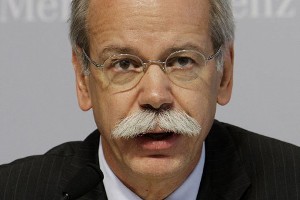
Consumers all around the world, and not just those normally so reliably wasteful American type ones, just aren’t buying these bug luxurious German cars anymore. But take heart a little. You can still blame Chrysler on this one if you want to, Daimler. This one last time, I mean. Onkel Dr. Zetsche will be pulling out his cost-cutting axe now all the same anyway, though.


 „Der Ergebnisrückgang sei vor allem auf Belastungen von 3,228 Milliarden Euro aus der Beteiligung an Chrysler sowie durch das niedrigere Ergebnis von Mercedes-Benz Cars bedingt.“

It’s good to be king

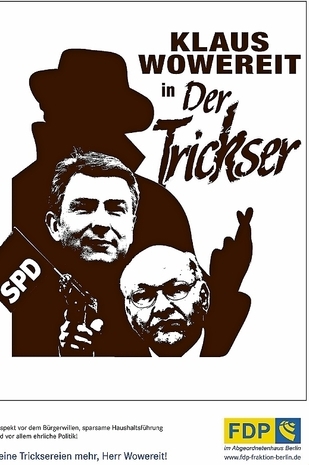
Berlin’s mayor Klaus Wowereit is becoming more like the Sun King all the time. After successfully campaigning to close the city’s famed Tempelhof Airport on grounds of nonprofitablitly, among other things, he has pushed through a rental contract with the Bread & Butter fashion tradeshow – Bread & Butter will use parts of the airport for two months a year over a period of five years, thus making it very difficult to find other renters – which appears to be anything but profitable itself. The maintenance costs to the city for the keeping the closed Airport “going” are much higher, you see.


 Der Wick... I mean Trickser.


But we may never know for sure just how bad a deal it is as the mayor refuses to disclose any details to anyone who asks him, the three opposition parties in the Rotes Rathaus included. I know what you’re thinking, but Rotes Rathaus doesn’t mean red rat house, its Berlin’s city hall and happens to be made out of red brick. Although, these days…


There’s a certain arrogance about Wowereit that obviously never sat well with those who have voted against him, but this growing distance to his Untertanen (subjects) below is slowly beginning to bug his buddies on the left now, too. Not that this matters or anything. But still.


“Sonnenkönig Wowereit schweigt.”

We’re in a corner and we like it there

Constraints, what constraints? We love constraints! And what’s a monopoly, between friends? Germans love board games of all kinds, you know, and they’ll play monopoly with anybody, as long as he or she’s a Russian, I guess.


That gives me gas


So whatcha gonna do? Achieving full energy independence isn’t an option for Germany and, being that the Germans won’t go nuclear or burn more coal (neither options are allowed for some strange reason) they’re going to have to be happy with their gas dependency on Russia (it’s around 40% at the moment).


And that’s why Angela Merkel, like that guy before her, believes that it’s good that the planned Nord Stream gas pipeline will bypass “veto players” like Poland and supply Germany directly with gas. It’s better for Europe that way, or something. Schroeder’s “unprecedented mixing of political and private commercial interests” was an awful, dreadful and despicable thing, Angie will tell you, but we’ll take that Russian gas all the same, no strings, I mean constraints, attached.


“The Nord Stream pipeline project was initially agreed to in late 2005 by then-Russian President Putin and former Chancellor Gerhard Schroeder, who signed the deal during his last days in office.”