That’s right, Berlin is the capital, the capital when it comes to having the nation’s most welfare (Hartz IV) recipients.

Nearly 1 in 5 Berliners are receiving it.
“Berlin bleibt das Armenhaus Deutschlands”
That’s right, Berlin is the capital, the capital when it comes to having the nation’s most welfare (Hartz IV) recipients.
Nearly 1 in 5 Berliners are receiving it.
“Berlin bleibt das Armenhaus Deutschlands”
“The German government has detailed financial support only for Magna, the more complex, controversial and higher-risk offer.”

“That has left GM suspecting that Germany is pandering to labor unions and seeking to curry favor with Moscow in preferring Magna.”
“The problem for Berlin could be that it has painted itself into a corner: damned if it pushes the high-risk Magna deal through, and damned if it doesn’t.”
Hmmm. Looks like the next big (German) government rescue plan might already be on its way.
“No wonder GM has revived ‘Plan B’ and may attempt to raise the $4.3 billion Opel needs to survive from other sources.”
“Germany’s statistics office said Tuesday that government spending and a slide in tax revenue had led to a 17.3-billion-euro ($24.7 billion) budget deficit in the first half of 2009, compared with a 7-billion-euro surplus ($10 billion) last year.”

“Ultimately Germany needs demand from its key trading partners–the United States and the rest of western Europe–to pick up. If not, all the government spending will mean its budget deficit will continue growing.”
“The German economy is still on a drip, getting infusions from policymakers. Some doubts remain whether the economy can stand on its own feet.”
It’s finally okay for us to start buying Japanese cars too!
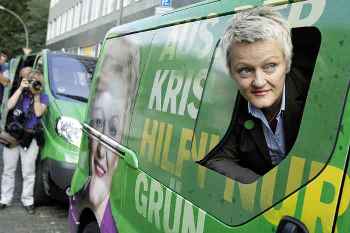
Or at least that’s what German Green Party whip Renate Künast seems to think. With calls for “Buy hybrid cars from Toyota!” and other provocative German-car-industry-bashing and name-calling name calls, Künast is hurting her fellow Germans’ German car loving feelings right and left. Or maybe she isn’t, hard to say for sure.
Personally, I’ve always felt that Germans secretly want to own Japanese cars (you rarely see one here, you know), it’s just that their families would disown them and the neighbors wouldn’t understand. Not that they do now, the neighbors, but still.
So, who knows? Maybe this offensive Green offensive might be the final straw to finally break the back of German Japanese car resistance and mobilize the already highly mobile German population to finally get out there and buy some Made in Japan already.
Or maybe it might just get the German car industry to finally budge just this little itsy bitty bit and start making more environmentally friendly automobiles. Nah.
„Wenn die Deutschen zu blöd sind, moderne Autos zu bauen, muss man den Leuten empfehlen, Toyota Prius zu kaufen.“
Although the title may be an unofficial one, it looks like its official now: Germany is poised to lose the title of world’s top exporter this year – to China (who else?). The recession may be over here (or not), but the recession elsewhere continues to lower the demand for expensive German cars, machinery and other Teutonic stuff.

In other words, the rest of the world is now doing what the Germans have been doing here all along: The cheaper the better. No, that’s not a dance, although it might become one.
“Germany’s trading partners are going more for cheaper products right now.”
I mean the recession is, in Germany.
So like, who won? Certainly the experts didn’t. But, then again, they never do.
“And while exports rose 7% in June, the fastest pace in nearly three years, few analysts had expected a return to overall economic growth so quickly.”
Or why else would Germany be selling such highly expensive weapons systems to one of everybody’s favorite nuclear-armed states?
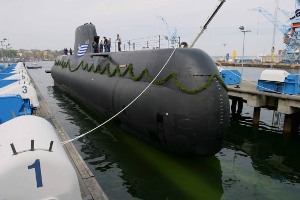
That’s right, after Chancellor Merkel’s government quietly gives its OK to the sale of three Class 214 submarines to Pakistan during the visit of a Pakistani delegation in Berlin today, Pakistan will become the first nation in maritime history to use these deadly underwater weapons against Islamist radicals in the mountainous border region between Pakistan and neighboring Afghanistan.
When asked how on earth a submarine could possibly be of any use in the rocky reaches of South Waziristan, a German military expert who refused to identify himself smugly replied “These are German submarines. They’re that good.”
“The money would be better spent on equipping and training its land forces to combat terrorist insurgents.”
So much for my theory about this being a German car subsidy conspiracy plan. What a lemon, this German Abwrackprämie or cash-for-clunkers idea has turned out to be. If you work in the German car industry, that is.
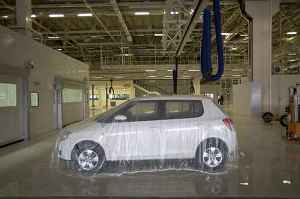
The government stepped in as usual and helped everybody again and no force in the universe could stop them, as usual again. But this time it was the German government helping out the Czechs, unintentionally of course. I know this sounds complicated at first but that’s only because it actually isn’t.
Since Berlin has been shelling out 2,500 euros to anybody who trades in his or her old wreck for a new one, I mean a new car, Skoda’s production plants have been at full production, if you get my drift. Hyundai, Renault and other foreign plants have been profiting from the handout, too.
Hey, the government meant well. They always do. Now if one could only find out how to stop them from helping maybe things might finally start moving forward here.
“Since the end of March, we are in full production — five days a week, on three shifts.”
Like where to find it. There are worse things to worry about, I guess.
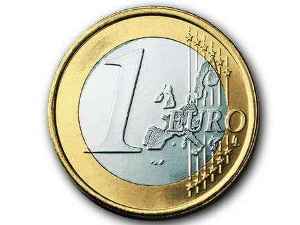
If you have to look at the bright side in Germany these days, and some folks just can’t help it, then maybe having a look at the German inflation rate might help you out. It’s the lowest it’s been in twenty years, at zero. Zero is pretty low, if you stop and think about it, so that’s a good thing, I think.
That’s right. Prices haven’t risen here in a year, on average, so-to-speak. Of course wages haven’t necessarily risen all that much either (for those still working), but still.
„Die Null-Inflation sorgt dafür, dass die Menschen trotz wachsender Ängste um ihren Arbeitsplatz oder die Sorge um die Staatsfinanzen ihre Kauflust bisher nicht verloren haben. Und der stabile Inlandskonsum ist derzeit die einzig verbliebene Konjunkturstütze.“
“It was never meant to be like this. A reunified Germany, at the heart of an expanding European Union and single currency, was supposed to offer a decent, stronger alternative to the “casino capitalism” that Germans have long thought of as represented by the US model that they love to hate.
When the credit crunch first broke in the autumn of 2007, bringing banks such as Northern Rock down almost immediately, the Germans allowed themselves a quiet chuckle of schadenfreude along the lines of “we told you so”.
But that was before the financial crisis swept through Germany’s banking system, which turned out to have had its tentacles deep into the sub-prime mortgage market in the United States. And it was before the collapse in world trade that Germany had previously depended on to drive its economy.”
“The Opel crisis is part of a much wider problem.”
 Observing Hermann