If Google won’t get you, Facebook will

Just when Germany thought it was finally getting Google under control (sort of), freakin’ Facebook comes along with a brand new service that will be able to locate mobile Facebook Germans faster than you can say hide-and-seek.

Of course Facebook Places users would have to want to use this service first and sign up for it and all that, but what’s that got to do with it? It’s the principle of the matter – I think.

After all, even if German Facebook users would want to be found by others they shouldn’t be allowed to be, because… Well, should they? What happens then?

This is really starting to get diabolical, I tell you. I think it’s the Brain Police.

Die Frage “Wo bist du?” wird man wohl künftig immer seltener hören.

Street View II

Or 2.0? The saga continues. Pack your canned goods and potable water, Germany. Street View is coming doch (after all).

But this time you don’t have to worry about lack of privacy and criminal abuse and all that stuff. This time it’s going to be a German kinda Street View thang.

Not only will the faces of individuals and license plates and street addresses be blurred out, German Street View is going to blurr out the houses and the streets, entire neighborhoods, cities, mountains, lakes and streams and other prominent geographical landmarks including some of our planet’s smaller oceans too – but they were kind of blurry to begin with anyway, so there.

People can also ask to have images of their homes removed from the database starting next week – a move aimed at dispelling privacy fears.

Give us your Festplatte

Boy oh boy. Does Germany’s ever have big Google by the little googles now.

Caught accidently (Google says) collecting private data while collecting WLAN data for their Street View photo archive (the first Google mess-up vis-a-vis Germany, as far as I’m concerned – other than offering Google here in the first place, I mean), Hamburg’s data protection supervisor dude has demanded that Google hand over their hard drive for inspection, or else.

Good thing for Google he doesn’t know that they actually have more than one.
 
Google apologized for collecting what it described as fragments of information from unsecured WLANs, saying its actions were inadvertent and the result of a programming error.

Sue Google

No, not Susan Google. You know, like in I’m gonna sue you?

And that’s what this artist lady over here in Germany tried to do (her name’s not Sue either, by the way).

Her gripe and/or argument? She got all hot and POed at Google for having the audacity to actually display in Google Bilder (Images) the very pictures she was displaying in the Internet her own damned self.

None of this Aufregung (excitement) flew with the German Federal Supreme Court, however, believe it or not. They said, in essence: If you didn’t want Google to display your pictures, you could have prevented them from doing so, which of course she could have and still can.

Damn. That’s way too much common sense for me. The Federal Supreme Court, in Germany of all places. These old codgers are behind the times with a capital B – for Bilder?

Die Klägerin unterhalte eine eigene Internetseite, auf der sie Abbildungen ihrer Kunstwerke eingestellt habe. Daher sei die Künstlerin mit der Anzeige ihrer Werke „im Rahmen der Bildersuche der Suchmaschine einverstanden“.

Oh. My. Google.

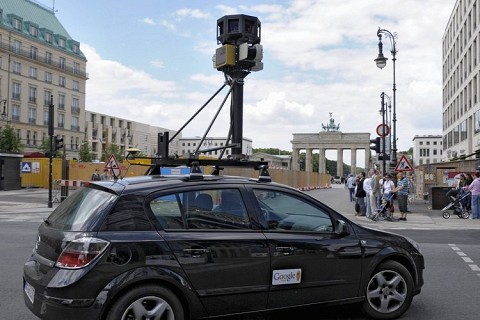
They’re at it again. This time Google’s StreetView car (they actually have several) has come under fire in Germany again for, gulp, collecting data on private Wi-Fi networks.

That this has been done for years already by many location-based service companies like Skyhook say, and applications like Twitter and even “good” browsers like Firefox makes no difference at all here, folks. Aufregung muss her (you just have to get hot and bothered).

Do no evil? Google kann do no good.

Datenschützer kritisieren die angebliche Speicherung von privaten Daten über WLAN-Netze durch Google Street View. Andere Anbieter bleiben von der Kritik ausgenommen, dabei gehen sie genauso vor.

No scary Google-mobiles here, please

Despite a recent high-level compromise, the German Street View saga continues.

A new report, and there’s always a new report if you want one, confirms that Google’s Street View is pretty much pure evil and they (whoever they are) have to be stopped at all costs. Stay tuned.

Die Auflagen, für die sich Rechtsprofessor Thomas Dreier und Professorin Indra Spiecker stark machen, gehen teils weit über die bestehenden Absprachen zwischen Google Deutschland und der zuständigen Datenschutzaufsichtsbehörde in Hamburg hinaus.

Iran paranoid about Google now too

Not unlike German fears about privacy when it comes to Google’s eerie Street-View technology – while gladly developing and using Street-View-type products of their own – Iran’s freely elected government sort of is also frightened about privacy when it comes to one of Google’s other creepy technologies: eMail (and that’s e for evil). And yeah, of course I know that Google didn’t invent eMail. But still.

The Iranian powers that be (or powers that is, if you prefer) are clearly concerned about privacy matters here; keeping their own damned privacy as private as inhumanly possible, that is. Otherwise, everybody out there knows what the hell they’re up to, get it?

So now following the German example, word is out that the Iranians are actually planning to introduce a new eMail technology of their own. It’s code name is MMail, I think (GMail war gestern). Or Mullah-Mail, if you prefer.

Es ist einer der populärsten E-Mail-Dienste in Iran – doch nun will die Regierung Googles GMail-Service offenbar sperren lassen. Laut einem Bericht des “Wall Street Journal” soll stattdessen ein eigenes Mail-System aufgebaut werden.

Germans? Hysterical about Google’s Street-View?

How you figure?

That German companies like the map manufacturer Tele Atlas or the small business Panogate (sightwalk.de) in Cologne do the same damned thing that Google does – make fotos of/in cities in order to publish them in the Internet and use them for navigation systems – that doesn’t matter here. What matters here is that a particularly awful and ominous “data octopus” is doing it.

Ob Microsoft (preview.local.live.com), der Kartenhersteller Tele Atlas oder das kleine Unternehmen Panogate (sightwalk.de) aus Köln, sie alle fotografieren systematisch die Städte dieser Welt – mal aus dem Flugzeug, mal aus dem Auto. Auch sie veröffentlichen diese Bilder im Internet oder nutzen sie für Navigationssysteme. Wenn sich die öffentliche Debatte nun auf Google konzentriert, dann wohl nur, weil sich mit diffusen Vorwürfen gegen den vermeintlichen “Datenkraken” leicht Ängste schüren lassen.

It’s quite simple, really. Germans, just like everybody else, really love angst. Only they love it here so much that they acually spell it with a capital A. You know, with an A like they use for Amerika (sorry, US-Amerika, of course).

Fast hysterisch wirken hingegen die Warnungen vor dem Verlust der Privatsphäre. Was ist damit gemeint? Die Privatsphäre der Hausfront? Google und Co. fotografieren grundsätzlich nur das, was jeder Fußgänger auf einer öffentlich zugänglichen Straße sieht.

Privacy?

Ever see Father Knows Best? Well over here it’s the state that always knows best, especially when it comes to dealing in stolen goods.

If Big Bruder wants to buy stolen secret Swiss bank account data on 1,500 alleged tax evaders from an informant, that’s OK here (Germans have always had a Herz für Informanten – a warm spot in their hearts for informers), but with Google, let’s say, by virtue of its very success here in Germany – having reached a substantially larger market share here over its rival search engines than it has elsewhere – this very success places it under immediate suspicion. Informants aren’t even necessary. Privacy is automatically in danger.

And then Big Bruder’s lawmakers, regulators and consumer advocates will invariably come in to “fix it” (fix what isn’t broken), all in the name of privacy of course.

With Google, nobody’s dealing in stolen goods – or are they? No, that’s eBay. But in both cases, whether it’s about Swiss bank accounts or Google’s success, one always has to play it safe here. It’s always guilty until proven innocent. Father knows best.

Google’s border-straddling scale and its brash ambitions raise alarms with some European politicians.

It’s us against Google, yet again

Google Book Search bad. German Digital Library good.

Upset and suspicious about Google’s attempts to digitalize books, pictures, sculptures, notes, music and films to make them available for everybody on the Internet, the German Cabinet has just agreed on a plan to digitalize books, pictures, sculptures, notes, music and films to make them available for everybody on the Internet.

I’m not making this up, people. I wouldn’t be able to. Contrary to what you might think, Germans don’t like technology. Not unless its their own, I mean.

Culture Minister Bernd Neumann called the project a “quantum leap into the world of digital information.”