Talk to the hand

“They are rejecting an idea before studying it.” What else is new, Jean-Claude? Remember Iraq? The Germans said no to that before even being asked.
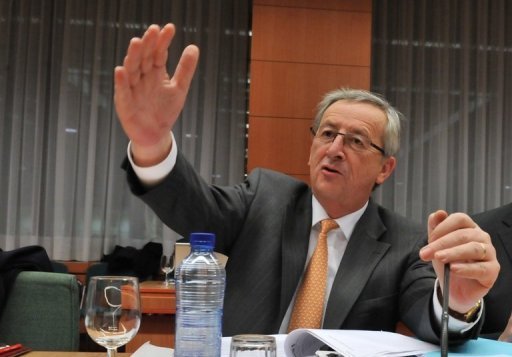
Eurogroup chairman Jean-Claude Juncker “launched a blistering attack” on Germany for its flat refusal to even consider his proposal to create eurozone bonds (“E-Bonds” would help weaker eurozone members raise money). He called the Germans “un-European.” Ouch. It doesn’t get much lower than that, people. Unless it’s “un-Southern European” maybe. Lower, get it?

Too bad he mixed up Merkel & Co. with somebody who gives a Scheiße. Just get used to it, Jean-Claude. And you just keep raising your hand as often as you like.

“This is very strange. This way of creating taboo areas in Europe and not dealing with others’ ideas is a very un-European way of dealing with European matters.”

Westerwelle in Iraq: “We want to send a signal”

And the signal is: We think it’ll be safe enough for us now to start making money down there again.

German Foreign Minister Guido Westerwelle made a surprise visit to Baghdad on Saturday, calling for more economic engagement in that country (he means of the German kind), which really isn’t much of a surpise, if you ask me.

In particular, a bilateral deal on the protection of investments is expected to be signed with Industry Minister Fawzi Hariri, with the new accord helping improve “economic and legal conditions for German companies” working in Iraq.

Geld ist doch für alle da

There’s money here for everybody. Remember the financial crisis? Long, long ago (in Germany)?

It seems that the Federal Reserve’s emergency loan programs really helped out a lot after all–German banks, that is. Hey, what’s a few trillion among friends?

Deutsche Banken haben das Förderprogramm der US-Notenbank inmitten der Finanzkrise kräftig genutzt.

“Deutschland macht dabei auch ein gutes Geschäft”

Germany is also getting a good bargain in the deal.

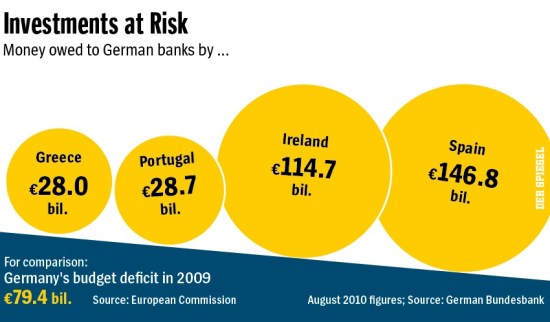
What deal you ask? You know, the one the Germans love moaning about so much at the Stammtisch (regulars’ table) these days: How poor Germany has to bail everbody out in Europe (Greece, Ireland, who’s next?) and how said poor Germans are poor victims yet again and blah, blah, tra, la, boo, hoo, hoo.

But there’s always a rest of the story.

Sure, the Germans have to “contribute” the most to this way cool European rescue parachute that keeps getting pulled these days, but they also have the most to gain if everything goes right.

How so? Some call it, I don’t know, refinancing. They borrow the money on the bond market for 3 percent and then loan it to the Greeks and the Irish (and the next folks to come along) for 5.8 percent. If these countries die Kurve kriegen (turn the corner), then the money comes rolling back in–and a big sweet profit to boot.

So dry your eyes over there at the Stammtisch already and take a deep breath after you order your next beer. Es wird alles gut. Everything will turn out good in the end. Maybe even real good.

“Wer sich selbst am Anleihemarkt für knapp drei Prozent refinanziere und an Krisenländer wie Griechenland und Irland Kredite zu einem Zinssatz von 5,8 Prozent ausreiche, könne selbst ordentliche Gewinne einstreichen.”

Who’s clueless now?

“About two weeks ago, Germany’s finance minister described U.S. economic policy as “clueless.” We don’t want to sound childish…

But after yet another bailout for an insolvent European country – about $137 billion for Ireland – we are inclined to ask: If the United States is clueless, what does that make Germany? The de facto leader of the crisis-ridden, 16-nation eurozone, Berlin has not performed its role brilliantly over the past year.”

—–

Fehlalarm des Tages (false alarm of the day):  A suitcase at the Düsseldorf Main Station.

Maybe history does repeat itself

At least when it comes to Germany’s interest in benefitting from currency troubles, I mean. Hey Greece, Ireland, Portugal, Spain, Italy… Stay hard-up or shut-up.

”The key principle of German economic policy was to persuade the French and Italians to lower the value of the D-mark so as to make Germany more competitive.”

“The Berlin government’s intransigence over the debt issue, while politically understandable from a German point of view, seemingly pays little heed to the realities of the euro economy, which are heavily tilted towards Germany.”

“In pre-EMU days, if the German economy were growing at an estimated 3.7% as it is this year, the German currency and interest rates would both come under upward pressure – damping exporters’ performance and the growth outlook. Now, however, with all EMU economies shackled together, and devaluation an impossibility for the peripheral countries, the hard-up states have nowhere to hide. Germany continues to profit from excellent export performance — and it can self-righteously point the finger of blame for the euro area’s woes at those debt-ridden peripheral states.”

Nothing Nouveau on the German Front

This is a very complex article, I grant you, a lot like that other one I mentioned recently, but with a little bit of effort I think I can somehow manage to summarize it for you thus (and I quote, more or less):

American society is breaking apart.

Everything is spiraling further and further into the abyss.

The American people are going through a Kafkaesque odyssey, the humiliation of which is hard to comprehend.

Help is not in sight, our government and our society have abandoned us.

Wall Street is preoccupied with chasing new profits again.

That old myth about working your way up, of bootstrap success and its ultimate prize, homeownership, has evaporated.

The middle class, America’s backbone, is crumbling.

The American Dream has turned into a nightmare.

Nothing’s going to happen because the political swing to the right is extremely hurtful and absolutely disastrous to the interest of the weakest.

Becoming unemployed is a devious trap. And on and on and tra, la, la until the amen part.

Like, you had no idea, did you? My fellow Americans, I mean. So there you have it. Yet again. And no, the O Word didn’t appear in this article either.

Germany and China vs. the USA

Guess who wins (these days, I mean)? Duh. But it’s only a paritial victory, as Germany tries to spin it (they don’t want to gloat all too much publically).

After China and Germany teamed up and publicly slammed the Federal Reserve’s decision to buy $600 billion in Treasury bonds last week, now they’re shoulder to shoulder at the G20 successfully resisting this EVIL infusion of cash (= dollar devaluation) together too. They are doing this because, well, only China is allowed to devaluate its currency, I guess. And a weak dollar also means a strong euro which would hurt German exports and, well, this isn’t allowed to happen either.

Strange bedfellows aren’t they? Sure. What can/will President Obama do about it? Not much, it seems. But at least everybody over there still really, really likes him. And that’s the main thing.

It’s a mystery, isn’t it? How we got here, I mean? Well, no. I guess it isn’t. But why this happened as it did is all too, uh, deep for me. It’s kind of like this current German hole within a hole conundrum going on.

I mean, don’t like two holes make a non-hole?

“Obama muss klein beigeben”

Germany home alone again

Although the Germans may not have noticed it yet.

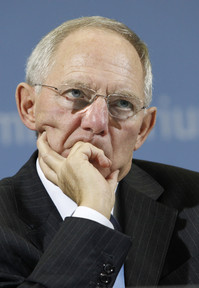
Talk about a fistful of dollars. Underscoring the mounting friction between Germany and its G-20 partners concerning the question of finanical policy, Germany’s Finance Minister Wolfgang Schaeuble said that the US plan to pump $600bn into the US economy was “clueless” and would create “extra problems for the world”.

So, like where’s the problem?

Of course the German coalition government needs to talk tough like this because it has to convince everyone here how austere it really is–it trails the opposition in opinion polls before six state elections next year and needs a success “after alienating German voters by supporting the bailout for Greece in May.” Calling US policy makers clueless is just the icing on the cake.

Can’t wait for the G-20 meeting in Seoul next week. To take a look at “united Europe’s” stand on the matter, I mean. Although if you’d ask President Obama, he’d probably tell you that Europe just doesn’t matter.

“Eine ganze Reihe von Amerikanern betrachte Europa zwar nicht als Problem, allerdings längst auch nicht mehr als Teil der Lösung. Obama scheint dazu zu gehören.”

And thanks a million for this one, Joe:

“You won’t find a lot of Keynesians here,” explained one German economic policymaker in Berlin in September. That will not be news to anyone who has spoken to his counterparts in Washington. In their view, Germany is a skulker, a rotten citizen of the global economy, the macroeconomic equivalent of a juvenile delinquent, or worse. It is a smart aleck in the emergency ward that is the global economy. It is a flouter of the prescriptions of the new Doctor New Deal who sits in the White House. 


 http://www.weeklystandard.com/articles/germany-said-no_513319.html
 
So when Obama administration officials urge Germans to stimulate, they are wrong, but not for the obvious reasons. It is not that they want to impose socialist programs on a capitalist system that is doing well without them. It is that they want to impose demand-stimulating programs on a system that is already absolutely glutted with them. It is as if the administration’s approach were to take as a baseline whatever any given government happens to be spending, and then to insist that the figure should be, say, 10 percent of GDP higher. This is about as reasonable as assuming your child will be half as likely to get pneumonia if you send him off to school wearing two down parkas.