Germans go home!

Back home to the German Mark, I mean.

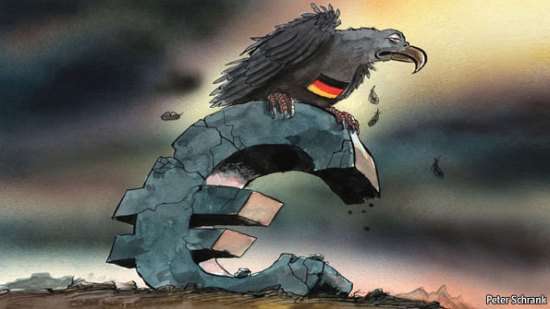
Zillbillionquadrillionaire rich dude George Soros has warned that Germany’s drastic plans to drastically slash its budget over the next four years is like, well, way too drastic and could even lead to the collapse of the euro – some seven hundred and eighty-seven zillbillionquadrillion of these already his own.

“Right now the Germans are dragging their neighbors into deflation,” he said. “Which threatens a long phase of stagnation.” And this is a real abomination. Across the nation.

“If the Germans don’t change their policy, their exit from the currency union would be helpful to the rest of Europe.”

So there we have it. I think.

“Wenn die Deutschen ihre Politik nicht ändern, wäre ihr Austritt aus der Währungsunion für den Rest Europas hilfreich.”
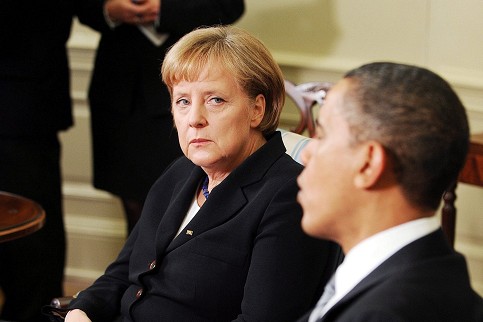
Dear Angela…

Stop all this austerity and savings crap and start burning up some euros already.

Yours truly,
Obama

Merkel’s savings measures, touted as Germany’s biggest austerity drive since World War Two, aim to deliver savings of 11.2 billion euros next year and lower a deficit set to exceed five per cent of gross domestic product (GDP) this year, according to an official draft of the plan.

Speaking of German cars…

Americans sure like buying them – again. Germans aren’t all that interested in them anymore, though (no more cash-for-clunkers).

Orders abroad are up 22 percent in May compared to a year earlier – with China and the United States providing the demand. We’ve been through this before, haven’t we (and again and again)?

“Die Bedeutung des US-Marktes nimmt wieder zu.”

Divided we stand

But at least divided we stand together, in “broad agreement.”

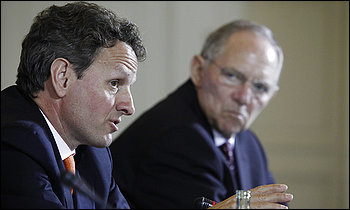
It goes like this: Tim Geithner is all for imposing more conservative rules on financial institutions too, Germany, as long as they’re not too conservative. Germany’s Wolfgang Schäuble, on the other hand, wants kind-of-sort-of the same thing, he says, as long as it’s more conservative than not too conservative and, above all else, international. And as long as it’s German unilateral at the same time too, of course.

Other than that though, they couldn’t agree on much of anything.

“We have a lot in common. We are going to have slightly different approaches. I don’t think we’ll know what separates us until we get to the next stage.”

Germany vs. Europe?

Well welcome to the club, Germany. Like what took you so long?

Now, at the worst possible moment, Germany is turning to nationalist illusions. Europe’s past economic successes are now viewed as German successes.

Europe’s current deep problems are everyone else’s except Germany’s. That is neither realistic nor sustainable. But German politicians and commentators are callously and self-destructively feeding these ideas.

Merkel botched it with the euro – at least as well as we would have

SPIEGEL: But most German politicians are committed to Europe.

Fischer: Only as long as it remains very abstract. But we have to give people enough credit to deal with unpleasant truths. No one explains why the euro is important for Germany and what its failure would mean. And no one explains why Germany has always paid — because it happens to be the big winner in Europe.

SPIEGEL: A community of solidarity means that Germany must pay for the failures of others.

Fischer: What nonsense! The European Union was a transfer union from the very beginning. The common market and the agrarian market were and still are primarily transfer guarantees for Germany and France!

SPIEGEL: How should Merkel have reacted?

Fischer: The chancellor should have put forward her own proposal to rescue the euro, in coordination with France. We have a responsibility as Europe’s strongest economic power. The EU cannot solve its problems in the long run if Germany hides itself. We are paying a high price for our resistance. We are viewed with suspicion in the entire Mediterranean region, and are seen as villains in Greece.

Ground Zero? Here?

Ground zero of Europe’s debt-currency-banking crisis isn’t in Greece, or Portugal, or Ireland or even Spain. It’s in Germany.”

“At one end is a powerful and highly efficient industrial export engine that generates a large trade surplus with the rest of the world, including most other countries in the eurozone. Instead of spending this new export wealth on a higher standard of living, however, parsimonious Germans prefer to save it, handing it over to thinly capitalized German banks that have proved equally efficient in destroying said wealth by investing it in risky securities issued, not coincidentally, by trading partners that need the capital to finance their trade deficits with Germany.”

“What Germans won’t accept is that they wouldn’t have been able to sell all those beautifully designed cars and well-engineered machine tools if Greeks and Spaniards and Americans hadn’t been willing to buy those goods and German banks hadn’t been so willing to lend them the money to do so. “

Standards schmandards

For all the talk about the profligacy of the Southern European nations, Germany itself falls short of euro area standards, calling for budget deficits of less than 3% and government debt below 60% of gross domestic product. The latest figures from Germany are 3.3% and 73%, according to Eurostat.

“If Germany weren’t in the euro area today, it wouldn’t be able to get in, because it violates both the debt and the deficit criteria,” Buiter said.