What Identity Do I Wear Today?

So what do you want, Germany? The Germans don’t even know themselves what they want with Europe and/or Germany: In a survey this September by Der Spiegel, clear majorities of Germans said that it wasn’t right to help Greece and other countries with the bailout fund and that Germany was not benefiting from the euro zone. But a clear majority also believed that European institutions should be given more power in a crisis. Classic German schizophrenia again or what?

Not that it matters or anything. In the final analysis nobody is asking you what you want: The European Union is a union not of peoples but of heads of state. “General Franco was a head of state, too.”

Nope, I still don’t know what “Europe” is supposed to mean here, but I keep getting the sneaking suspicion that I’m not the only one living in Europe who feels that way. It’s just that I, as a non-European, have the luxury of being able to admit that I don’t get it and that I don’t really care.

But as this latest crisis develops, one thing seems certain. Whatever Europe may be, it clearly has something to do with illusion.  Illusion with an s on the end. With lots of illusions. One illusion after the next. Here’s one, for example:

Europe is founded on the illusion of German money without German control. And that bargain has worked, until now, because of the way Germany sees itself within Europe (which itself, as the polls suggest, is an illusion).

“As a good German one has to be a good European.”

More Angst Underway

In a shocking new study or something, psychologist expert types have just discovered that up to 17 percent of German young people between the ages of 14 and 20 are currently suffering from the what is now to become the dreaded mass illness ailment sickness known as “social phobia” (formarly known as adolescence). No one has bothered to tell them about it yet, either.

These chronic sufferers, especially the girl ones, regularly avoid situations in which they must meet people they don’t know and do things that they don’t want to do. But there is good news, researchers say. This scourge of mankind (teenkind?) can be treated successfully. By finally growing up already.

“Die gute Nachricht ist, dass soziale Phobien erfolgreich behandelt werden können.”

Is it Newspeak or Newsspeak?

The Fukushima worst case scenario has now actually happened, in Germany. And the Fukushima worst case scenario is that the Fukushima worst case scenario never happened. Sometimes the truth raises it’s ugly and pointy little head, even here. Only for a second or two, but still.

I read the news today, oh boy. And not that any of you out there really care or anything, but I discovered that even journalists with the best of politically correct intentions can screw up from time to time. In this case it was in a Zeit article entitled Stress und Strahlung (Stress and Radiation) by Hans Schuh*. It was about how, well, something called “psychosocial stress” resulting from the Fukushima incident will now be producing more victims than the radiation did (I think he meant in Japan because psychosocial stress victims have been dropping like flies here in Germany for months now).

Like duh, Hans. Something has to produce victims when the “Super-GAU” everyone was banking on never materialized, right?

My favorite line in the article: In hindsight it has been revealed that with regard to one aspect of the accident’s occurance the world community (he actually means Germany here, of course) was taken in by an error: The “worst case scenario in the fuel cooling basin” never took place.

I’ve got to know, folks: How on earth did this ever get past the Brain Police?

I know how. “The people” will automatically understand that the worst case scenario took place anyway, sort of, irgendwie. They have long been aware of the fact that their reality must be made to comply with your/our ideologically motivated fear agenda, so it ain’t no big thing, this one little slip-up. This type of thing only makes Newspeak stronger, I think, although I can’t claim to be fluent in it yet myself.

Im Rückblick offenbart sich auch, dass die Weltgemeinde in Bezug auf das Unfallgeschehen zumindest in einem Punkt einem Irrtum aufgessen ist: Der “GAU im Abklingbecken”, der global Schlagzeilen machte fand gar nicht statt.”

* You won’t be finding this article online for some reason. I guess it’s not fit for the masses just yet.

News Alert! Here’s the article after all. They publish these online a little later, I guess.

New Angst Study Producing More New Angst

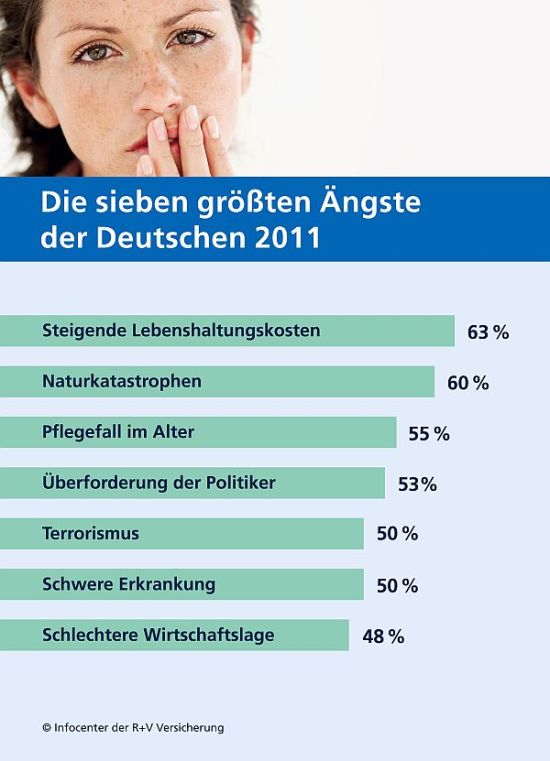
A new study from the R+V Insurance Company (hmmm, an insurance company) indicates that Germans have a whole new list of things to scare the Hosen off them that they didn’t have last year. Is there a pattern developing here or something?

Some of this year’s top favorites (so far) are ecological catastrophes (a perennial hit), the “super worst case scenario” that took place after the earthquake in Japan, the so-called EHEC scandal (go organic sprouts!) and those bloody and yucky revolts still going on down there in the Arabian World.

But what really scares them most is, well, their money. Or the thought of losing it, I should say. Along with their fear of rising energy costs (hmmm, where might those rising energy costs be coming from?), over 70 percent of Germans asked are scared to death of the imminent bankruptcy of a few of them there EU countries down south which will cost the German taxpayer dearly.

Hey. No angst, no fun.

70 Prozent der Deutschen befürchten, dass die drohende Pleite einiger EU-Länder den deutschen Steuerzahler teuer zu stehen kommt – keine Angst erreichte 2011 höhere Werte.

Everything Is So Wonderfulawful Here

Things have never been better here in Germany, we are told. And yet the German nation still can’t seem to get up off the collective couch (the psychiatrist’s kind).

This guy has an interesting take on Germany’s latest “season of angst” or why a prosperous nation has this obsessive need to turn on itself (and those around it).

His bewilderment is uncalled for however, I find. I can only wonder why he wonders. The Germans were, are and always will be collectively schizophrenic, in their own peculiar (cute?) little way. They are permanently krankgeschrieben (off sick) and that couch is, well, where they live.

Yet it is very hard to find anyone here who is happy about this state of affairs. Unlike the great Rhineland industrial booms of the 1950s and 1970s, this one is provoking Germans to turn against their government, against Europe, against technology and growth, against outsiders. It is an inward-looking, self-questioning moment in a country that the rest of Europe very badly needs to be involved in affairs outside its borders.