Can you read me?

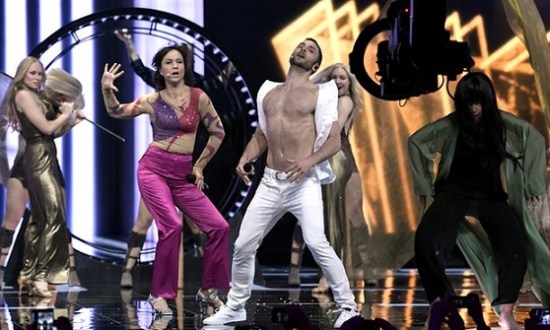
Eurovision is once again upon us, which is scary enough. But now it’s also time for us to find out that it has something called a “deeper meaning.” All it took for this was 35,000 pounds (€40,000) of British government funding, a few academics and a whole lot of not having a life. Here are just a few of the revolutionary revelations and fun facts about Eurovision that none of us really wanted to know about:
For the first time, there will be a major academic review of Eurovision, including a series of workshops that will be completed this weekend in Düsseldorf, Germany, where the 2011 Eurovision Song Contest is being hosted, and culminate with the publication of a book of essays.
We have been assured that “it really takes international and multidisciplinary perspectives to even start to pick away at what Eurovision means.” Or why anyone would want to (pick away at it), I assume
Eurovision is “56 years of European pop, gender and representational history.” Not to mention the really sucky music part.
“Eurovision is an arena for European identification in which both national identity and also participation in a European identity are confirmed.” Yeah, OK. Whatever.
But of course not even seasoned academics can be expected to be experts at Eurovision geography, folks. Some of my personal Eurovision favorites, for instance, are European nations like Israel, Azerbaijan, Georgia, Morocco and Kazakhstan.
Little technicalities like these can be educational, however. “At least it gets people thinking about a country which normally wouldn’t cross their minds. Maybe they’ll look on a map to try to figure out where it is,”
And…
Eurovision is the world’s largest live non-sporting television event.
Eurovision has grown more since 1989 than either NATO or the European Union.
Eurovision is not just kitsch and lamé, it is “a night when Europe comes together symbolically” (and nasty stereotypes about national identity (in stereo) lead to animosity and symbolic surrogate war).
And last but not least, Eurovision is queer. “Another subject you won’t have to dig too deep into the academics’ footnotes to find is the ‘queerness’ of an annual event that has come to be known as ‘Gay Christmas.'”
So sit back this weekend and enjoy some European unity, televoting and really crappy music. Ho, ho, ho or something.
Not even semi-utopian Eurovision has succeeded in bridging every cultural divide.
 Observing Hermann