The crisis is over, let’s save even more!

In case you hadn’t noticed, German psychology is different than other kinds of folks’ psychology (volks-psychology?). At least when it comes to saving money it is.

Whereas Americans, let’s say, save the little that they can when times are hard and then toss it out with both fists like crazy people the first chance they get, Germans save when the times are hard and then save even more when the times are good again. The spending part gets removed from the calculation here entirely.

And that’s what’s happening now, again. Now that the financial crisis is ancient history and everything is booming here again and unemployment is supposedly under three million and milk and honey are flowing down the streets and into the gutter and all that, private Germans are saving more privately than ever–an average of about 11.5 percent of what they’ve earned this past six months.

And no, they don’t maybe know something that the rest of us don’t know. They’re just hamsters. It’s in their jeans. I mean genes.

“Für die privaten Haushalte zusammen ergibt sich ein Sparvolumen von rund 93 Milliarden Euro.”

PS: I’m thinking now it’s maybe just a big game or something that only the initiated (the Germans themselves) know about. Whoever has saved the most money by the time he or she dies, wins.

Saving ain’t what it used to be

In Germany, I mean. About 16 percent of the German population doesn’t have anything left over to save anymore.

But the rest who do are still pretty good at it–and they are just as conservative about their saving strategies as they have ever been. Some 49 percent of savers save using the good old-fashioned savings account, 35 percent still like the old Bausparvertrag technique (a savings contract with a home building society), 31 percent save using insurance policies and only about 22 percent go for stocks and bonds.

And that all of these numbers added up together give you a number like way higher than 100 percent only goes to show you just how good at saving these Germans really are. Damn. I wish we could do that.

“Lediglich fünf Prozent aller Sparer legen besonderen Wert darauf, dass sie die Finanzprodukte, in die sie investieren, auch vollständig verstehen.”

Export this

Tim Geitner surely meant well when he suggested that certain powerful G-20 export nations like Germany might maybe ought to want to cap their trade surpluses and deficits at 4% of GDP.  But well just isn’t good enough when dealing with the Germans (and their money).

German Economy Minister Rainer Brüderle quickly retorted however, warning against “planned economy thinking” and “macro-economic fine-tuning and quantitative target-setting,” whatever that means. “Eat me completely,” in other words.

Die Vereinigten Staaten kritisieren immer wieder den hohen Exportüberschuss von Deutschland und China.

German trade with Iran still wunderbar

“Reports indicate Germany’s exports to Iran have reached near the two-billion Euros mark in the first half of 2010.”

“The figure represents a 14 percent rise in Iranian imports from Europe’s largest economy, compared to the same period last year.”

Bei deutschen Behörden und der Industrie stoßen die Pläne der EU-Kommission auf Empörung. Dort werden die Sanktionen gegen Iran als zu massiv und unprofessionell gewertet.

Get your latest angst here!

Oh boy, another German angst study just came out. But nobody is brave enough to read it yet so I’ll have to give you a quick summary instead.

There is a certain logic to these studies, by the way. There always is, although it may not seem all that logical to you or to me.

For instance, after having patted themselves on the back over the past few weeks about how great the German economy is doing, it only stands to reason (here) that the latest number one German angst has to do with just that; the economy. Some 67 percent of Germans asked are shaking in their boots about it – and worry about the climbing cost of living at the same time. A mere 61 percent of those asked worry about becoming unemployed.

But it’s only going to get more frightening, folks. A group of economic experts has just revised their growth prediction for the Germany economy this year upwards fron 2.1 to 3.4 percent. Boo!

Wie andere Experten haben die Kieler ihre Schätzung für 2010 deutlich erhöht. Bisher hatten sie für 2010 nur 2,1 Prozent Wachstum veranschlagt, nun erwarten sie ein Plus von 3,4 Prozent.

Vacation Nation

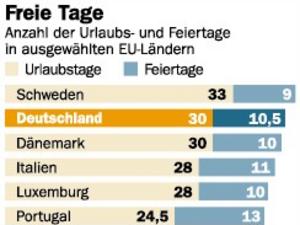
At least they waited until the vacation season was over. In what can only be seen as an attempt to stage a hilarous end of summer practical joke, the spokeswoman for a small business entrepreneur association has actually suggested that Germans go on vacation too much and that they should cut their annual leave time down from six weeks to four.

Cutting vacation time in Germany? Hardy, har, har. That’s a good one.

Es gibt Themen, bei denen verstehen die Deutschen keinen Spaß.

Do not pass go, do not collect $200

The next euro whammy? Now it’s time to assist Portugal. Bring out your Microcurrency, Germany. But don’t spend it all at one place.


“The alternative currency is not some gimmicky fundraiser. It may look a little like Monopoly money, but the chiemgauer is real. One chiemgauer equals one euro. It’s been around for eight years, almost as long as the euro, the common currency now used by 16 of the 27 EU members.”

Live a little!

If you want to. But you don’t want to, so you won’t. Despite a falling inflation rate and all the coaxing from the outside you want, Germans “can’t get over their stingy ways and fiscal paranoia to boost spending” (they don’t seem to mind if everybody else out there does the spending for them though).

“Germany seems to be preparing instead to further cut back on spending. Unlike most Americans, Germans pay their credit card bills in full at the end of every month. Only 39% own their own houses or apartments, compared with two-thirds of Britons and Americans. Only about 10% of Germans invest in the stock market, compared with half of all Americans.

Last year, Germany expanded public spending meant to stimulate growth, but at the same time it imposed a constitutional requirement to bring the deficit down to below 0.35% of GDP by 2016, a goal critics describe as unrealistic and unnecessary.

All of this contributes to the impression, shared by Germans themselves, that a strong strain of frugality shapes the national psyche.”

Change has come to Germany

Not yet.

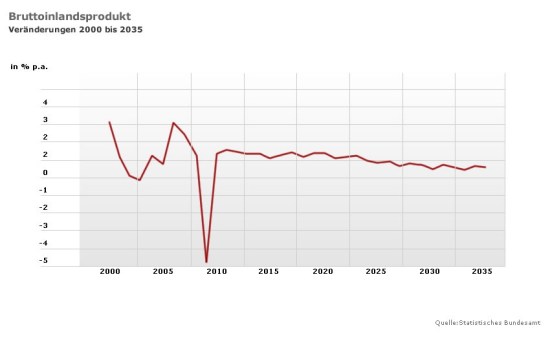
According to a Swiss study entitled “Germany Report 2035”, if the demographically challenged German nation does not modernize it’s act real pronto – raising the retirement age, letting in more immigrants, putting more women to work and increasing the number of hours worked each week – the country’s average annual growth rate will only reach an anemic 1 percent over the coming 25 years.

So hey, the change that’s about to happen here is going to start spinning everybody’s heads, right? Right.

Besides, this is a Swiss report. 

Die Zahl der Arbeitsfähigen sinkt um mehr als acht Millionen.