You can tell this guy’s not German

Sure, his opinion may have been published in the Spiegel (The German People’s Cube), but this otherwise reasonable and balanced assessment of nuclear energy in the New Age of Post-Fukushima Germany has some major flaws in it, all of them having to do with thinking it possible that the German response to Fukushima could ever be “thoughtful and considered, instead of emotional and political.”
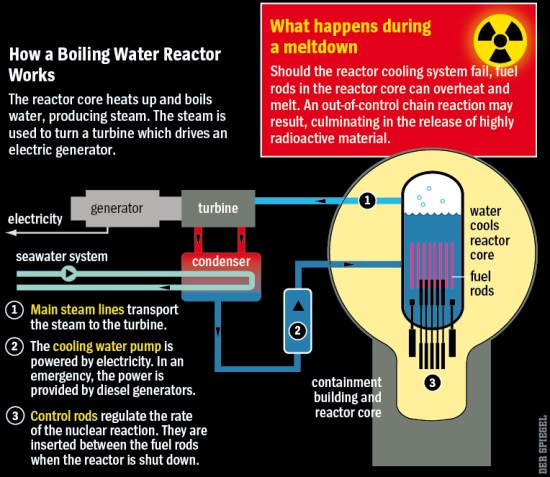
Many people have already formed solid opinions and only take into account what supports their views. (This is called confirmation bias, by the way.) But many of these beliefs are irrational and only fed by the many figures, measurements and limits being made public, which hardly anyone can make sense of.

This can be seen very clearly in the current situation in Fukushima. The Americans have recommended that all citizens evacuate the area within an 80-kilometer (50-mile) radius of the stricken power plant. The Germans have moved their embassy to Osaka. Even people who are really well informed have left Tokyo in the belief that you can never be careful enough.

Though I can understand this reasoning, it’s wrong. What’s more, it sends a devastating message to the Japanese who have to stay. They have started to distrust their own government, and fear is spreading. This is a terrible side effect of this excessive concern — and the panicked reaction — in Germany.

Indeed, it is clear that the major long-term issues with an accident at a nuclear power station are not medical; instead, they are political, psychological and economic. Given these circumstance, the German response to the Fukushima accident needs to be thoughtful and considered, instead of emotional and political. It should be based on a consideration of energy needs for the next several decades and a careful assessment of benefits and risks of alternative energy sources. If such an analysis is done, I suspect nuclear energy will come out in a favorable light.

PS: Thanks for your comment on How do you keep the hysteria going?, A.K. Strange how that very thought crossed my mind too. More people died in this one smashup than have died (or most likely will die) due to the Fukushima catastrophe. You don’t and won’t see anybody getting hysterical here about driving too fast because of this (speed is always involved in accidents like this).
Fukushima Out, Ozone In

The Fukushima crisis fading into the sunset as it must, temporary ersatz crises are now being  brought into play regularly in the not-so-vain hope of keeping the German national hysteria level unusually high, which isn’t all that unusual if you stop to think about it, really.

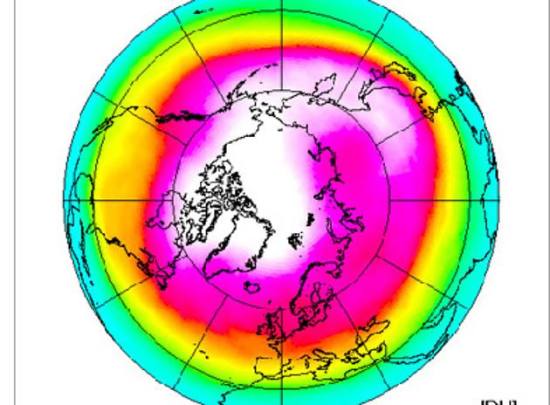
Today’s state of emergency was triggered by reported ozone layer depletion in the Arctic. Germany is now in a state of “ozone alarm” after UN scientists have determined that the Arctic’s ozone layer thickness has reached an alaming level and could cause in Germany, among other things, a mysterious medical condition known here as Sonnenbrand (burn of the sun or “sunburn”).

And I quote here, sort of: “The Arctic experiences ozone layer depletion seasonally up to around 30 percent. But this year’s unusual combination of extremely cold temperature in the stratosphere and the increase in the CFCs from refrigeration and aerosol sprays have caused a new record-high of 40 percent depletion.”

I don’t know, man. How did Commander Cody used to put it?

One drink of wine, two drinks of gin…
And I’m lost in the ozone again.

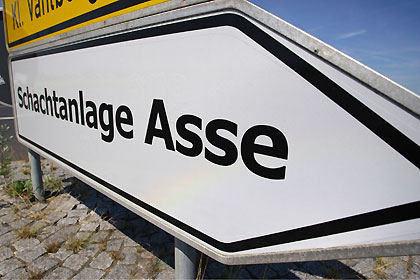
Erreichen sie (Schichten mit ozonarmer Luft) bewohnte Gebiete, droht Menschen, die im nun beginnenden Frühling die Sonne genießen wollen, unvermutet ein Sonnenbrand.

PS: They found their balls again. Now they know how many balls it takes to fill the Albert Hall.

How do you keep the hysteria going?

It’s clearly getting tougher and tougher with each passing day. When you’re well into your third week of daily reports about the Fukushima SUPER-GAU (disaster beyond all expectations) and that nuclear worst case scenario just simply won’t happen, even the most loyal alarmist starts getting a little pooped out. The Spannung (tension) just won’t steigen (mount) anymore.

I mean, we’ve already had the German atomic turnaround and the German Green triumph and the old German nuclear reactors are already shut off (and won’t be turned back on again) and the entire German nuclear power industry will be shut down next before all too long too so like what’s left to get excited about? Nothing? But what’s that got to do with anything? There was nothing to get excited about in the first place.

Poor devils, they’re scrambling and hustling as best they can but the pickings are awfully slim. They’re trying it today with 2285 missing fuel element ball thingies at a German nuclear research center. Talk about boring.

Like I said, slim pickin’s. But hey, it’s a Monday. See what they throw at us tomorrow.

Es klingt wie ein verspäteter Aprilscherz: Das Forschungszentrum Jülich vermisst 2285 Brennelementekugeln.

PS: Thanks for the link, A.K. – Diese kollektive Besoffenheit über Fukushima, diese unglaubliche Dummheit, dieses Ausrasten eines ganzen Volks haben mich eines Besseren belehrt.

Heine, der Emigrant in seiner Matratzengruft, hat alles richtig gesehen.

http://zettelsraum.blogspot.com/2011/04/biografien-ein-deutscher-dialog-zettel_03.html

Don’t Read This

If you want to keep your Fukushima radiation hysteria level high, that is.

Another German contrarian opinion. Here are one or two interesting points (sorry, non-German readers):

The measurements alone reveal nothing about danger or risk. Higher radioactivity in the atmosphere, measured in various places in Japan, give us a snapshot but not a coherent picture. The doses of radiation are not constant and fluctuate dramatically.

But no one in Japan who has eaten contaminated food will die as a consequence of the radiation exposure now measured, it is not strong enough.

The residents of Tokyo are currently less exposed (to dangerous levels of radiation, considered to start at 100 millisievert) than a traveller on a flight from New York to Tokyo and back–that would be 200 millisievert.

These comparisons show how a perceived risk and the actual danger can drift apart. Being panic-stricken in German won’t help. The Japanese show impressively how to deal cool-headed with a critical situation. They will master this crisis, regardless of how it turns out.

Diese Relationen zeigen, wie ein gefühltes Risiko und die tatsächliche Gefährdung auseinanderdriften können. Panik, wie sie manchen in Deutschland befällt, hilft nicht weiter. Die Japaner zeigen eindrucksvoll, wie besonnen sie mit der kritischen Situation umgehen. Sie werden diese Krise meistern, ganz gleich, wie sie ausgeht. 

Blind Me With Science

Please.

It shouldn’t be a surprise that 300 scientists “from various areas of expertise” have written a letter to Angie Merkel requesting that Germany shut down Germany’s risky nuclear reactors (the entire industry) as soon as possible. What surprises me is when I occasionally bump into a German scientist who isn’t prepared to jump off the cliff with everybody else. They are, needless to say, very few and very far between.

Here’s what physicist Christoph Barthe (a climate change guy) has to say about German nuclear power in an opinion piece called Despite Fukushima (page 15, Die Zeit No. 14, 31 March 2011):

Felix Dachel maintains in his response to “In Praise of the Movement” (Zeit Nr. 13) that the majority of Germans were already against nuclear energy before Fukushima. This is incorrect. An Allensbach survey from March, 2010 revealed that 44% of those asked said that, “all things considered,” they were for the further use of nuclear power, 37% were against it. A survey taken by TNS Emnid in February 2010 revealed that 60% of Germans asked were for the continued use of nuclear energy once the question of the final disposal of nuclear waste gets cleared up, 37% were against it.

Now a lot of nonsense is being spread around in the public concerning this question of the final disposal of nuclear waste. The unresolved waste disposal issue is certainly an effective public appeal argument for the anti-nuclear movement, but it is completely inappropriate as an excuse to phase-out nuclear power. The amount of highly radioactive waste is extremely small: Three-thousandth of a gram per kilowatt hour in Germany. There are more than enough suitable rock layers available which have been stable for countless millions of years and which we can expect with good conscience to remain that way for a few more million years to come. That is simple geologic knowledge. In contrast to that, greenhouse gases continue to be pumped into the atmosphere with foreseeable catastrophic effects that the same anti-nuclear activists warn us about.

It is the same thing when you compare the risks of climate change with the risks of nuclear energy, a technology that has been, despite 30 years of resistance to it, the most climate compatible energy source yet developed. If you compare the very slight risk of radioactive pollution with the very real danger caused by the continued unabated pollution of the atmosphere through greenhouse gases, generation after generation, then it must be clear that the question of risk speaks in favor of nuclear energy and not against it—despite Fukushima.

“There’s an app for that”

And there’s a market for it too. In Germany there is.

This one is bound to sell like hotcakes. A German developer has wasted no time in bringing out an Apple app that gives you the location of the AKW nearest you. You know, Atomkraftwerk (nuclear power plant)?

It also gives the user the pertinant information about each one located like how soon we’re all gonna die, the next demonstration planned, the shutdown date. Stuff like that.
 
Dank des AKW-Finders muss man sich nun nicht mehr durch komplexe Online-Angebote arbeiten, sondern bekommt sämtliche Infos auf einen Blick präsentiert.

German Gaijin Just Don’t Get It

How could they?

Here are some lines from a report by a Spiegel journalist who, being a product of his Umwelt (environment), obviously can’t understand what is going on with these peculiar, “fatalistic” Japanese who have the audacity to show courage in the face of disaster.

There is little evidence of panic.

There is not a single person protesting on the streets in the entire city (Tokyo).

Japanese fireman Nakamura Junichiro: “It was not my choice, but I wanted to go there. This is the most difficult hour for Japan. It was my duty.”

“The tsunami represents a good opportunity to cleanse this greed (the egoism the elder speaker believes his fellow Japanese have succombed to), and one we must avail ourselves of.”

The destructive forces of nature, writes Asia expert Ian Buruma, are “to a certain extent part of Japanese culture.” This creates fertile ground for a Japanese fatalism that has developed throughout history and culminates in the expression “shikata ga nai,” meaning “it can’t be helped.” A further product is the widespread belief that nothing beautiful on Earth is permanent and that the Japanese people must close ranks in times of national disaster.

Those who seek to wait it out in Osaka must be gaijin — a non-Japanese or outsider. Someone who doesn’t understand that now, more than ever, every cog in the wheel counts. Someone who shirks his responsibility while a hero like fireman Nakamura Junichiro risks his life to cool down the reactors in Fukushima.

Germans Shut Down Simpsons Too

Just in case. For three months or so, I assume.

After the government shut down seven nuclear reactors for fear of, uh, fear itself, German broadcasters have now decided to ban episodes of The Simpsons that poke fun at nuclear disasters.

It seems that now that the Greens have exploited “the situation” (no, not that guy on Jersey Shore) and leapt to power in two state governments after elections held over the weekend, said broadcasters fear that hysterical Germans watching these episodes could die of hysterical laughter.

Chancellor Angela Merkel announced earlier this month a three-month moratorium on plans to extend the operating times of Germany’s nuclear plants and ordered that the seven oldest reactors be shut down.

If Germans got much greener…

They would start blending in with the leaves and the flowers here.

Green? They call their bicycles recycles here.

Table legs sprout roots here, it’s that green.

We’re talking green. One guy I know named his kid Kyoto.

Some folks are so green that they carry a tree around with them at all times for optimum air quality.

And German businesses aren’t much better these days. Some have turned so green that employees hug their corporate offices.

Green? They are so green that the very thought of unsorted garbage landing in a landfill makes them turn red.

Logic in the Time of Hysteria

What is the connection between a 9.0 earthquake that hits Japan and damages a nuclear power plant there and the nuclear power plants operating in Germany?

There isn’t one. But there doesn’t have to be one once the hysteria hits the fan.

Angie Merkel could have tried sticking to her guns and not playing to the crowd like she did but the result would have probably been the same.

Pech gehabt (tough luck).

German Chancellor Angela Merkel’s Christian Democrats are set to lose the key state of Baden-Wuerttemberg after six decades, exit polls suggest.