Get your latest angst here!

Oh boy, another German angst study just came out. But nobody is brave enough to read it yet so I’ll have to give you a quick summary instead.

There is a certain logic to these studies, by the way. There always is, although it may not seem all that logical to you or to me.

For instance, after having patted themselves on the back over the past few weeks about how great the German economy is doing, it only stands to reason (here) that the latest number one German angst has to do with just that; the economy. Some 67 percent of Germans asked are shaking in their boots about it – and worry about the climbing cost of living at the same time. A mere 61 percent of those asked worry about becoming unemployed.

But it’s only going to get more frightening, folks. A group of economic experts has just revised their growth prediction for the Germany economy this year upwards fron 2.1 to 3.4 percent. Boo!

Wie andere Experten haben die Kieler ihre Schätzung für 2010 deutlich erhöht. Bisher hatten sie für 2010 nur 2,1 Prozent Wachstum veranschlagt, nun erwarten sie ein Plus von 3,4 Prozent.

Germans concerned about American middle class

Sort of. I mean like, who else will keep buying their exports even though they can’t afford to?

“While America’s super-rich congratulate themselves on donating billions to charity, the rest of the country is worse off than ever.”

PS: The word “Obama” cannot be found in this article.

Live a little!

If you want to. But you don’t want to, so you won’t. Despite a falling inflation rate and all the coaxing from the outside you want, Germans “can’t get over their stingy ways and fiscal paranoia to boost spending” (they don’t seem to mind if everybody else out there does the spending for them though).

“Germany seems to be preparing instead to further cut back on spending. Unlike most Americans, Germans pay their credit card bills in full at the end of every month. Only 39% own their own houses or apartments, compared with two-thirds of Britons and Americans. Only about 10% of Germans invest in the stock market, compared with half of all Americans.

Last year, Germany expanded public spending meant to stimulate growth, but at the same time it imposed a constitutional requirement to bring the deficit down to below 0.35% of GDP by 2016, a goal critics describe as unrealistic and unnecessary.

All of this contributes to the impression, shared by Germans themselves, that a strong strain of frugality shapes the national psyche.”

Change has come to Germany

Not yet.

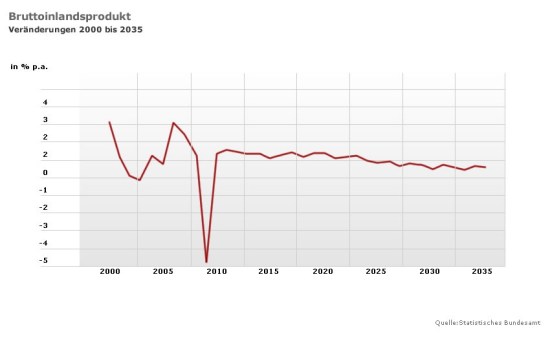
According to a Swiss study entitled “Germany Report 2035”, if the demographically challenged German nation does not modernize it’s act real pronto – raising the retirement age, letting in more immigrants, putting more women to work and increasing the number of hours worked each week – the country’s average annual growth rate will only reach an anemic 1 percent over the coming 25 years.

So hey, the change that’s about to happen here is going to start spinning everybody’s heads, right? Right.

Besides, this is a Swiss report. 

Die Zahl der Arbeitsfähigen sinkt um mehr als acht Millionen.

Greeks to boycott German products they can’t afford to pay for right now anyway

Pissed off about a Focus magazine cover depicting Venus de Milo (some old Greek actress or something) flipping off the rest of Europe (meaning Germany) and carrying the title “Crooks in the Euro Family”, the Greek Consumer Association has called for the boycott of German goods which nobody in Greece can afford to buy right now anyway.

The Greeks are a little touchy these days because their government/state/civilization is on the verge of bankruptcy or something (like join the club already). The Germans are a little touchy these days because the Germans are always a little touchy.

Die Verfälschung einer Statue der griechischen Geschichte, Schönheit und Zivilisation, die aus einer Zeit stammt, wo sie (die Deutschen) Bananen auf Bäumen gegessen haben, ist unverzeihlich und nicht hinnehmbar.”

Self-intrest rates sure are high in Europe these days

Well they sure are here in Germany (see Greece).

“Germany’s heavy reliance on exports has already been controversial on the international stage, in a similar way to the Western world’s growing frustration with China over its dominance in cheap exports.”

“We can’t go back to the era where the Chinese or the Germans or other countries just are selling everything to us; we’re taking out a bunch of credit card debt or home equity loans, but we’re not selling anything to them,” Obama said.

Go west, German autombile companies!

Mit einem blauen Auge davongekommen (getting out of the econmic crisis with just a black eye), German automobile locust types now have their other eye clearly focused on US-Amerika and plan to produce even more of their fancy schmancy Germerican cars there.

Actually, they’ve been doing this quite some time already and doing it quite well, thank you. They’ve continually increased their share of the American Automobile Market Pie these past five years and now enjoy a healthy 7.3 percent piece of it. And believe it or not, the American auto market is still the biggest in the world, although I wouldn’t know why. Or you wouldn’t think so these days, I mean.

Or could it be that German auto makers just want to get the hell out of Germany because, I dunno, German workers are too expensive? Nah.

Die deutsche Autoindustrie sieht sich in den USA als Krisengewinner.

Crisis, crisis and a little more crisis, to go

When will it end? VW just set a new record in sales, the German stock market just made another billion, the energy giant RWE beat it’s 2008 profit goals admirably, Axel Springer publishing (Bild) has never made more money, Sixt is expecting a booming 2009, it just goes on and on and on, people.


 Ho hum, another record.


Stop the world I want to get off or something. When are we ever going to see a little light at the end of the economic tunnel? Before we all roll over and die, I mean.


PS: Speaking of cars (even if VW didn’t actually invent them), Germany still loves you anyway, Mr. President. Noch (for now).