Time To Say Goodbye

To all those jobs in the German nuclear power industry, I mean. It’s phase-out time in more ways than one over here.

It’s coming out that E.ON, Germany’s largest energy provider, is now to go on an extreme austerity diet and is about to “restructure,” as they like to say, know what I’m saying? They’re even talking about closing down the big new headquarters they just moved into a year ago.

But hey, it’s all worth it. No pain no gain or something. And don’t worry, there are no other hidden fallout issues here, either.

Of 17 German nuclear power plants, half are now turned off; all of them will be shut by 2022. That’s a loss of 22 billion euros in profits.

“Frau am Steuer…das wird teuer!”

“A woman at the wheel, that’ll cost you!”

Who would have thought that? According to Germany’s Federal Agency for Electricity, the German electricity grid is in a thoroughly chaotic condition these days. No one can explain why. And the cost of purchasing needed electricity (nuclear generated) at the European Energy Exchange has already gone up 10 percent and further increases are expected to follow soon. It’s bizarre. It’s almost as if some crazy person had shut down eight nuclear power plants here or something.

Yup, Angie Merkel’s Fukushima-driven German angst Atomaustieg (nuclear phase-out) may have indeed been absolutely necessary and of critical urgency (opinion polls, folks, you gots to give the people what they want), but hysteria does have its price. Even in Germany, I mean. But who cares? I know the Germans pretty well and I am convinced that they are all going to be more than willing to pay radically higher electricity bills in order to avoid the, uh, tsunami threat on the home front.

What I really don’t understand is the economics at play here. There is clearly an overabundance of hysteria in this country, right? Shouldn’t that make the price of hysteria, like, cheaper or something? I’d ask an economist but you know how the adage goes: For every economist there is an equal and opposite economist.

“Das Bundeskartellamt erwartet als Folge des Atomausstiegs steigende Strompreise. An der Strombörse sind die Preise bereits um zehn Prozent gestiegen.”

German (Carbon) Footprints in The Sand

What are we cheering about again? (This is another one of those Green Shirt terror posts.)

In a democracy, you can say A, but you can also say B, just as you can rely on the assumption that nothing has to last forever. Everything can be changed, amended, courses reversed. In short, the very life and soul of democracy is that there are always other options.

Germany’s federal government is now abusing that basic rule in a scandalous way. There can be no doubt that the country needs to be looking at a smart mix of different energy sources for the future, and that developing viable alternatives to atomic power is an urgent necessity. Yet the manner in which the federal government has rushed to its decision to put a definitive stop to the use of nuclear energy by 2022 runs counter to all rules of democratic procedure. It began when, for politically motivated and tactical reasons alone, the government went back on the agreement made last fall — just seven months ago — to extend the life span of nuclear power plants. After the Japanese plant Fukushima began leaking radiation, it felt compelled to cede to public pressure by making a rapid move away from atomic power. Backtracking in the blink of an eye, the government moved so quickly partly out of fear of the Greens, and entirely without discussion or reflection.

… Germany has shown no respect for the energy policies of other E.U. countries, and particularly no trace of consideration for the East-West split that exists in Europe over nuclear power. Instead, Germany has chosen to go it alone on this issue, assuming a kind of avant-garde, “moral high ground” role that is not always going to play well elsewhere.

Die Bundesnetzagentur schlägt Alarm: Wegen des Atomausstiegs befürchtet die Behörde bereits in der kommenden Woche zu Pfingsten Schwierigkeiten beim Stromtransport.

PS: And lest we forget…

Germans To End Opposition To New Overhead Power Lines Overnight

As reported earlier, in order to avoid stunting the growth in Europe’s largest economy after its decision to shut down nuclear power forever, Germany must now carry out a massive expansion of it’s electricity-delivery network.

The overhead power lines which will be necessary to connect new offshore wind farms in the north to the factory-rich south and to allow the high-volume energy transfer from French nuclear reactors to cover the shortfall as Germany phases out its own reactors (they only provide a mere 23 percent of the country’s current energy demand) are, however, “unsightly and yucky,” as all Germans know. And they will also probably cause cancer, too (the next DANGER, but that will be another story later, guaranteed).

Fortunately for the German nation, it’s altruistic, selfless citizens have spontaneously decided to sacrifice their own petty personal concerns and grievences in regard to these power lines and win one for the collective common good by immediately ending all opposition to the construction of said yucky power lines and promising to never ever bitch or moan about them ever again, honest.

And if you believe that you can build your overhead power line on some prime Florida swamp land I’ve got for sale for you right here.

A grid upgrade is essential, and Germans must end their opposition to new power lines overhead, energy economics professor Christoph Weber said.

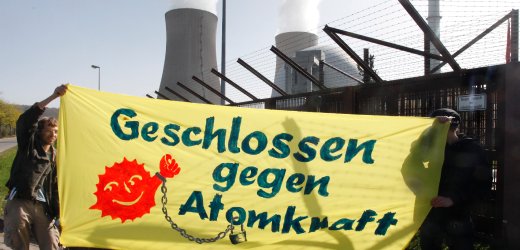
More Green Shirt Activity

See? I told ya.

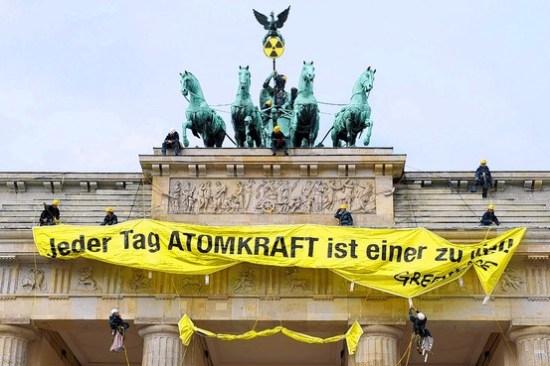
Greenpeace activists climbed on top of Berlin’s Brandenburg Gate yesterday to demand a speedy end to the use of atomic energy (by 2015).

I guess 2022 just ain’t speedy enough.

Every day of Green terror is one day too many (my translation).”

PS: The best part about the article was the Google ad I saw next to it: “Price check for 900 electicity providers: Compare prices and save money today!”

German Vocabulary of the Day

Alleingang: Going it alone.

Although every German knows that things go invariably terribly wrong whenever Germans do this (go it alone), they sometimes simply just can’t help themselves (think the recent UN Libya resolution episode, for instance) and let this atavistic throwback throw them back to behavior (misbehavior) they will bald (soon) regret. For the latest case in point see Ausstieg.

Ausstieg: This means to exit, phase-out. Germans are the born Aussteiger (exit-ers or escapists), but this is getting ever harder and harder for them to do. Executive Director Nobuo Tanaka of the International Atomic Energy Agency, IAEA (not IKEA), for instance,  has warned Germany about going their nuclear phase-out alone (see Alleingang). Germany’s policies here affect all of Europe, he says, and “it’s not about a German problem, it’s an overall European problem.”

Blackout: This means blackout. German power companies are now warning that should the Ausstieg and Alleingang described above be implemented too quickly and too efficiently (a grave possibility in Germany), they will not be able to guarantee an uninterupted power supply for their customers in Southern Germany during the so-called “winter” months.

Die Netzfirmen warnten, wenn nur die im Zuge des Atom-Moratoriums stillgelegten Alt-Meiler weiter vom Netz blieben, fehlten an kalten Wintertagen in Süddeutschland etwa 2000 Megawatt Leistung.

Horror Scenario?

10 euros a month tops? For a “turbo” phase-out of atomic energy in Germany?

According to the Spiegel, that’s what “almost all” German citizens would be willing to pay to get out of the tsunami-plagued industry pronto (German tsunamis are indeed rare, but still). And they mean 10 euros a month per German household, by the way, not for the whole country.

That certainly is reassuring (sort of) after hearing all these Horrorszenarien (horror scenarios) being circulated out there by crackpot organizations like the Federal Association of German Industry (BDI) these days. They warn, for instance, that a quick German nuclear power halt could raise electricity prices here by as much as 30 percent (that would be more than 10 euros a month I think, but still).

I am sure that “almost all” German citizens would be willing to shell that out too.

But, then again, I am also sure that invading reptilian humanoids disguised as human beings are secretly controlling the fate of the human race.

Es darf nichts kosten (it just can’t cost anything).

PS: Thanks for the link, Joe.

U-Turn, I-Turn, We All Turn

Turn, as in spinnen (to spin or, in this case, to be mental). This is another one of those only-in-Germany ones.
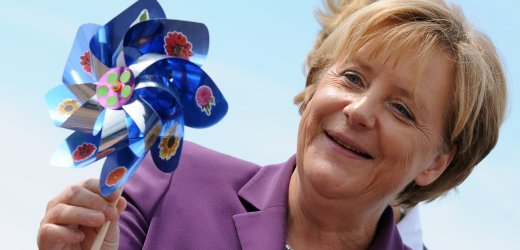
How long has it been since the latest greatest German Wende (turnaround)? Read some of these:

The U-turn on nuclear policy Chancellor Angela Merkel announced last month following the Fukushima accident will involve a massive expansion of renewable energies — as rapidly as possible. She is giving the public what it wants. But the shift will nevertheless provoke a major backlash. Germans may love their green energy, but they also have a growing proclivity towards not-in-my-backyard (NIMBY) lawsuits and referenda.

Many are now asking themselves if the transition to renewable energies will ruin the nation’s countryside.

Germany’s Federal Agency for Nature Conservation is already warning that in the rush to expand renewable energies, nature and wildlife conservation is being put on the back burner.

Germany’s opposition to wind power is well organized. The website windkraftgegner.de (wind power opponents), lists more than 70 protest campaigns.

Opposition is also mounting against the massive power masts that will be needed to transport clean energy across Germany and Europe.

And on and on and on. I don’t make this stuff up, people. Now they’re takin’ it to the streets to protest against renewable energy.

And the Green party’s grand energy strategy after their magnificent triumph down there in Baden-Wuerttemberg last month? Save power.

“We as Greens need to demonstrate our credibility,” national party co-chair Claudia Roth has said. At the same time, though, the Greens are very often active in the local NIMBY protests against the very kind of projects the party backs.

Nein, Danke! We’ll import nuclear energy instead!

This is where the European unity part comes in, I guess (and the electricity still has to come out of the Dose/wall socket somehow, doesn’t it?).

Ever since the nuclear power plant moratorium has kicked in, Germany has begun importing more foreign energy than it exports, most of this having been generated at French nuclear power plants. This is where the ideological wheels hit the road, people. Are we having Realpolitik yet?

It’s typically German somehow: Loudly wash your hands of the matter while letting someone else do the dirty work for you.

And speaking of Realpolitik, I can’t wait until the “paying for all of this” part kicks in. There won’t be a moratorium on that one. It won’t be too long until the next wave of hysteria hits the fan again, in other words.

Davon profitieren vor allem französische AKW.

Blind Me With Science

Please.

It shouldn’t be a surprise that 300 scientists “from various areas of expertise” have written a letter to Angie Merkel requesting that Germany shut down Germany’s risky nuclear reactors (the entire industry) as soon as possible. What surprises me is when I occasionally bump into a German scientist who isn’t prepared to jump off the cliff with everybody else. They are, needless to say, very few and very far between.

Here’s what physicist Christoph Barthe (a climate change guy) has to say about German nuclear power in an opinion piece called Despite Fukushima (page 15, Die Zeit No. 14, 31 March 2011):

Felix Dachel maintains in his response to “In Praise of the Movement” (Zeit Nr. 13) that the majority of Germans were already against nuclear energy before Fukushima. This is incorrect. An Allensbach survey from March, 2010 revealed that 44% of those asked said that, “all things considered,” they were for the further use of nuclear power, 37% were against it. A survey taken by TNS Emnid in February 2010 revealed that 60% of Germans asked were for the continued use of nuclear energy once the question of the final disposal of nuclear waste gets cleared up, 37% were against it.

Now a lot of nonsense is being spread around in the public concerning this question of the final disposal of nuclear waste. The unresolved waste disposal issue is certainly an effective public appeal argument for the anti-nuclear movement, but it is completely inappropriate as an excuse to phase-out nuclear power. The amount of highly radioactive waste is extremely small: Three-thousandth of a gram per kilowatt hour in Germany. There are more than enough suitable rock layers available which have been stable for countless millions of years and which we can expect with good conscience to remain that way for a few more million years to come. That is simple geologic knowledge. In contrast to that, greenhouse gases continue to be pumped into the atmosphere with foreseeable catastrophic effects that the same anti-nuclear activists warn us about.

It is the same thing when you compare the risks of climate change with the risks of nuclear energy, a technology that has been, despite 30 years of resistance to it, the most climate compatible energy source yet developed. If you compare the very slight risk of radioactive pollution with the very real danger caused by the continued unabated pollution of the atmosphere through greenhouse gases, generation after generation, then it must be clear that the question of risk speaks in favor of nuclear energy and not against it—despite Fukushima.