But he’ll get over it

Real fast. It’s just how they roll here.

German defence minister deplores meagre military spending – Boris Pistorius’s criticism comes on eve of Nato summit in Washington.

German defence minister Boris Pistorius has criticised his government for approving less than a fifth of the budget increase he said was needed by Germany’s military, in stark remarks on the eve of a Nato summit in Washington.

Germany is also thinking about offering free beer for everybody…

But that ain’t gonna happen either.

Germany is thinking about bringing back conscription – But the chancellor is reluctant.

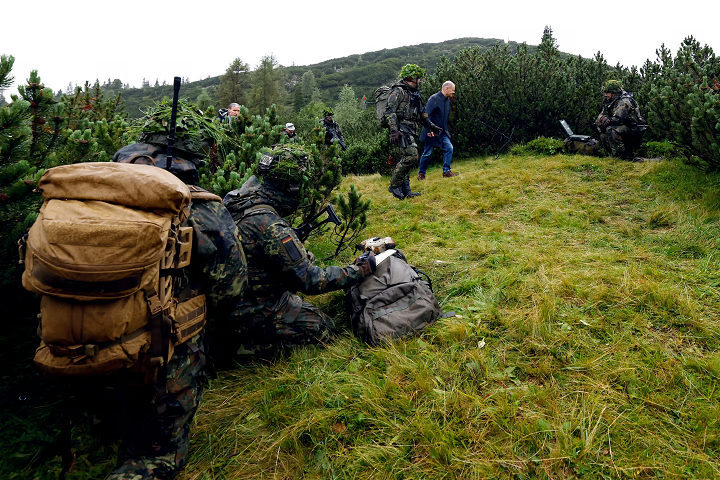
“Kriegstüchtig” does not trip easily off the English tongue. Nor does it fall easily on German ears. Translated roughly as “war-ready”, it is a word deployed by Boris Pistorius, the defence minister, to describe his favoured destination for the long under-resourced Bundeswehr, or armed forces. Money is now pouring in, and Mr Pistorius is overhauling the Bundeswehr’s structures. But like many of its nato allies, Germany is struggling to find enough willing recruits. The minister is among many who want Germany to consider restoring conscription, suspended since 2011, to get the numbers up.

We’ll be ready for war by 2129

I mean 2029, of course.

But only if nothing unforeseen happens. Like war, or something.

German defense minister calls for war readiness by 2029 – Germany’s Boris Pistorius has said the country needs to prepare for a worst-case scenario regarding the specter of war in Europe. He also said a return to some form of military conscription would likely be necessary.

Having a “war-capable” army?

What will these crazy Germans dream up next?

Germany’s defense minister overhauls the military command as he seeks ‘war-capable’ armed forces – Germany’s defense minister has announced a plan to streamline and reorganize the country’s military command as part of efforts to make the armed forces of NATO’s most populous European member “war-capable.”

German of the day: Na also, es geht doch

That means, more or less: “Well, what do you know? It’s possible after all.”

Germany hits 2% NATO spending target for first time since end of Cold War – Germany has met a NATO alliance target to spend 2% of its gross domestic product on defence for the first time since the early 1990s, a defence ministry spokesperson said on Wednesday, as spending ramped up after Russia’s invasion of Ukraine in 2022.

The German government is allocating the equivalent of 71.8 billion euros ($76.8 billion) for defence spending in the current year through regular and special budget outlays. However, the sum of its total defence spending is classified.

Just in the nick of time!

Hang in there, Lithuania.

German cavalry is on its way.

German brigade to be combat ready in Lithuania, on Russian border, in 2027.

A permanent German brigade of about 4,800 soldiers in Lithuania, on the Russian border, will be combat-ready in 2027, defence ministers of both NATO members said on Monday after signing an agreement on German troops’ first permanent foreign deployment since World War Two.

Nothing to fear, Germans

You’ll never ever find yourselves in that role and everybody knows it. Like, we get it already. Yawn.

It would be nice, however, if you could maybe possibly perhaps put yourselves in the position to defend yourselves. Just saying.

Most Germans oppose military leadership role in Europe – 54% of Germans say they do not want Berlin to pursue more active foreign policy, and 71% say they are against taking on leadership role for Europe’s defense.

According to the survey, a majority of Germans are against a more militarized foreign policy, but support diplomatic efforts to find peaceful solutions to international conflicts.

Are you serious?

About getting serious?

Don’t take that nonsense seriously, folks. I’m serious.

Wind of change: Germany gets serious about plans to make military ‘fit for war’ – The return of full-scale armed conflict to Europe has Germany dramatically reframing its security policy.

With Russia and Ukraine still locked in combat after nearly two years and a major Israeli-Palestinian conflict underway, the European Union and NATO are feeling their way into a chaotic new world security order – and Europe’s largest economy is shaking up decades-old ideas on what its military is actually for.