Too Lidl Too Late?

More like too Lidl too big and too early.
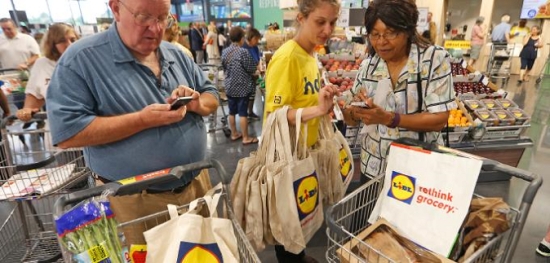
Lidl

The expansion of German discount chain Lidl into US-Amerika is turning out to be less successful than hoped, to put it mildly. Sales are disappointing and the two billion euros planned to cover investment and start-up losses will not be enough. Management apparently chose too many wrong locations and built stores that were much too big. Instead of the 100 stores planned for last year only 47 actually opened.

This puzzles me a bit. You can’t walk a quorter of a mile in Germany without running into one of these places. And when I read how Lidl prices in the US seem to be just as low or lower than they are here, how could they possibly fail? Well, if they do, there’s still Aldi, right?

Die extrem jungen Expansionsteams haben in Amerika oftmals falsche Standorte ausgewählt. Zudem wurden zu große und zu teure Märkte gebaut. Die Umsätze sind enttäuschend. Die ursprünglich kalkulierten zwei Milliarden Euro für Investitionen und Anlaufverluste werden nach Informationen vom manager magazin nicht ausreichen.
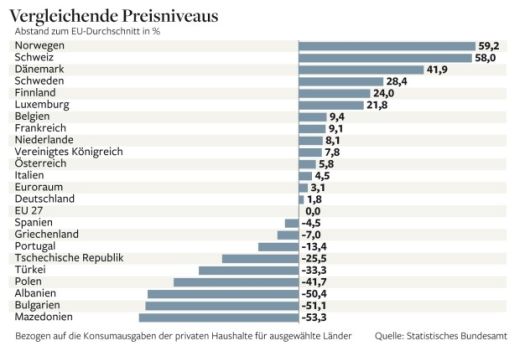
Discountrepublik Deutschland

Verblüffender Befund (an amazing finding)? I don’t see how it could amaze anyone here – anyone who has ever gone shopping in Germany and then compared those prices to those you would pay in other European countries, that is.

Prices

Germans apparently aren’t aware of the fact that they have some of the lowest Lebenshaltungskosten (living costs or cost of living) in all of Europe. Of their immediate neighbors, it’s only cheaper to live in Poland and Czechia.

What is really amazing I find, however, is the fact that the Germans are able to enjoy these cheap prices while still having a higher per capita GDP than a lot of the European countries with a higher cost of living (Belgium, Denmark, France).

Beats the hell out of me. Hey, es darf eben nichts kosten here.

Verbraucher in Deutschland bekommen für ihren Euro mehr als die Menschen in den Nachbarländern. Lediglich bei den Nachbarn in Polen und Tschechien sind die Lebenshaltungskosten niedriger.

Alternative Reality Expensive As Hell

As part of Germany’s switch to renewables, industry has been exempt from paying higher prices associated with solar and wind energy. The European Commission, however, believes the practice distorts competition on the Continent. Huge penalties could be in store.

Bill

The costs of start-up financing for green energy and the compensation for expansion of the power grid are added to customers’ electricity bills in the form of a special tax. The entire subsidy system is supposed to come to an end when green energy becomes competitive. That, at least, is the theory.

But the reality is different. No longer can one simply describe the tax as a way to get renewable energies off the ground. Indeed, following Berlin’s decision two years ago to shelve nuclear energy and accelerate the expansion of renewables, the EEG (Renewable Energies Act) has become a giant redistribution machine.

“The fact that German electricity prices are among the highest in Europe despite relatively low wholesale prices must serve as a warning signal.”