“Undecided”

Don’t be misled by that American mainstream media or whatever else you may have seen or heard.

Germany’s FOCUS Online will clear it for you: Yesterday’s US-Amerikan election was “undecided” and everything’s still OK in Obamaland, honest.

And here you thought denial was a river in Egypt.

“Seine Partei erzielte bei den Kongresswahlen die größten Zugewinne seit mehr als 70 Jahren.”

Natural factors?

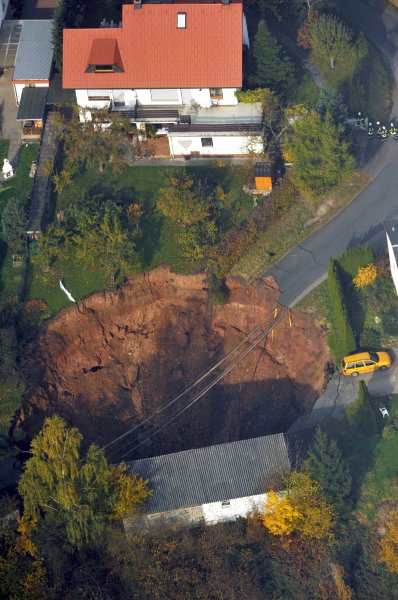
Yeah, sure. This kind of thing happens here in Germany all the time. Talk about your Loch (hole) Ness Monster.

Authorities in a place called Schmalkalden (itself a bit of hole, I guess) say that this big honking 98-foot-deep-mega-crater that just caved in out of nowhere today and ate somebody’s car and who the hell knows what else was caused by natural factors rather than bad industrial things like mining or whatever so don’t worry because it’s a “bio-hole” or something and therefore good for you so everything’s OK people and just keep on moving along (in big, concentric circles), nothing to see here.

“Luther said residents were lucky not to have been hurt.”

The crisis is over, let’s save even more!

In case you hadn’t noticed, German psychology is different than other kinds of folks’ psychology (volks-psychology?). At least when it comes to saving money it is.

Whereas Americans, let’s say, save the little that they can when times are hard and then toss it out with both fists like crazy people the first chance they get, Germans save when the times are hard and then save even more when the times are good again. The spending part gets removed from the calculation here entirely.

And that’s what’s happening now, again. Now that the financial crisis is ancient history and everything is booming here again and unemployment is supposedly under three million and milk and honey are flowing down the streets and into the gutter and all that, private Germans are saving more privately than ever–an average of about 11.5 percent of what they’ve earned this past six months.

And no, they don’t maybe know something that the rest of us don’t know. They’re just hamsters. It’s in their jeans. I mean genes.

“Für die privaten Haushalte zusammen ergibt sich ein Sparvolumen von rund 93 Milliarden Euro.”

PS: I’m thinking now it’s maybe just a big game or something that only the initiated (the Germans themselves) know about. Whoever has saved the most money by the time he or she dies, wins.

Military restructuring?

Ich bin gespannt (I’m dying to know what’ll happen here).

Sure, making the German Bundeswehr more efficient and less bureaucratic sounds like a great idea, at first.

But think it through, people: There are 250,000 troops right now, of which only 10,000 (tops) can ever be deployed at once (not put into real combat situations mind you, not officially anyway, “deployed”). And I’m not joking here with the numbers, by the way.

So what happens when they drop the number of troops down to 180,000? Are we really supposed to believe that once they do the Bundeswehr will “double the number of troops that can be deployed at any one time from 7,000 to 14,000?”

Wer’s glaubt wird selig! (A likely story.)

Saving ain’t what it used to be

In Germany, I mean. About 16 percent of the German population doesn’t have anything left over to save anymore.

But the rest who do are still pretty good at it–and they are just as conservative about their saving strategies as they have ever been. Some 49 percent of savers save using the good old-fashioned savings account, 35 percent still like the old Bausparvertrag technique (a savings contract with a home building society), 31 percent save using insurance policies and only about 22 percent go for stocks and bonds.

And that all of these numbers added up together give you a number like way higher than 100 percent only goes to show you just how good at saving these Germans really are. Damn. I wish we could do that.

“Lediglich fünf Prozent aller Sparer legen besonderen Wert darauf, dass sie die Finanzprodukte, in die sie investieren, auch vollständig verstehen.”

Export this

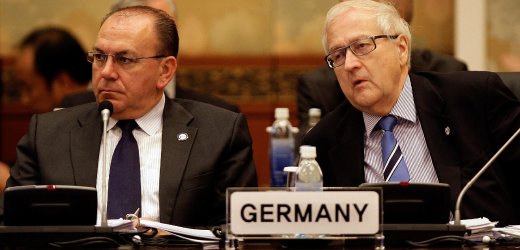
Tim Geitner surely meant well when he suggested that certain powerful G-20 export nations like Germany might maybe ought to want to cap their trade surpluses and deficits at 4% of GDP.  But well just isn’t good enough when dealing with the Germans (and their money).

German Economy Minister Rainer Brüderle quickly retorted however, warning against “planned economy thinking” and “macro-economic fine-tuning and quantitative target-setting,” whatever that means. “Eat me completely,” in other words.

Die Vereinigten Staaten kritisieren immer wieder den hohen Exportüberschuss von Deutschland und China.