German car industry sheds 51,500 jobs in a year – The dip equates to almost 7% of the total workforce in the German auto sector. Faltering exports to China and the US play a role, as new tariffs raise barriers to entry in both these core markets.
“The US and China are currently the cause of major concerns.”
If the Chinese can’t displace the American workforce anymore, then they’ll displace another one (or two, or three…).
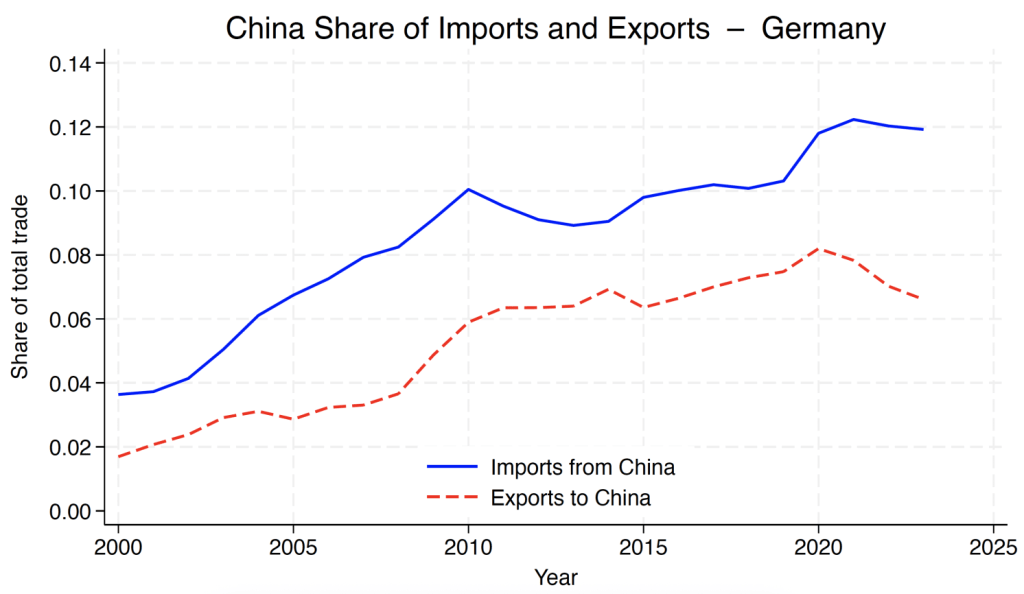
The China shock hits Germany – Trade with China displaced large parts of the American workforce in the 2000s, but Germany did not experience a similar shock at the time…
German exporters don’t want US trade deal ‘at any price’, says trade group – The European Commission aims to reach a trade agreement outline with the U.S. in the coming days, ahead of the August 1 deadline set by President Donald Trump for broad tariff increases.
Exports to the United States dropped 7.7% in May month on month, following a 10.5% decline in April, data showed on Tuesday.
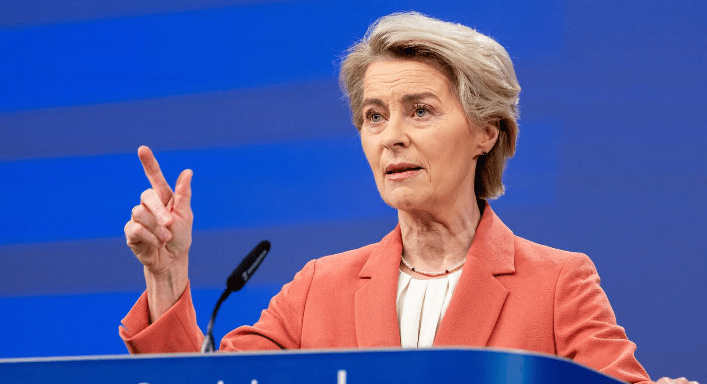
“On this point, Donald is right — there is a serious problem,” EU Commission President Ursula von der Leyen said, as she slammed Beijing for disrupting global trade with subsidies to boost its own companies – accusing the CCP of “weaponizing” its leading position in the production and refinement of raw materials used for cars, batteries and wind turbines.
She then encouraged Trump to join forces with US allies to address China’s trade imbalances, rather than punishing them with his own tariff scheme.
“When we focus our attention on tariffs between partners, it diverts our energy from the real challenge — one that threatens us all.”
Then an agreement is reached and the tariffs are lowered. We could ask Elon but this doesn’t seem like rocket science to me.
Trump’s Tariffs Cost BMW $11 Million A Day, So Germans Want A Deal – European carmakers are losing millions daily to US tariffs despite American production bases.
Trade wars rarely end well for anyone involved, and when the crossfire hits the automotive industry, the damage adds up fast. Nowhere is that more evident than in Germany, where the ongoing tariff standoff is racking up some eye-watering costs. According to a new report, BMW is losing a staggering $11.3 (£8.4 / €10) million per day thanks to U.S. tariffs.
EU offers USA deal on free trade – The EU has proposed to US President Trump that all tariffs on industrial goods be abolished on both sides. We are ready to negotiate, said Commission President von der Leyen.
Germany urges EU unity after Trump unveils sweeping tariffs – The EU’s Ursula von der Leyen has warned that the bloc is prepared to respond to new US tariffs imposed by President Donald Trump’s administration. Germany also criticized Trump’s trade measures. DW has more.
Germany’s trade surplus with US reaches new record – Germany’s trade surplus with the United States reached a record level, data from the statistics office showed, as countries wait to learn how US President Donald Trump will impose tariffs on imported goods.
Germany’s trade surplus with the U.S. expanded to €70 billion (HK$563.1 billion) in 2024, well above the previous record of €63.3 billion reported for the full year 2023.
“It would be hard to imagine worse timing,” said Holger Goerg, from the Kiel Institute for the World Economy.
Trump substantially raised tariffs on steel and aluminum imports on Monday to a flat 25 percent “without exceptions or exemptions.”
As Trump threatens EU with tariffs, Germany announces trade surplus worth $74.1 billion with U.S. – Germany logged a record trade surplus with the United States last year, data showed Friday, news that could stoke tensions with US President Donald Trump as he threatens the EU with tariffs.
The United States also returned as the top trading partner for Europe’s biggest economy last year, it showed, overtaking China which had been in the number one spot since 2016…
Germany accounts for a hefty chunk of the European Union’s large trade surplus with the United States, which has been a source of anger for Trump.
Just like we did with our dependency on Russian gas a few years back.
It’s called diversification through more dangerous entanglement.
German investment in China soars despite Berlin’s diversification drive – Politicians warn of rising geopolitical tensions but country’s carmakers stick with Chinese manufacturing.
German direct investment into China has risen sharply this year, in a sign that companies in Europe’s largest economy are ignoring pleas from their government to diversify into other, less geopolitically risky markets.