German of the day: Arbeitslosigkeit

That means unemployment.

Germany news: Unemployment tops 3 million as industry slumps – Over three million people are currently unemployed in Germany, with 1.1 million drawing unemployment checks, authorities say.

Germany’s employment agency recorded a jump of 71,000 in monthly unemployment numbers, pushing the total to over 3 million.

EU’s biggest economy reports 6.4% overall unemployment rate.

German of the day: Blutung

That means hemorrhage.

Germany news: Industry hemorrhaging 15,000 jobs a month – Industry boss Tanja Gönner says the situation is critical but offers opportunity.

The head of the Federation of German Industries (BDI) says the country has become less competitive and called on politicians and business leaders to usher in a course correction.

Have money, will travel

Anywhere, just to get out of Germany.

Survey: Half of Germany’s top earners consider moving abroad – Within a year, more than 288,000 Germans have moved abroad. A recent survey suggests many highly skilled professionals are eyeing a move – and most do not expect to return soon.
Within the space of a year, more than 288,000 German citizens have moved abroad. This is confirmed by data from Germany’s Federal Statistical Office.

A recent survey commissioned by the job platform Indeed suggests that the trend is continuing: since 2020, the number of searches for international job offers has more than doubled.

Plans to move abroad are particularly widespread among top earners.

German of the day: Stellenabbau

That means job cuts. Deep cuts, in this case.

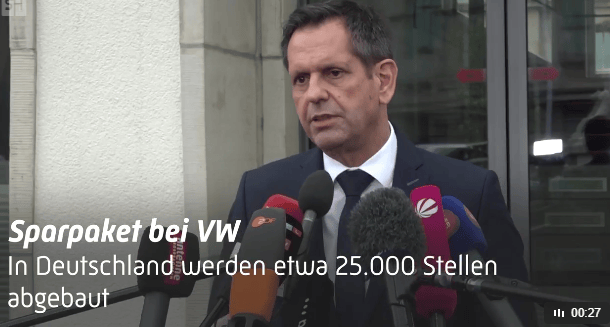
Job Cuts at VW: Auto Giant Plans to Cut Up to 100,000 Jobs – The crisis in the auto industry continues. VW is now reportedly doubling its original layoff plans – and some plants are also expected to be closed.

According to information from Manager Magazin, the Volkswagen Group plans to cut up to 100,000 jobs. Citing insider information, the publication reported that the restructuring is to be carried out over the next few years. This would effectively double the previous job-cut target. In addition, plans are reportedly in place to close four plants in Hanover, Emden, Zwickau, and Neckarsulm (Audi) in the medium term.

The next 20,000 jobs gone

Could it be our ridiculously high energy costs? Nah.

Germany’s industrial engine sputters as Bosch axes 20,000 jobs – Rising unemployment rate piles pressure on Chancellor Friedrich Merz’s government.

German industrial giant Bosch on Friday confirmed plans to cut 20,000 jobs after profits nearly halved last year, underlining the mounting strain on Germany’s once-dominant manufacturing sector and increasing the pressure on politicians in Berlin to find a solution.

Official data released Friday also showed Germany’s unemployment rate, unadjusted for seasonal factors, rising to 6.6 percent — the highest level in twelve years. The number of unemployed people surpassed three million in January.

German of the day: Stellenabbau

That means job cuts.

German business groups expect job cuts in 2026 as economic crisis drags on – A majority of German business associations expect job cuts in 2026 as the country’s economic crisis persists, with industry hit hardest by global protectionism and weak exports, a survey by the German Economic Institute IW showed on Monday.

Of 46 business associations surveyed, 22 anticipate workforce reductions next year. Only nine expect to increase hiring and 15 foresee stable employment levels.

There’s always a first time

Then a second, then a third…

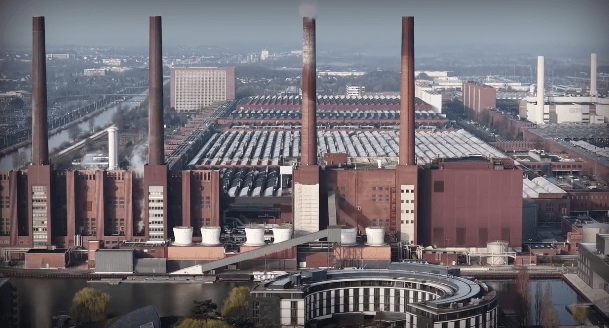
Volkswagen shutters a German plant for first time ever as Trump tariffs squeeze car giant – Volkswagen is ending vehicle production at its Dresden factory — the first time in the automaker’s 88-year history that it has closed a plant in its home country — as weakening demand and punishing US tariffs squeeze the German car giant.

The last vehicle rolled off the line Tuesday at the Dresden site, known as the “Transparent Factory” because of its glass-walled design, capping 24 years of production that began in 2001.

Output kaputt

To put it nicely.

German industrial output posts biggest decline in more than three years – German industrial output fell much further than expected in August, pushed down by a sharp decrease in car production as frontloaded demand ahead of U.S. tariffs dried up.

Industrial production fell by 4.3% compared with the previous month, the federal statistics office said on Wednesday, the biggest fall since March 2022, just after Russia’s invasion of Ukraine. Analysts polled by Reuters had predicted a 1.0% fall.

13,000 jobs here, 4,000 jobs there…

Progress marches on.

Industrial giant Bosch shocks Germany with plans to cut 13,000 jobs – The Bosch group, one of Germany’s leading industrial players, has announced a far-reaching job cut programme. On 25 September the company said it would cut an additional 13,000 positions by 2030.

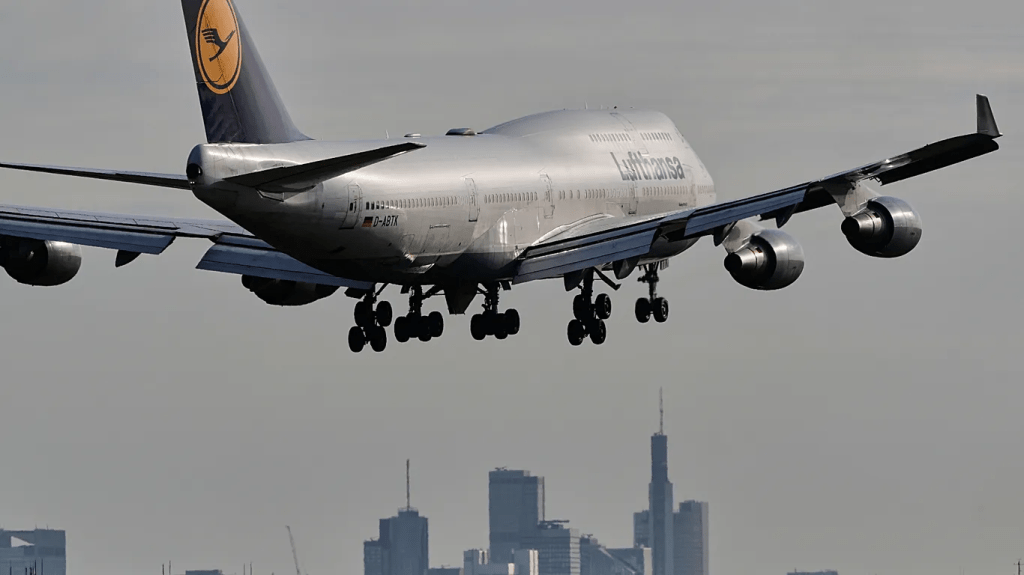
Germany’s Lufthansa To Cut 4,000 Jobs By 2030, Targetting Admin – Lufthansa set new financial targets for 2028-2030, including an adjusted operating margin of eight to 10 percent.

Work more than 34 hours a week?

Not with us!

Does Germany need to work harder? Its government seems to think so – The average workweek in Germany last year was about 34 hours, according to Eurostat data, less than France and Greece as well as the average across the European Union, which was 36 hours. In addition, German labor productivity per hour has also been essentially flat since 2009.

A study by the Organization for Economic Co-operation and Development reports that Germans work the least among its member countries, clocking in at 1,335 hours per person per year in 2023, compared to 1,496 hours in the U.K. and 1,805 hours in the U.S.