Speaking of Heuling…

The current women’s soccer fest has shown me once again that women just aren’t as good at soccer as men are. When it comes to fake soccer injuries, I mean.

“As soccer fans, we are shocked, shocked to learn that some players might not really be injured when they flop onto the pitch. Now comes a study suggesting that women are less likely to fake soccer injuries than men.”

They’re just missing that killer instinct or something.

In what part of Europe is Azerbaijan again?

Yet another breathtaking performance. But the real question is “can Eurovision burnish Azerbaijan’s image (I didn’t know it even had one)?”

And sure they were predictably outrageous, but they’ll never make the top ten.

Ich habe auf Aserbaidschan gewettet!“

Earth to academia, Earth to academia…

Can you read me?

Eurovision is once again upon us, which is scary enough. But now it’s also time for us to find out that it has something called a “deeper meaning.” All it took for this was 35,000 pounds (€40,000) of British government funding, a few academics and a whole lot of not having a life. Here are just a few of the revolutionary revelations and fun facts about Eurovision that none of us really wanted to know about:

For the first time, there will be a major academic review of Eurovision, including a series of workshops that will be completed this weekend in Düsseldorf, Germany, where the 2011 Eurovision Song Contest is being hosted, and culminate with the publication of a book of essays. 
 
We have been assured that “it really takes international and multidisciplinary perspectives to even start to pick away at what Eurovision means.” Or why anyone would want to (pick away at it), I assume

Eurovision is “56 years of European pop, gender and representational history.” Not to mention the really sucky music part.

“Eurovision is an arena for European identification in which both national identity and also participation in a European identity are confirmed.” Yeah, OK. Whatever.

But of course not even seasoned academics can be expected to be experts at Eurovision geography, folks. Some of my personal Eurovision favorites, for instance, are European nations like Israel, Azerbaijan, Georgia, Morocco and Kazakhstan.

Little technicalities like these can be educational, however. “At least it gets people thinking about a country which normally wouldn’t cross their minds. Maybe they’ll look on a map to try to figure out where it is,”

And…

Eurovision is the world’s largest live non-sporting television event.

Eurovision has grown more since 1989 than either NATO or the European Union.

Eurovision is not just kitsch and lamé, it is “a night when Europe comes together symbolically” (and nasty stereotypes about national identity (in stereo) lead to animosity and symbolic surrogate war).

And last but not least, Eurovision is queer. “Another subject you won’t have to dig too deep into the academics’ footnotes to find is the ‘queerness’ of an annual event that has come to be known as ‘Gay Christmas.'”

So sit back this weekend and enjoy some European unity, televoting and really crappy music. Ho, ho, ho or something.

Not even semi-utopian Eurovision has succeeded in bridging every cultural divide.

Reality Show 2.0

David Lynch (OK, his son) interviewing randomly selected Germans about their randomly selected lives? This ought to make The Blair Witch Project look like Sesame Street.

But I guess that’s the idea behind “Interview Project Germany,” asking real people real questions and then really listening to what they have to say (for real). No bells, no whistles. Just the facts, ma’am. Oh the horror already.

“Viele Leute haben uns ihr Herz ausgeschüttet – manchmal hat es sich so angefühlt, als hätten sie nur auf uns gewartet.”

German Hostages Released in Iran Shortly After Which Iranian Film Takes Top Prize at Berlinale

Two German hostages have suddenly been released after four months of imprisonment in Iran.

Shortly after their release, an Iranian film took the top prize at the Berlinale.

I’m just sayin’, OK?

Jury president Isabella Rossellini said the choice of Farhadi’s film was “pretty unanimous.”

Hot Dog It Another Baader-Meinhof Film!

The Berlinale is always good for a surprize. But it’s always the same one: No surprizes.

How original, sort of. Hopeless romantics that they are, politically correct Germans everywhere will be as enamored as they should be in this latest “political love story” about (with?) the RAF, “If Not Us, Who?”

Specifically, it’s about two fine young terrorists who fell in love, made love and then went on to become key figures in that wacky and fun-loving leftist group that carried out a bloody campaign of kidnappings and murders in the 1970s. You know, kind of like the Manson clan only, this being Germany, their madness was more political?

It’s a film that wants us to truly understand these folks with, I dunno, understanding, understanding how their political consciousness arose, with a special emphasis being placed on the conflict between the Nazi and postwar generations–an aspect that has never ever, ever been addressed here in this country before, ever, not once, honest. In other words, they were the victims (again).

Be sure to see it. It’s so… Political. And Romantic with a big R. If it doesn’t win the Golden Bear than… If not them, who?

Ghost of Madonna Haunts City

Her career having died long ago, residents of Berlin, of all places, have for several nights running found themselves subjected to a series of ghostly encounters with the ethereal non-being of “the Queen of Pop.”

One visitor to the Asphalt Club became terrified when she accidentally captured a ghostly apparition that resembled a woman dressed in black on her phone’s camera. The incident happened while snapping images of herself in a mirror in the lady’s room. When she returned home later that morning, she viewed the pictures and was stunned to see the gruesome phantom in one of the frames, clearly recognizable as Madonna, circa 1993.

Other witnesses saw the spooky specter wandering aimlessly along Potsdamer Platz, accosting  bystanders and asking them if anyone had seen her “baby,” twenty four-year-old boy toy Brahim Zaibat.

No one can explain why the brazen banshee is here right now and no one can say for sure just how much longer these hideous visions can last, but one zombie expert here believes that once this year’s Berlinale is finally over, this Spuk, as the Germans say, too shall pass.

“Good European pieties and delirious anti-American phantasms”

It’s all here. Ya gottcha European Film Academy Awards, your European Director, your European Screenwriter, your European Actor, your European Composer, your European Production Designer and even your European Oscar, all right here in Europe. Financed primarily by Germany, of course (where all the shots get called these days), but still. Germany is part of Europe too, you know.

Now all you need is your appropriate inappropriate European Film with your suitably anti-American fantasy exposing that country for the “fundamentalist totalitarian state” it is (as put so diplomatically by European Film Academy Presidente por Life Wim Wenders–he’s a European too, by the way) and the recipe is complete.

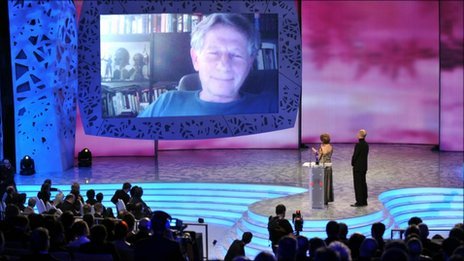
So this year’s wiener (or is it weiner or even whiner?) is: Roman Polanski for “Ghost Writer.” It’s the heart-warming story of an Iraq War-related assasination of a CIA-controlled US-Amerikan imperialist Tony Blair robot or puppet dude, take your pick he’s both (I knew I always liked that guy for some reason).

Gee, I wonder who got the Best Foreign Language Film Language European Oscar Award this year? I’m going to go way out on a limb on this one and say German.

German-funded “European” film prize goes to German-funded anti-American film.

Thanks for the link, Joe.