Bank Bad But Accounting Worse

This is government regulation in action, folks. Nationalize the banks? You betcha. State-owned banks are clearly the way to go.

“Germany is €55bn richer than it previously thought because of an accounting error at state-owned bank Hypo Real Estate Holding.” You see? The government really can make money out of nothing (and the chicks for free).

To be fair though, what’s 55 billion euros these days? And this mistake could have happened to anybody: “Collateral for derivatives wasn’t netted between the asset and liability side.” In other words, a government expert mixed up the + with the -.

The finance spokesman didn’t directly comment on the accounting error.

We Hate Being The Hegemon

But somebody has to do it.
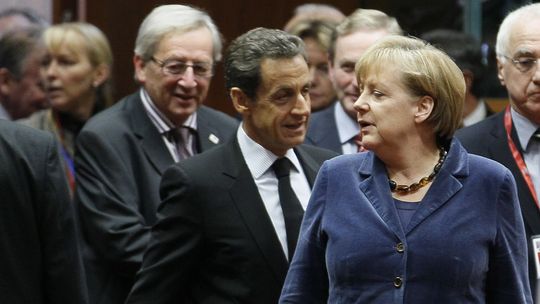
It wasn’t all that long ago that Germany knew how important it was in Europe but kept its mouth shut about it (while pulling the strings behind France’s back). Those days of semi-credible falsche Bescheidenheit (false modesty) are over, sort of. Now they continue to refuse to lead openly, but still pull the strings. Only France isn’t standing there anymore.

As shown once again during yesterday’s latest “rescue” of Europe, Germany makes the decisions while France still holds the press conferences, but the absurdity of this show is starting to lose a lot of its regular viewers. This formula has jumped the shark, in other words.

But as long as major contradictions keep on coming, everybody here in Germany is happy. You remember, don’t you? Germany fled into the EU to protect itself from itself (there was something about World War II a few years ago). Now it dominates Europe through its sheer economic power anyway, but still psychologically/socially/institutionally traumatized (and loving it), refuses to openly take the role history has assigned it. It prefers instead to publically turn its back on Europe (nobody on the street in Germany truly undestands or much cares about Europe) and concentrate instead on more important things at home like solar energy, local elections and not hurting coalition partners’ feelings.

In other words, Germany may clearly call all the shots now, but it still refuses to lead. Which is kind of clever, if you think about it. When everything ends up going tango uniform later, it wasn’t Germany’s fault.

Mit politischer Macht verhält es sich wie mit Millionen von Euro auf dem Konto: Man spricht nicht darüber.

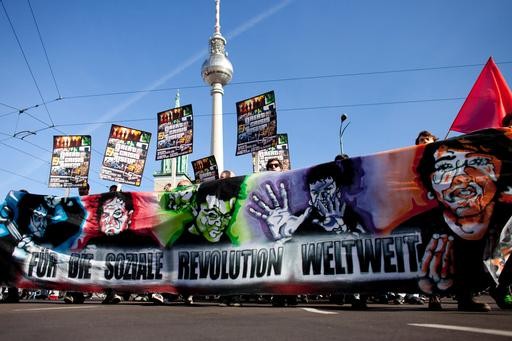
Revolutionary Masses (Yearning To Be Seen)

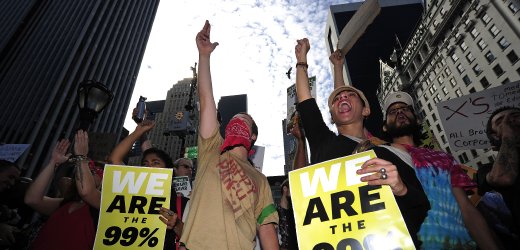
Hampered by nice weather and apathetic compatriots who actually have to work for a living, a massive crowd of some 300 (three hundred) global democrats and worldwide social revolutionaries nevertheless managed to occupy the city of Berlin over the weekend again already.

Denouncing banking and financial industry practices and other unspeakable injustices of the new century – and possibly having been inspired by something called the “Occupy Wall Street” movement in New York (the weather there is less nice at the moment I’m told) – the German revolutionary masses doing the occupying this week were notably smaller than the already rather puny ones amassed at German protests a week ago, but still.

“Derweil will die OccupyBerlin-Bewegung nach eigenen Angaben ihre täglichen Mahnwachen vor dem Bundestag fortsetzen. Seit Sonntag vergangener Woche kämen zwischen 100 und 200 Teilnehmer.”

Germans Mobilizing For World Financial Revolution

Man oh man is this country ever ripe for revolution again already.

Literally a dozen or two protesters took part in the “Occupy Frankfurt” campaign a week or two ago and some reports indicate that a few of them even stayed there to continue protesting overnight. And that was just the start of it, folks. There were surely even dozens more occupying Frankfurt during protests now being held against the ECB this weekend although I’m having trouble finding news reports covering them because most Frankfurters leave Frankfurt over the weekend, it seems, as nobody here really seems to care.

One has to stop for a minute and consider the dreadful conditions under which the German people have to live in order to really understand why “casino capitalism” opponents will soon be taking down the financial world as we know it (or at least the German one). Unemployment is drastically lower here than in the US, for instance (and the unemployment rate keeps on dropping), but still. Obama is still Mr. Clean over here and always will be (so he can’t be the ineffectual disappointment that many of his compatriots are now taking to the street about). And despite the fact that “the ECB is one of the most powerful democracy-free zones in the EU and has acted in accordance with the interests of the financial industry for years,” many a thinking German financial expert can’t understand “why the ECB, of all financial institutions, should be declared the root of all evil rather than, say, Deutsche Bank or the Frankfurt Stock Exchange.”

No matter. This revolution is another in a long line of historical necessities and it is time for all of us to prepare for the coming cataclysmic change. It will not be televised, however. The ratings are simply too low.

One other important element is lacking in Germany: disappointment over Barack Obama, the man many Americans had pinned their hopes on to improve their society.

New Angst Study Producing More New Angst

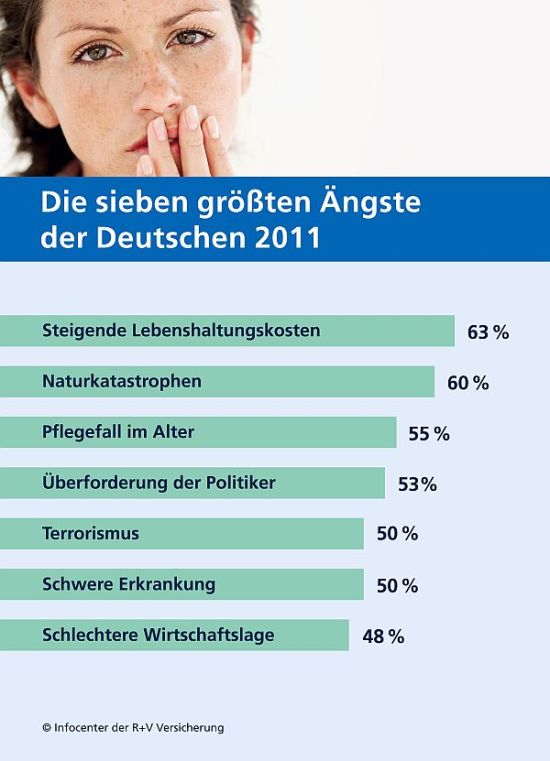
A new study from the R+V Insurance Company (hmmm, an insurance company) indicates that Germans have a whole new list of things to scare the Hosen off them that they didn’t have last year. Is there a pattern developing here or something?

Some of this year’s top favorites (so far) are ecological catastrophes (a perennial hit), the “super worst case scenario” that took place after the earthquake in Japan, the so-called EHEC scandal (go organic sprouts!) and those bloody and yucky revolts still going on down there in the Arabian World.

But what really scares them most is, well, their money. Or the thought of losing it, I should say. Along with their fear of rising energy costs (hmmm, where might those rising energy costs be coming from?), over 70 percent of Germans asked are scared to death of the imminent bankruptcy of a few of them there EU countries down south which will cost the German taxpayer dearly.

Hey. No angst, no fun.

70 Prozent der Deutschen befürchten, dass die drohende Pleite einiger EU-Länder den deutschen Steuerzahler teuer zu stehen kommt – keine Angst erreichte 2011 höhere Werte.

A New Currency Order

Are we having a Reichseuro yet?

“Conceived as a tool for integrating Germany into Europe, and preventing Germans from dominating others, it (the euro) has become the opposite.”

Germany’s neighbors and allies are growing increasingly concerned about Berlin’s foreign policy direction. Some even fear that efforts to export its fiscal ideas could mean the prosperous country has lost sight of the European idea. Or worse yet, that it wants to dominate the currency union.

You will save until it hurts, I tell you! Sign ze papers old man!

Ain’t no “might” about it, Fareed

If push comes to shove over here, I mean.

Why Germany might let Europe fall

The old structure of Europe rested on an extraordinary degree of German abnegation of its own interests.  The Germans believed their national interest lay in subordinating itself in every way to Europe’s broader interest.  That was what Europe was built on.

Today what people are basically asking is: “Is Europe’s debt going to be centralized or not?” In other words, is Europe going to be willing to say, “All our debt is pooled together and theoretically, as a single entity, we’ll pay it back.”

The key to this commitment is Germany. Germany is the only country that can pay.

The key to Europe’s future is how Germany conceives of its interests.

So once it gets real ugly, and it’s going to get a whole lot uglier yet, the last guy out please remember to turn off the lights.

PS: This gives “Old Europe” and “New Europe” a whole new meaning, don’t it?

Germany’s Little Greece

Or little Greeces, I guess I should say. Remember all that German finger-pointing at Athens and the indignant lectures about “financial responsibility,” “saving until it hurts” and “working harder?”

Well four of Germany’s sixteen state governments are so way out of control with their money (or lack of it) that they now face the distinct possiblity of sliding into a homegrown debt crises of their own.

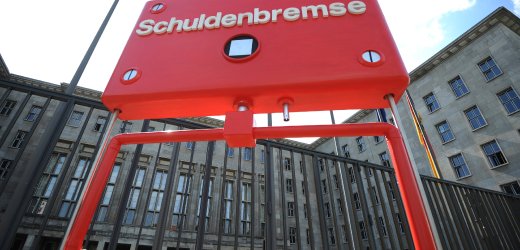
This is the first time that the so-called “stability council” has put on its “debt-brake,” emergency procedures created by the federal government two years ago which is aimed at forcing all state budgets to be in surplus by the year 2020.

And the losers are (who else?): Berlin. Oh yeah, and Bremen, Schleswig-Holstein and Saarland. And just to stick with Berlin, how high is this city in debt? It’s only around something like sort of 62 billion freakin’ euros (17,140 euros per resident).

And how does this way cool debt-brake work? That’s easy. If the states promise to be good in the future (2011 to 2019) they will get an additional 800 million financial support from the federal government each year. You know, just like the way they do it down in Greece. I can’t wait to hear the next lecture.

In den betroffenen Ländern wurden bereits Sparmaßnahmen ergriffen. Im Gegenzug erhalten sie von 2011 bis 2019 Finanzhilfen von insgesamt 800 Millionen Euro pro Jahr, um die Schuldenbremse einzuhalten und ihre Defizite abzubauen.

Good Bank Bad Bank

Amerikanische Banken sind böse, deutsche sind gut.

Deutsche Bank AG, whose bets against subprime mortgages helped it weather the financial crisis, pressed to sell a $1.1 billion collateralized debt obligation to clients in 2007 as the co-head of its CDO team foresaw a market slump, a U.S. Senate panel found.

Lippmann (not the co-head but then-top CDO trader), whose bets against the housing market were also described in Michael Lewis’s “The Big Short,” had repeatedly tried to warn co-workers and clients in 2006 and 2007 about the poor quality of the mortgage securities underlying many CDOs, according to the report. The return on his bets against mortgages “was the largest profit obtained from a single position in Deutsche Bank history.”

“Keep your fingers crossed but I think we will price this just before the market falls off a cliff.”

So how do German financial experts react to the big short CDO scam and the crisis that followed? How else? American banks have to take the responsibility for what happened.

“Im Nachgang der Finanzkrise müssen sich amerikanische Banken verantworten.”

Who’s clueless now?

“About two weeks ago, Germany’s finance minister described U.S. economic policy as “clueless.” We don’t want to sound childish…

But after yet another bailout for an insolvent European country – about $137 billion for Ireland – we are inclined to ask: If the United States is clueless, what does that make Germany? The de facto leader of the crisis-ridden, 16-nation eurozone, Berlin has not performed its role brilliantly over the past year.”

—–

Fehlalarm des Tages (false alarm of the day):  A suitcase at the Düsseldorf Main Station.