Germany to blacklist own airports

After pannicked German demands that the EU draw up a blacklist of unsafe foreign freight dispatchers and airports to help improve air cargo security following the recent bomb plots originating in Yemen and Greece, Germans everywhere were relieved to learn that many of their own airports would most likely be placed near the top of the list.

One of the said explosive devices recently passed undetected through a transfer point at Cologne-Bonn Airport and was later discovered at East Midlands Airport in the UK.

“National measures are not very effective,” said Thomas de Maiziere, Germany’s interior minister. “Well, at least ours aren’t. Please, somebody out there help us close these high risk puppies down ASAP!”

“Last month, the United States and Britain advised caution to travelers visiting Germany and France and intelligence sources spoke of plots against European cities involving al Qaeda and allied militants, some of them European citizens or residents. But de Maiziere then said he saw no immediate signs of a threat, talking instead of a general abstract danger.”

Mardi Gras is a little early this year

The Jecken (carnival revelers) are out en masse in Gorleben again.

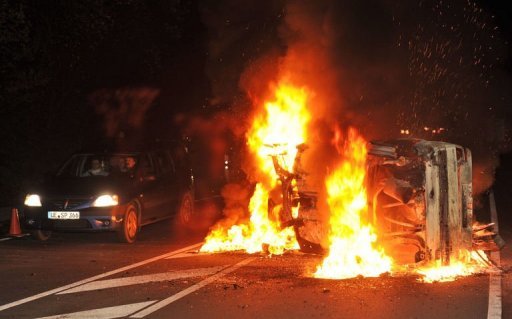
Much like the famous Karneval celebrations in Cologne and other German cities held in February, the jolly and popular annual German Gorleben Riot Ritual, held in November, is an ancient Teutonic tradition (going back some 33 years now) in which large numbers of Green and mean-spirited anarchists protest against nuclear energy in general and the still quite vague government plans for nuclear waste disposal in particular at a charming little hole-in-the-wall interim storage facility located in a quaint little piece of Zauberwald (magic forest) in which all participants reach their collective climax simultaneously once the transport of “Castor” dry cask containers by rail through northern France and Germany, well, reaches its climax too–and everything gets Molotov cocktailed big time.

“Karneval? Sich albern verkleiden, laut rumgrölen und anderen auf den Sack gehen.” 

Ah! Scenic Lake Constance…

The charming landscape, the panoramic views, the armaments industries booming everywhere…

Of course none of these companies (or the communities that live off them) use terms like that if they can avoid it. They prefer calling them “security engineering” or “defense technology” businesses instead, for some strange reason. Maybe because like everwhere else in Germany, they’re all pacifists down here too? Interesting article.

“Genuine pacifists are hard to find around Lake Constance. Most have turned more pragmatic long ago–or maybe their name is Nena. The pop singer performed here last year at MTU’s 100th year anniversary company celebration. And she sang her peace song 99 Luftballons too, of course, and 14,000 guests sang along with her. Before Nena arrived, the celebration’s main attraction had been a Leopard II tank.”

“Laut dem schwedischen Friedensforschungsinstitut Sipri liegt die Bundesrepublik auf Rang drei hinter den USA und Russland–und das, obwohl die deutschen Exportkontrollen zu den strengsten der Welt zählen.”

Germany home alone again

Although the Germans may not have noticed it yet.
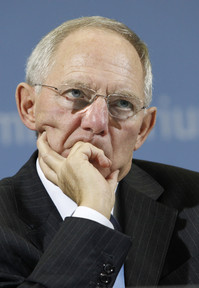
Talk about a fistful of dollars. Underscoring the mounting friction between Germany and its G-20 partners concerning the question of finanical policy, Germany’s Finance Minister Wolfgang Schaeuble said that the US plan to pump $600bn into the US economy was “clueless” and would create “extra problems for the world”.

So, like where’s the problem?

Of course the German coalition government needs to talk tough like this because it has to convince everyone here how austere it really is–it trails the opposition in opinion polls before six state elections next year and needs a success “after alienating German voters by supporting the bailout for Greece in May.” Calling US policy makers clueless is just the icing on the cake.

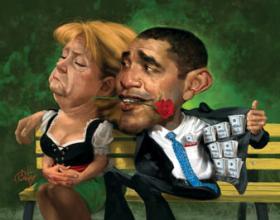
Can’t wait for the G-20 meeting in Seoul next week. To take a look at “united Europe’s” stand on the matter, I mean. Although if you’d ask President Obama, he’d probably tell you that Europe just doesn’t matter.

“Eine ganze Reihe von Amerikanern betrachte Europa zwar nicht als Problem, allerdings längst auch nicht mehr als Teil der Lösung. Obama scheint dazu zu gehören.”

And thanks a million for this one, Joe:

“You won’t find a lot of Keynesians here,” explained one German economic policymaker in Berlin in September. That will not be news to anyone who has spoken to his counterparts in Washington. In their view, Germany is a skulker, a rotten citizen of the global economy, the macroeconomic equivalent of a juvenile delinquent, or worse. It is a smart aleck in the emergency ward that is the global economy. It is a flouter of the prescriptions of the new Doctor New Deal who sits in the White House. 


 http://www.weeklystandard.com/articles/germany-said-no_513319.html
 
So when Obama administration officials urge Germans to stimulate, they are wrong, but not for the obvious reasons. It is not that they want to impose socialist programs on a capitalist system that is doing well without them. It is that they want to impose demand-stimulating programs on a system that is already absolutely glutted with them. It is as if the administration’s approach were to take as a baseline whatever any given government happens to be spending, and then to insist that the figure should be, say, 10 percent of GDP higher. This is about as reasonable as assuming your child will be half as likely to get pneumonia if you send him off to school wearing two down parkas.

 

“Undecided”

Don’t be misled by that American mainstream media or whatever else you may have seen or heard.

Germany’s FOCUS Online will clear it for you: Yesterday’s US-Amerikan election was “undecided” and everything’s still OK in Obamaland, honest.

And here you thought denial was a river in Egypt.

“Seine Partei erzielte bei den Kongresswahlen die größten Zugewinne seit mehr als 70 Jahren.”

Natural factors?

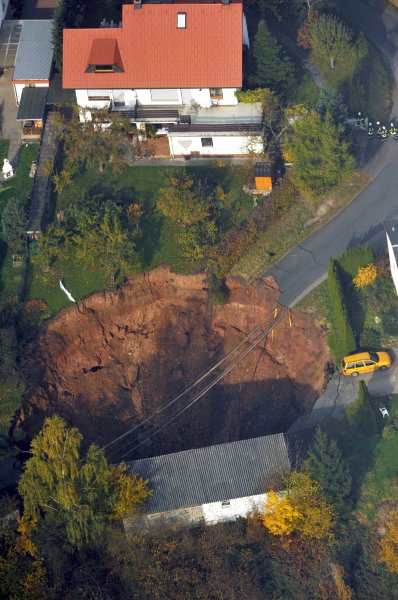
Yeah, sure. This kind of thing happens here in Germany all the time. Talk about your Loch (hole) Ness Monster.

Authorities in a place called Schmalkalden (itself a bit of hole, I guess) say that this big honking 98-foot-deep-mega-crater that just caved in out of nowhere today and ate somebody’s car and who the hell knows what else was caused by natural factors rather than bad industrial things like mining or whatever so don’t worry because it’s a “bio-hole” or something and therefore good for you so everything’s OK people and just keep on moving along (in big, concentric circles), nothing to see here.

“Luther said residents were lucky not to have been hurt.”

The crisis is over, let’s save even more!

In case you hadn’t noticed, German psychology is different than other kinds of folks’ psychology (volks-psychology?). At least when it comes to saving money it is.

Whereas Americans, let’s say, save the little that they can when times are hard and then toss it out with both fists like crazy people the first chance they get, Germans save when the times are hard and then save even more when the times are good again. The spending part gets removed from the calculation here entirely.

And that’s what’s happening now, again. Now that the financial crisis is ancient history and everything is booming here again and unemployment is supposedly under three million and milk and honey are flowing down the streets and into the gutter and all that, private Germans are saving more privately than ever–an average of about 11.5 percent of what they’ve earned this past six months.

And no, they don’t maybe know something that the rest of us don’t know. They’re just hamsters. It’s in their jeans. I mean genes.

“Für die privaten Haushalte zusammen ergibt sich ein Sparvolumen von rund 93 Milliarden Euro.”

PS: I’m thinking now it’s maybe just a big game or something that only the initiated (the Germans themselves) know about. Whoever has saved the most money by the time he or she dies, wins.

Military restructuring?

Ich bin gespannt (I’m dying to know what’ll happen here).

Sure, making the German Bundeswehr more efficient and less bureaucratic sounds like a great idea, at first.

But think it through, people: There are 250,000 troops right now, of which only 10,000 (tops) can ever be deployed at once (not put into real combat situations mind you, not officially anyway, “deployed”). And I’m not joking here with the numbers, by the way.

So what happens when they drop the number of troops down to 180,000? Are we really supposed to believe that once they do the Bundeswehr will “double the number of troops that can be deployed at any one time from 7,000 to 14,000?”

Wer’s glaubt wird selig! (A likely story.)