Weapons orders? Bitte!

Please! By all means.

But to be willing to actually use them ourselves? Nein, danke!

German Defense Companies Could Be Europe’s Arsenal of Democracy – But for the Bundeswehr to fight will take a culture shift, not just weapons orders.

More than a decade ago, the German government made the deliberate decision to kill the ability of the Bundeswehr, Germany’s military, to fight a conventional land war in Europe and strip it of the equipment, manpower, and resources to do so. In 1990, as the Cold War was ending, the then-West German Bundeswehr alone was still able to field 215 combat battalions in a high state of readiness. Today, Germany has around 34 battalions, and the word “combat” is a bit of a misnomer. They are at such a low state of military readiness that when the 10th Tank Division conducted an exercise late last year, its entire deployed fleet of 18 Puma infantry fighting vehicles broke down…

Shouldn’t You Unveil A First-Ever Army First?

This is kind of like leading from behind. Or being led from a behind, if you get my drift.

Germany to unveil first-ever National Security Strategy – Chancellor Olaf Scholz’s government is set to unveil Germany’s first National Security Strategy on Wednesday which aims to provide an overview of the country’s foreign policy and ensure a cohesive cross-ministry approach to security.

Germany has had policy documents in the past addressing security but Scholz’s three-way coalition agreed it wanted a more comprehensive strategy in its pact in November 2021.

There’s Something In The Air

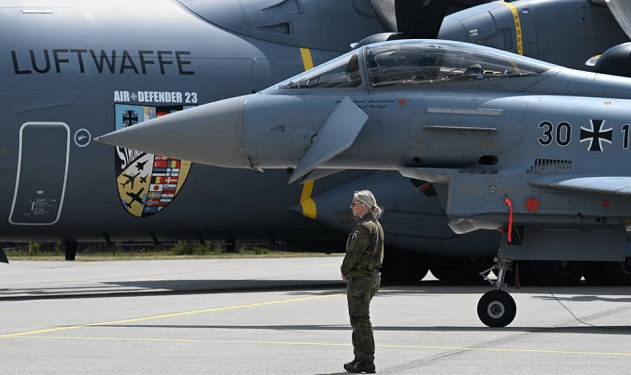
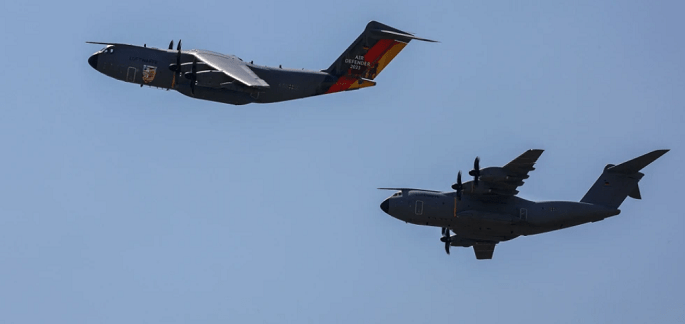
After six years of careful planning, NATO officially launched its 2023 Air Defender military exercise in Germany on Monday; 23 NATO countries—including newest member Finland—will participate, as will nonmember Sweden, whose bid to join the alliance has been stalled by Turkey and Hungary. Japan, which last month began talks to establish the bloc’s first liaison base in Asia to counter China, is also participating as an observer.

Germany May Be Arming Ukraine

But it clearly has no intention of arming itself.

This is still considered news?

Germany is finally focusing on defending NATO, but its military ‘lacks almost everything’ it needs to do it, a former German general says.

In the early years after the Cold War, the military of the reunited Germany — comprising the West German Bundeswehr and parts of East Germany’s National Volksarmee — was a large, well-trained, and well-equipped force.

In 1990, that force had almost 500,000 personnel. Today, the German military is just 183,000-strong, and it can’t meet its recruiting goals. In 2018, half of its jet fighters and none of its six submarines were rated ready for combat. In 2022, German commanders complained that their Puma infantry fighting vehicles were plagued by defects.

Me Too

I miss the Cold War too. Good times. MAD times (Mutually Assured Destruction).

How I do wish we could turn back the clock.

After the wall came down – with the more benign cousin of today’s callous capitalism the victor – we took a summer trip to Berlin in the ever-dependable family BMW (it looked like an East German Trabbi compared to modern cars today). I remember sitting in the back listening to Madonna’s latest album on my Walkman as the bright energetic Berlin streets slipped by the car window. Besides the Brandenburg Gate, we bought giant furry Russian winter hats and military cap badges and chunks of the wall being sold on lines of tables.

Happy days. The global standoff was over, with us coming out on top. How did we let that slip through our fingers?

The Leak Of All Leaks

This is not.

Uh, everybody knows this already. Is it still considered a leak if everybody knew it already? I mean, if it was already leaking? Like, heavily? Germany has never been able to fulfill its NATO obligations. That’s just what it does. That’s its business model.

Germany can’t fulfill NATO obligations, says army chief in leaked memo – A division promised to the transatlantic military alliance isn’t fully battle-ready.

You Can Always Count On Us

To not be counted on.

Don’t thank us. It’s just what we do. Or don’t do, in this case.

German minister expects Bundeswehr shortages beyond 2030.

German Defense Minister Boris Pistorius has said the country’s military, the Bundeswehr, will not be able to bridge gaps in funding and supplies by 2030.

“We all know that the existing gaps cannot be completely closed by 2030… It will take years. Everyone is aware of that…”

Chancellor Olaf Scholz announced a special fund to raise €100 billion for the Bundeswehr last year, although this has not yet been put to use. The government last week also earmarked €12 billion over the next nine years to supply Ukraine with newly produced weapons and ammunition rather than from German stockpiles.

Everything Is Going To Plan

You didn’t really believe that Germany was going to spend that 100 billion euro special fund for the military for the military, did you?

German military in worse shape than before Russia’s invasion – The German military is suffering from a greater shortage of weapons and equipment than before Russia’s invasion of Ukraine a year ago, the Parliamentary Commissioner for the Armed Forces said in her annual report on Tuesday.

“The Bundeswehr has too little of everything, and it has even less since (Russia’s invasion on) Feb. 24, 2022,” Eva Hoegl, who acts as an advocate defending the rights of the troops, told reporters in Berlin.

German Of The Day: Zeitenwende

That means turning point.

Germans love announcing turning points. It makes things sound so, I dunno, official or something. And it’s official here too: Their latest military turning point is working almost as well as their energy turning point (Energiewende) did. Namely, not at all.

Germany’s military ‘Zeitenwende’ is off to a slow start.

Three days after Russia invaded Ukraine, German Chancellor Olaf Scholz delivered a rousing speech to the Bundestag. He had a clear message: Russian President Vladimir Putin’s aggression has ushered in a new era of war in Europe, and wealthy countries like Germany, having pared down their defense spending for decades, needed to rearm. A year after German lawmakers applauded Scholz’s call to action, and as Scholz visits the White House on March 3, 2023, one must ask what has become of Germany’s much-heralded Zeitenwende, or “turning point.”

Nor Will He

Olaf Scholz has not delivered on his sweeping vision for a more modern, more active German military.

And anybody who thinks will ever live up to their promises about defense spending is a fool.

Chancellor Olaf Scholz summarized his country’s approach to the war in Ukraine. “Despite all the pressure to take action,” he said, “caution must take priority over hasty decisions, unity over solo actions.” The line provided Scholz’s most explicit defense to date of Germany’s cycle of denial and delay.

A year ago, Scholz announced a special investment fund of more than 100 billion euros to strengthen the German military, but less than a third of those euros have been assigned to contracts. Defense Minister Boris Pistorius recently aired concerns that Germany’s stockpiles have been depleted by its generous transfers to Ukraine. These comments strain common sense when most of the “special funds” remained unspent until December, when lawmakers finally approved the first procurements. This month, Scholz also abandoned plans to establish a National Security Council, a body that would have been well suited to manage an expanded role in the defense of Europe.