Looft-shif-TEHK’-nik

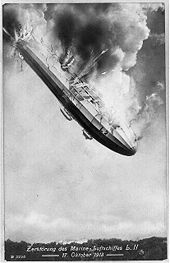
Is nothing sacred anymore? Goodyear Tire & Rubber Co. says it will team up with Germany’s ZLT Zeppelin Luftschifftechnik to build three new blimps beginning in 2013.

Goodyear’s CEO says updating the fleet will “assure that future generations will be able to experience the joy of seeing a Goodyear blimp gracing the skies.”

The airships will be built by Zeppelin and Goodyear teams at Goodyear’s airship hangar near Akron.

Horror Scenario?

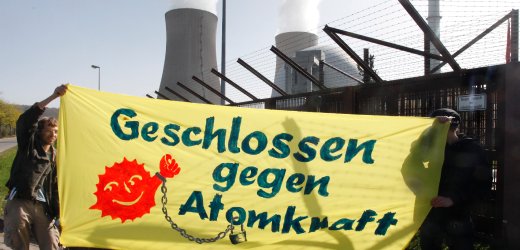
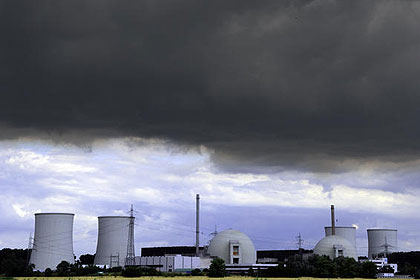
10 euros a month tops? For a “turbo” phase-out of atomic energy in Germany?

According to the Spiegel, that’s what “almost all” German citizens would be willing to pay to get out of the tsunami-plagued industry pronto (German tsunamis are indeed rare, but still). And they mean 10 euros a month per German household, by the way, not for the whole country.

That certainly is reassuring (sort of) after hearing all these Horrorszenarien (horror scenarios) being circulated out there by crackpot organizations like the Federal Association of German Industry (BDI) these days. They warn, for instance, that a quick German nuclear power halt could raise electricity prices here by as much as 30 percent (that would be more than 10 euros a month I think, but still).

I am sure that “almost all” German citizens would be willing to shell that out too.

But, then again, I am also sure that invading reptilian humanoids disguised as human beings are secretly controlling the fate of the human race.

Es darf nichts kosten (it just can’t cost anything).

PS: Thanks for the link, Joe.

“Die Noch-Supermacht”

Like S&P, Germany ITSELF believes that it’s time for “the yet superpower” to start saving big time and pronto. And I for one would listen (you know, like listening to E. F. Hutton when they used to talk?) because the Germans have had a whole lot of experience in giving good advice like this as of late. Just look at how their recommendations have helped Greece, for instance.

“The danger is that the Americans are still lulled into a false sense of security.”

“Möglich, dass Obama dann (nach der Wiederwahl) wirklich anfängt zu sparen.”

Good Bank Bad Bank

Amerikanische Banken sind böse, deutsche sind gut.

Deutsche Bank AG, whose bets against subprime mortgages helped it weather the financial crisis, pressed to sell a $1.1 billion collateralized debt obligation to clients in 2007 as the co-head of its CDO team foresaw a market slump, a U.S. Senate panel found.

Lippmann (not the co-head but then-top CDO trader), whose bets against the housing market were also described in Michael Lewis’s “The Big Short,” had repeatedly tried to warn co-workers and clients in 2006 and 2007 about the poor quality of the mortgage securities underlying many CDOs, according to the report. The return on his bets against mortgages “was the largest profit obtained from a single position in Deutsche Bank history.”

“Keep your fingers crossed but I think we will price this just before the market falls off a cliff.”

So how do German financial experts react to the big short CDO scam and the crisis that followed? How else? American banks have to take the responsibility for what happened.

“Im Nachgang der Finanzkrise müssen sich amerikanische Banken verantworten.”

Funnel Payments Stopped Despite Iranian Pledge

Despite Iranian President Mahmoud Ahmadinejad’s repeated pledge to Germany that Iran’s nuclear program is being used for energy only and that he would reveal any future secret Iranian nuclear site plans “as soon as he became aware of them,” a spokesman for the German government says that the deal to funnel oil payments from India to Iran through Germany’s central bank has been scrapped.

Enraged by this sudden change of heart, Mr. Ahmadinejad asked the Germans “But what about my promise to give 60-days notice before unleashing any surprise attacks on Israel using the missiles that we almost certainly do not have, to the best of my recollection? Doesn’t that mean anything?”

Washington has questioned Germany’s resolve to enforce sanctions given its strong trading links with Tehran.

Blind Me With Science

Please.

It shouldn’t be a surprise that 300 scientists “from various areas of expertise” have written a letter to Angie Merkel requesting that Germany shut down Germany’s risky nuclear reactors (the entire industry) as soon as possible. What surprises me is when I occasionally bump into a German scientist who isn’t prepared to jump off the cliff with everybody else. They are, needless to say, very few and very far between.

Here’s what physicist Christoph Barthe (a climate change guy) has to say about German nuclear power in an opinion piece called Despite Fukushima (page 15, Die Zeit No. 14, 31 March 2011):

Felix Dachel maintains in his response to “In Praise of the Movement” (Zeit Nr. 13) that the majority of Germans were already against nuclear energy before Fukushima. This is incorrect. An Allensbach survey from March, 2010 revealed that 44% of those asked said that, “all things considered,” they were for the further use of nuclear power, 37% were against it. A survey taken by TNS Emnid in February 2010 revealed that 60% of Germans asked were for the continued use of nuclear energy once the question of the final disposal of nuclear waste gets cleared up, 37% were against it.

Now a lot of nonsense is being spread around in the public concerning this question of the final disposal of nuclear waste. The unresolved waste disposal issue is certainly an effective public appeal argument for the anti-nuclear movement, but it is completely inappropriate as an excuse to phase-out nuclear power. The amount of highly radioactive waste is extremely small: Three-thousandth of a gram per kilowatt hour in Germany. There are more than enough suitable rock layers available which have been stable for countless millions of years and which we can expect with good conscience to remain that way for a few more million years to come. That is simple geologic knowledge. In contrast to that, greenhouse gases continue to be pumped into the atmosphere with foreseeable catastrophic effects that the same anti-nuclear activists warn us about.

It is the same thing when you compare the risks of climate change with the risks of nuclear energy, a technology that has been, despite 30 years of resistance to it, the most climate compatible energy source yet developed. If you compare the very slight risk of radioactive pollution with the very real danger caused by the continued unabated pollution of the atmosphere through greenhouse gases, generation after generation, then it must be clear that the question of risk speaks in favor of nuclear energy and not against it—despite Fukushima.

Cows Still Mad In Germany

Or angry, at the very least. And wouldn’t you be? After ten long years of taking testing samples from the brains of 21 million cattle in Germany for BSE, scientists have concluded that mad-cow disease maybe sort of never took hold here after all.

But the war must go on. Why is hard to say, but it must. Sicher ist sicher ist sicher (it’s better to be safe than sorry) already. And what’s €150 million a year for a danger to consumers that , uh, hasn’t been a danger to consmers for many years now, if ever at all?

Or as one pissed off medical specialist said: “That is more than twice the budget that all university hospitals have at their disposal for diagnosing infections in their patients.”

Since news of the disease reached Germany, some 15,355 cattle have been killed in so-called stock and cohort culling. All of 12 animals sick with BSE were discovered at German slaughterhouses with the help of rapid tests. The last case was diagnosed five years ago.

Tourists Threaten Kreuzberger Biotope

“We have no intention of building a wall in Kreuzberg.” Not yet anyway. But if record-breaking numbers of tourists keep coming to Berlin all the freakin’ time, Green politicians may have to reconsider that.

It appears that certain residents in Berlin Kreuzberg have become quite hostile when it comes to hostels these days. They don’t want their colorful Kiez (neighborhood) tainted by tacky tourists. They want to keep on doing the tainting themselves. 

Remember: This is the same biotope where expensive cars go up in spontaneous combustion on a regular basis and McDonalds restaurants are the work of the devil herself. Tourism? Nein danke!

Die Grünen wollen die Zahl der Hostels und Hotels in dem Bezirk beschränken, außerdem umweltfreundliche Unterkünfte mit Ökosiegel auszeichnen.

Are these the sanctions you were talking about, Guido?

The issue of German exports is more complex. After the embargo was lifted, Germany’s arms business with Libya was quickly put back on track. German exports to Libya were worth €53 million in 2009, the third highest in Europe.

The Gadhafi regime has been blocking the mobile phone and GPS networks in Libya for days — possibly with the help of German technology — to prevent protesters from being able to communicate with each other.

And there is also controversy over the radar technology that Germany supplied to Libya to help it secure its borders. In 2010, the EU pledged to give the dictator €50 million so that Libya could prevent African refugees from reaching Europe’s coasts. But this and other deals like it are now coming back to bite the EU.

“The situation in Libya illustrates the fundamental problem that the long-term effects of arms transfers are not taken into account.”

Germany Talks Tough To Gaddafi Now That He’s Gone

He is gone by now, right? No matter. Libya has left him so it comes down to the same thing.

After recently flying to Tehran to meet with Iran’s otherwise quite isolated president, Mr. Laugh-A-Minute Mahmoud Ahmadinejad–a condition made by the Iranians in order to secure the release of two German hostages–German foreign minster Guido Westerwelle wants the world to know that he can also be a real toughy too and has threatened the now irrelevant Libyan dictator Muammar Gaddafi with “sanctions” should the violence in Libya continue.

Well, if The Artist Formally Known As Gaddafi isn’t gone by now, the threat of German sanctions will certainly be the last straw that will break his camel’s back, right?

“We are still absolutely clear about the fact that the situation in Iran concerning human rights and political freedoms is unacceptably bad.”