Are We Having A European Lifestyle Yet?

Is this the end of “the European way of life” as we know it?

European leaders have been muddling through instead of properly tackling the debt crisis. Now it threatens the very foundations of the European Union and could destroy a lifestyle that millions of Europeans take for granted.

Funny. I thought taking things for granted was what the European lifestyle was all about.

“We need fiscal discipline because we have a debt problem… No euro bonds as long as I live.”

Our Debt Still Doesn’t Stink

German government debt keeps climbing relentlessly higher and reached an all-time high during the first three months of this year. The federal, state and local governments then reached a debt to the tune of 2 trillion euros.

That was 2.1 percent or 42.3 billion euros higher (deeper?) than  in the previous year’s quarter, reported the Federal Office of Statistics in Wiesbaden on Monday.

Now if only Greece and Co. could learn to control their government spending like the Germans do. Oh, wait. They already have. Or do. Or whatever.

Deutschlands Staatsschulden auf Rekordhoch gestiegen

The Great European Divide

There’s Germany, it seems. And then there’s (practically) everybody else in Europe.
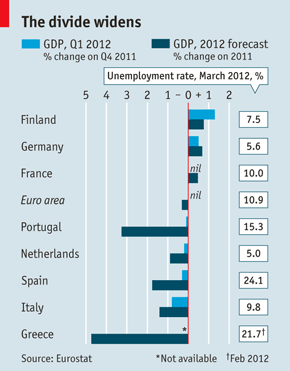
The Economist notes: The hope is that Germany, which produces over a quarter of euro-zone output, can pull along the rest. But the worry is that the latest bout of euro sickness may sap confidence even in Germany, aborting a broader recovery.

With unemployment at 6% compared with a 15-year high of 11% across the euro zone and over 20% in Spain and Greece, Germans feel less pressure to save in case they lose their jobs. And a more confident Germany helps everyone by spending more on imports. German inflation at 2.2% is now below average.

German resilience reflects several strengths. Although growth in the first quarter was helped by exports, the usual mainstay, it has increasingly been backed by domestic demand, which accounted for three-quarters of GDP growth in 2011. This reorientation has happened because Germany avoided the debt excesses (? hmmm, relatively speaking perhaps, but I’ve seen some other numbers here), both private and public, that inhibit growth elsewhere. With relatively low debt, German households and firms can borrow more. What is more, they can do it at rock-bottom rates. Paradoxically, Germany is benefiting from the euro crisis, as investors seek a haven. Yields on ten-year German government bonds have fallen below 1.5%.

Paradoxically, Germany is benefiting from the euro crisis, as investors seek a haven. Yields on ten-year German government bonds have fallen below 1.5%.

And yet, after having read all these impressive figures up there, there’s another German paradox I keep running into here all the time: Germans on the street aren’t nearly as confident as this article wants to imply, at least not when it comes to the euro and the euro-zone. How else do you explain the fact that nearly every second German now thinks that the introduction of the euro was a big honking mistake in the first place?

Die Euro-Einführung war ein Fehler, glauben knapp die Hälfte der Deutschen.

Or Maybe It Does Stink (Our Debt)

What, me worry?

The German debt agency was forced to retain almost half of a sale of 6 billion euros due to a shortage of bids by investors, sparking fears that Europe’s debt crisis is now even starting to threaten Berlin.

The German government is still resisting calls (from France and elsewhere) to allow the ECB to act more decisively.

“It is a complete and utter disaster,” one financial expert dude in London said. “And everybody has hurt feelings,” I replied. “And that’s the main thing.”

It’s starting to get ugly, folks, in other words. Uh, are we having a panic yet?

“The debt crisis is burrowing ever deeper, like a worm, and is now reaching Germany.”

Google Still Evil

But at least it saves German companies tons of money.

Something called the Institute for German Economy has just found out that fast research (and other services) carried out using Google saves German companies some 6.84 euros per employee per year. And how did they find this stuff out? I dunno. I guess they googled it or something.

Unfortunately, Google doesn’t seem to be helping the German national debt very much these days. In absolute terms, every German citizen carries 24,904 euros worth of public debt, whatever public debt is worth these days. Are we having a Greece here yet?

„Wirkungsvolle Online-Tools sind heute entscheidend für Umsatz, Produktivität und Innovationsfähigkeit vieler Unternehmen.“ 

What Identity Do I Wear Today?

So what do you want, Germany? The Germans don’t even know themselves what they want with Europe and/or Germany: In a survey this September by Der Spiegel, clear majorities of Germans said that it wasn’t right to help Greece and other countries with the bailout fund and that Germany was not benefiting from the euro zone. But a clear majority also believed that European institutions should be given more power in a crisis. Classic German schizophrenia again or what?

Not that it matters or anything. In the final analysis nobody is asking you what you want: The European Union is a union not of peoples but of heads of state. “General Franco was a head of state, too.”

Nope, I still don’t know what “Europe” is supposed to mean here, but I keep getting the sneaking suspicion that I’m not the only one living in Europe who feels that way. It’s just that I, as a non-European, have the luxury of being able to admit that I don’t get it and that I don’t really care.

But as this latest crisis develops, one thing seems certain. Whatever Europe may be, it clearly has something to do with illusion.  Illusion with an s on the end. With lots of illusions. One illusion after the next. Here’s one, for example:

Europe is founded on the illusion of German money without German control. And that bargain has worked, until now, because of the way Germany sees itself within Europe (which itself, as the polls suggest, is an illusion).

“As a good German one has to be a good European.”

Do as I say, not as I do

Believe you me, Europe, President Barack Obama knows what he’s talking about when he’s talking about debt.

And that is why he wants YOU to solve your eurozone debt crisis pronto. He is, after all, “deeply engaged” with European nations about solving the eurozone debt crisis, if less so about solving the American one, and is deeply convinced that European countries need to coordinate fiscal policies just like the American administration and Congress have not.

“Right now you have a single currency but you don’t have a single set of economic policies, and that’s created great difficulty,” the President said. “Like duh, we know all about that. Just look at us if you want to see what that kind of clueless leadership gets you.”

“Europa hat derzeit zwar eine geeinte Währung, aber es verfügt über keine gemeinsame Wirtschaftspolitik. Und das schafft große Probleme.”

Debt Expert Deutschland

SPIEGEL ONLINE: Mr. Ritschl, Germany is coming across like a know-it-all in the debate over aid for Greece. Berlin is intransigent and is demanding obedience from Athens. Is this attitude justified?

Ritschl: No, there is no basis for it.

SPIEGEL ONLINE: Most Germans would likely disagree.

Ritschl: That may be, but during the 20th century, Germany was responsible for what were the biggest national bankruptcies in recent history. It is only thanks to the United States, which sacrificed vast amounts of money after both World War I and World War II, that Germany is financially stable today and holds the status of Europe’s headmaster. That fact, unfortunately, often seems to be forgotten.

SPIEGEL ONLINE: What happened back then exactly?

Ritschl: From 1924 to 1929, the Weimar Republic lived on credit and even borrowed the money it needed for its World War I reparations payments from America. This credit pyramid collapsed during the economic crisis of 1931. The money was gone, the damage to the United States enormous, the effect on the global economy devastating.

SPIEGEL ONLINE: The situation after World War II was similar.

Ritschl: But right afterwards, America immediately took steps to ensure there wouldn’t be a repeat of high reparations demands made on Germany. With only a few exceptions, all such demands were put on the backburner until Germany’s future reunification. For Germany, that was a life-saving gesture, and it was the actual financial basis of the Wirtschaftswunder, or economic miracle (that began in the 1950s). But it also meant that the victims of the German occupation in Europe also had to forgo reparations, including the Greeks.

“He warns the country should take a more chaste approach in the euro crisis or it could face renewed demands for World War II reparations.”

My Big Fat Greek Bailout II

Certainly not back by populist demand, the German government now seems prepared to stop the bitching and moaning long enough to support funding for the sequel to the first Greek Bailout box office flop and enable the EU to wrap up a second package of aid loans to help a struggling Greece or, to be more exact, the German banks that are now terribly exposed to a possible default there.

“Germany is considering dropping its push for an early rescheduling of Greek bonds in order to facilitate a new package of aid loans for Greece, according to people familiar with the matter. Berlin’s concession that it must lend Greece more money, even without burden-sharing by bondholders in the short term, would help Europe overcome its impasse over Greece’s funding needs before the indebted country runs out of cash in mid-July.”

But if you want any popcorn, you’re going to have to bring it yourself.

Größter Garant der griechischen Zahlungsfähigkeit nach dem IWF mit 30 Mrd. ist Deutschland mit 22,4 Mrd.