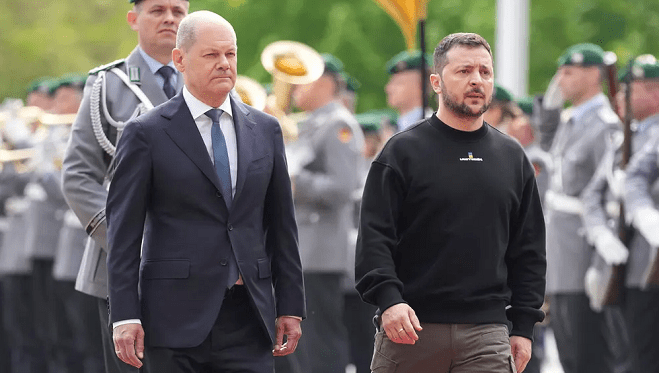
As a welcome gift, Scholz put together an arms package worth 2.7 billion euros. Germany is supplying more infantry fighting vehicles, older Leopard-1s, howitzers, armored combat vehicles, reconnaissance drones and ammunition. It is the most extensive pledge by the German government since the start of the war.
Germany is finally focusing on defending NATO, but its military ‘lacks almost everything’ it needs to do it, a former German general says.
In the early years after the Cold War, the military of the reunited Germany — comprising the West German Bundeswehr and parts of East Germany’s National Volksarmee — was a large, well-trained, and well-equipped force.
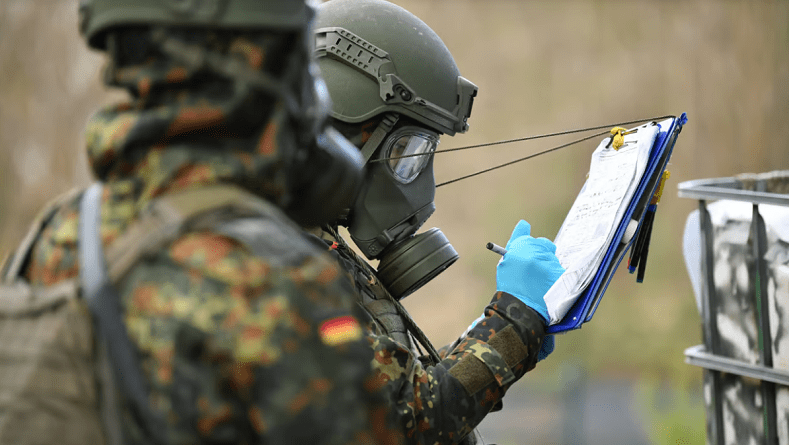
In 1990, that force had almost 500,000 personnel. Today, the German military is just 183,000-strong, and it can’t meet its recruiting goals. In 2018, half of its jet fighters and none of its six submarines were rated ready for combat. In 2022, German commanders complained that their Puma infantry fighting vehicles were plagued by defects.
Uh, everybody knows this already. Is it still considered a leak if everybody knew it already? I mean, if it was already leaking? Like, heavily? Germany has never been able to fulfill its NATO obligations. That’s just what it does. That’s its business model.
Germany can’t fulfill NATO obligations, says army chief in leaked memo – A division promised to the transatlantic military alliance isn’t fully battle-ready.
That’s how it’s always been in today’s Germany. Search here (in the upper left) for “beautiful German weapon sale” to get just a few examples.
Thanks to Putin, Business Is Booming for Germany’s Defense Contractors – As governments rearm in response to Russia’s invasion of Ukraine, the German arms industry is a prime beneficiary, and that’s making some of the public uncomfortable.
Don’t thank us. It’s just what we do. Or don’t do, in this case.
German minister expects Bundeswehr shortages beyond 2030.
German Defense Minister Boris Pistorius has said the country’s military, the Bundeswehr, will not be able to bridge gaps in funding and supplies by 2030.
“We all know that the existing gaps cannot be completely closed by 2030… It will take years. Everyone is aware of that…”
Chancellor Olaf Scholz announced a special fund to raise €100 billion for the Bundeswehr last year, although this has not yet been put to use. The government last week also earmarked €12 billion over the next nine years to supply Ukraine with newly produced weapons and ammunition rather than from German stockpiles.
You didn’t really believe that Germany was going to spend that 100 billion euro special fund for the military for the military, did you?
German military in worse shape than before Russia’s invasion – The German military is suffering from a greater shortage of weapons and equipment than before Russia’s invasion of Ukraine a year ago, the Parliamentary Commissioner for the Armed Forces said in her annual report on Tuesday.
“The Bundeswehr has too little of everything, and it has even less since (Russia’s invasion on) Feb. 24, 2022,” Eva Hoegl, who acts as an advocate defending the rights of the troops, told reporters in Berlin.
Germans love announcing turning points. It makes things sound so, I dunno, official or something. And it’s official here too: Their latest military turning point is working almost as well as their energy turning point (Energiewende) did. Namely, not at all.
Germany’s military ‘Zeitenwende’ is off to a slow start.
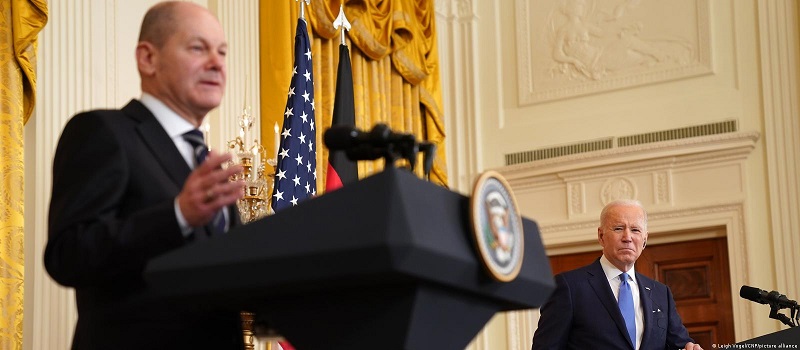
Three days after Russia invaded Ukraine, German Chancellor Olaf Scholz delivered a rousing speech to the Bundestag. He had a clear message: Russian President Vladimir Putin’s aggression has ushered in a new era of war in Europe, and wealthy countries like Germany, having pared down their defense spending for decades, needed to rearm. A year after German lawmakers applauded Scholz’s call to action, and as Scholz visits the White House on March 3, 2023, one must ask what has become of Germany’s much-heralded Zeitenwende, or “turning point.”
To Mini-Mr. Nothing himself. Wow, and to think that he flew all the way over from Germany just to receive this nothing. But it was “profound” nothing, after all. And that’s certainly better than nothing. So think nothing of it.
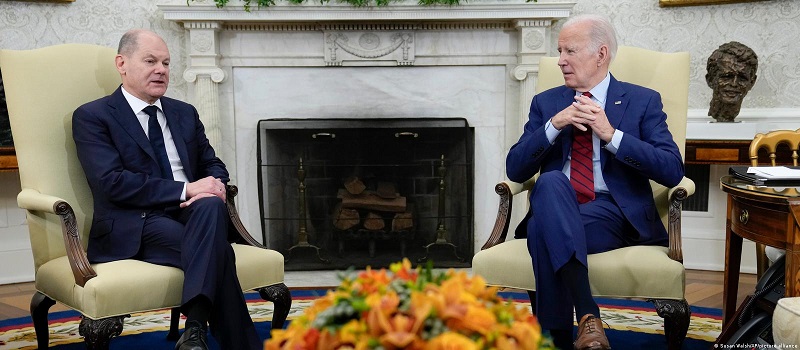
Biden thanks Scholz for ‘profound’ German support on Ukraine – German Chancellor Olaf Scholz and President Biden praised trans-Atlantic unity and vowed to keep up their joint cooperation to support Ukraine during Scholz’s visit to the White House.
Olaf Scholz has not delivered on his sweeping vision for a more modern, more active German military.
And anybody who thinks will ever live up to their promises about defense spending is a fool.
Chancellor Olaf Scholz summarized his country’s approach to the war in Ukraine. “Despite all the pressure to take action,” he said, “caution must take priority over hasty decisions, unity over solo actions.” The line provided Scholz’s most explicit defense to date of Germany’s cycle of denial and delay.
A year ago, Scholz announced a special investment fund of more than 100 billion euros to strengthen the German military, but less than a third of those euros have been assigned to contracts. Defense Minister Boris Pistorius recently aired concerns that Germany’s stockpiles have been depleted by its generous transfers to Ukraine. These comments strain common sense when most of the “special funds” remained unspent until December, when lawmakers finally approved the first procurements. This month, Scholz also abandoned plans to establish a National Security Council, a body that would have been well suited to manage an expanded role in the defense of Europe.




 Observing Hermann