Fukushima Goes Broadway

Sort of. Remember Fukushima? That Japanese Super-GAU (nuclear worst case scenario) that, well, never happened? You know, the one after that earthquake in Japan that managed to shut down 8 nuclear power plants in Germany (and could you imagine having to explain that to a visitor here from outer space?)?
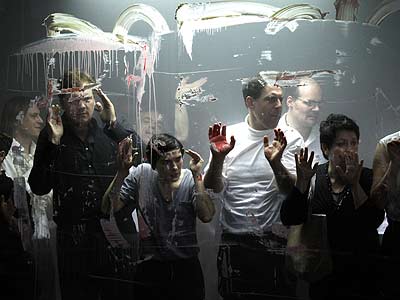
Well, the German intellectually correct caste is bound and determined never to forget (one of their favorite pastimes) and that is why they are now making even more theater about the Fukushima Theater (Theater machen means kicking up a fuss here) by bringing out a worst case scenario theater piece addressing this epoch-making event. It’s called “Kein Licht” meaning No Light. And no, it is not a musical.

Needless to say, this is German highbrow theater vom Feinsten (at its best). And it starts with the title, I find. It’s so ambiguous or something. Although, on the other hand, what else could they call it other than No Light? The freakin’ power plant just got turned off (the loss of light connected with such an action being a logical consequence German nuclear energy opponants have not yet managed to properly address).

But screw the title, the main thing is that this production creates “an atmosphere of total anxiety.” I mean, why else whould a German theater-goer go and see it otherwise? You know, it’s a production with lots of darkness and water and slippery mud and rubber boots and all the other stuff that happens right after a nuclear catastrophe in Japan that never took place. And nudity too, I assume. All German highbrow theater pieces have naked people in them at one point. That’s just what they do here. Although you might think that with the play being called No Light nudity might not have the desired effect, which is supposed to be loud yawning, as far as I can tell.

And the message? Some Künstler say it is an attack upon the media and other fear industrialists (see the Greens & Co.) who are willing to exploit the suffering of others and create panic to increase their sales and thus make a lot of money and/or influence. You know, it’s a critique on those who misuse a serious issue like this to scare others for their own self-aggrandizement and profit. So make sure to buy your tickets early.

Es ist ein Schwall von Texten, die meist in keinem Zusammenhang stehen.

Japanese Typhoon May Shut Down More German Nuclear Power Plants If They Can Still Find Any In Operation

It’s all over. All over again already, I mean. German press reports have confirmed that typhoon Roke has reached Fukushima ITSELF.

Worse still, the dreadful storm has wreaked havoc there, having damaged one of the facility’s surveillence cameras. It may have even knocked it down. German citizens in or around Japan would be asked to leave the area immediately if there were any there to be asked to do so but there aren’t, so they won’t be. German citizens at home are asked to remain there, at home, until further notice.

It goes without saying that Germany’s nuclear energy policy will certainly be reviewed again although there’s not all that much more nuclear energy left here to policy anymore.

Außer einer durch den Sturm beschädigten Überwachungskamera gab es keine weiteren Schadensmeldungen aus dem bei einem Erdbeben sowie einem Tsunami im März havarierten Atomkraftwerk Fukushima-Daiichi.

Is it Newspeak or Newsspeak?

The Fukushima worst case scenario has now actually happened, in Germany. And the Fukushima worst case scenario is that the Fukushima worst case scenario never happened. Sometimes the truth raises it’s ugly and pointy little head, even here. Only for a second or two, but still.

I read the news today, oh boy. And not that any of you out there really care or anything, but I discovered that even journalists with the best of politically correct intentions can screw up from time to time. In this case it was in a Zeit article entitled Stress und Strahlung (Stress and Radiation) by Hans Schuh*. It was about how, well, something called “psychosocial stress” resulting from the Fukushima incident will now be producing more victims than the radiation did (I think he meant in Japan because psychosocial stress victims have been dropping like flies here in Germany for months now).

Like duh, Hans. Something has to produce victims when the “Super-GAU” everyone was banking on never materialized, right?

My favorite line in the article: In hindsight it has been revealed that with regard to one aspect of the accident’s occurance the world community (he actually means Germany here, of course) was taken in by an error: The “worst case scenario in the fuel cooling basin” never took place.

I’ve got to know, folks: How on earth did this ever get past the Brain Police?

I know how. “The people” will automatically understand that the worst case scenario took place anyway, sort of, irgendwie. They have long been aware of the fact that their reality must be made to comply with your/our ideologically motivated fear agenda, so it ain’t no big thing, this one little slip-up. This type of thing only makes Newspeak stronger, I think, although I can’t claim to be fluent in it yet myself.

Im Rückblick offenbart sich auch, dass die Weltgemeinde in Bezug auf das Unfallgeschehen zumindest in einem Punkt einem Irrtum aufgessen ist: Der “GAU im Abklingbecken”, der global Schlagzeilen machte fand gar nicht statt.”

* You won’t be finding this article online for some reason. I guess it’s not fit for the masses just yet.

News Alert! Here’s the article after all. They publish these online a little later, I guess.

New Angst Study Producing More New Angst

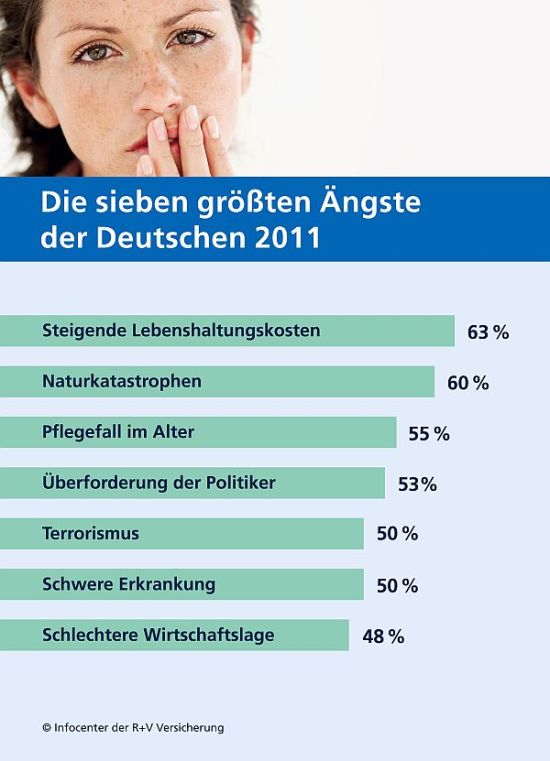
A new study from the R+V Insurance Company (hmmm, an insurance company) indicates that Germans have a whole new list of things to scare the Hosen off them that they didn’t have last year. Is there a pattern developing here or something?

Some of this year’s top favorites (so far) are ecological catastrophes (a perennial hit), the “super worst case scenario” that took place after the earthquake in Japan, the so-called EHEC scandal (go organic sprouts!) and those bloody and yucky revolts still going on down there in the Arabian World.

But what really scares them most is, well, their money. Or the thought of losing it, I should say. Along with their fear of rising energy costs (hmmm, where might those rising energy costs be coming from?), over 70 percent of Germans asked are scared to death of the imminent bankruptcy of a few of them there EU countries down south which will cost the German taxpayer dearly.

Hey. No angst, no fun.

70 Prozent der Deutschen befürchten, dass die drohende Pleite einiger EU-Länder den deutschen Steuerzahler teuer zu stehen kommt – keine Angst erreichte 2011 höhere Werte.

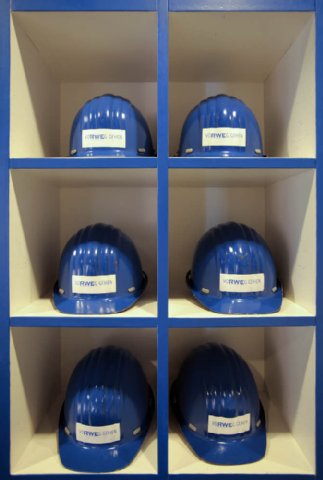
RWE Jobs Next

German utility RWE AG (RWE.XE) Tuesday said it swung to a net loss in the second quarter of 2011, driven mainly by additional costs related to Germany’s decision to exit nuclear energy by 2022 and a tax on nuclear fuel.

The early closure of reactors also resulted in an earnings shortfall, because RWE sold forward the electricity that should have been produced in its two shuttered reactors. To meet its supply obligations the company now has to produce that electricity in more expensive plants or buy power on the market, both of which hurts generation margins.

Bad Jobs Must Go

Wow. Even the Brave New Non-Nuclear World (in Germany) demands its tribute.

10,000 jobs at Germany’s energy giant Eon will have to go, for instance. But these folks will gladly take on this burden because its what “the people” want. Unfortunately, only about one third of those gladly taking on the burden will be German employees, but you can bet that there will be  further opportunites for them to excel in the very near brave new future.

Das sind mehr als zehn Prozent der gesamten Belegschaft. Damit würde der Sparkurs des Konzerns viel härter ausfallen als bisher bekannt.

Time To Say Goodbye

To all those jobs in the German nuclear power industry, I mean. It’s phase-out time in more ways than one over here.

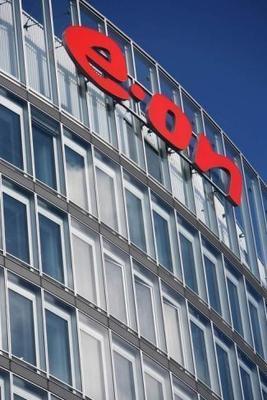
It’s coming out that E.ON, Germany’s largest energy provider, is now to go on an extreme austerity diet and is about to “restructure,” as they like to say, know what I’m saying? They’re even talking about closing down the big new headquarters they just moved into a year ago.

But hey, it’s all worth it. No pain no gain or something. And don’t worry, there are no other hidden fallout issues here, either.

Of 17 German nuclear power plants, half are now turned off; all of them will be shut by 2022. That’s a loss of 22 billion euros in profits.

Green Electricity Threatening Energy Turnaround

Yeah, I know. You thought that Germany’s Energiewende (energy turnaround) was synonymous with green or eco-power (I did too). But if you listen to what some scientist types are saying (Rheinisch-Westfälischen Institut für Wirtschaftsforschung or RWI, for instance)–and you won’t, and nobody else will either–the present state of renewable energy in Germany is so clearly deficient and so way too costly (especially when it comes to generating solar energy) that they recommend rethinking the whole big turnaraound thang (not that all that much thinking had gone into it in the first place or anything, that rethinking part was just a figure of speach).

Some of these folks are even starting to call this mess Der große Solarschwindel (The Great Solar Energy Scam). But, like I said, nobody is particularly interested in hearing about things like this. Or do you want the Green Shirts to come knocking on your door one night? And after all, money is no object here. It never is when it isn’t your own.

Es bestehen derzeit in Deutschland so große Defizite in Bezug auf Leitungsbau, Speicherkapazitäten und bei der Vernetzung mit den europäischen Nachbarn, dass es vorerst nicht ratsam erscheint, mit dem Ausbau regenerativer Stromerzeugungskapazitäten fortzufahren.

“Frau am Steuer…das wird teuer!”

“A woman at the wheel, that’ll cost you!”

Who would have thought that? According to Germany’s Federal Agency for Electricity, the German electricity grid is in a thoroughly chaotic condition these days. No one can explain why. And the cost of purchasing needed electricity (nuclear generated) at the European Energy Exchange has already gone up 10 percent and further increases are expected to follow soon. It’s bizarre. It’s almost as if some crazy person had shut down eight nuclear power plants here or something.

Yup, Angie Merkel’s Fukushima-driven German angst Atomaustieg (nuclear phase-out) may have indeed been absolutely necessary and of critical urgency (opinion polls, folks, you gots to give the people what they want), but hysteria does have its price. Even in Germany, I mean. But who cares? I know the Germans pretty well and I am convinced that they are all going to be more than willing to pay radically higher electricity bills in order to avoid the, uh, tsunami threat on the home front.

What I really don’t understand is the economics at play here. There is clearly an overabundance of hysteria in this country, right? Shouldn’t that make the price of hysteria, like, cheaper or something? I’d ask an economist but you know how the adage goes: For every economist there is an equal and opposite economist.

“Das Bundeskartellamt erwartet als Folge des Atomausstiegs steigende Strompreise. An der Strombörse sind die Preise bereits um zehn Prozent gestiegen.”

The Green Plague (Another Green Shirt Terror Post)

Now it’s tainted German sprouts that have caused the deadly E. coli (Ehec) outbreak (but remember, the source of the outbreak seems to change here every few hours–ask Spanish organic cucumber farmers). Sprouts? That’s another one of them there green organic foods, ain’t it?

Anyway, one German Spiegel reader who goes by the name of alex300 is mad as hell and isn’t going to take it anymore. I feel his pain and stuff. He writes:

“What have we learned from the organic crisis?

1. That green organic farmers can cause more damage than Chernobyl and Fukushima together. How many deaths have been attributed to Fukushima? Just one worker who died of a heart attack. How many deaths do we have to thank for the green organic madness? More than 2000 contaminated by health stores and organic sprouts, about 1000 of them with irreparable brain and kidney damage, and 21 dead.

2. That biogas plants are much more dangerous than nuclear reactors. An atomic reactor can contaminate a 30 km area around it, max. The multiresistant bacteria that breed in biogas plants can wipe out all of humanity.

No power to the green organic plague!”

I hope alex300 is feeling better now. I sure do. For now.

Was haben wir aus der Biokrise gelernt?

1. Die grünen Biobauer können viel mehr schaden anrichten als Tschernobyl und  Fukushima zusammen. Wie viele Tote hat Fukushima verschuldet? Nur einen Arbeiter, der an einem Herzinfarkt verstarb. Wie viele Tote haben wir dank dem grünen Biowahn? Mehr als 2000 verseuchten durch Reformhäuser und Biosprossen, ca. 1000 mit irreparablen Hirn- und Nierenschäden und 21 Toten.

2. Die Biogasanlagen sind wesentlich gefährlicher als die AKWs. Ein AKW kann maximal 30 km Umgebung gefährlich verseuchen. Die multiresistenten Bakterien, die in Biogasanlagen brüten, können die ganze Menschheit auslöschen.

Keine Macht der grünen Bioseuche!