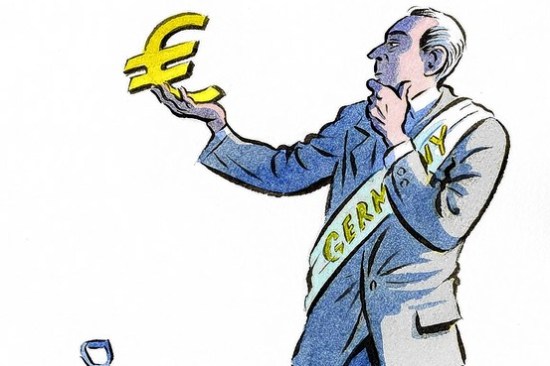
“We don’t like your profligate spending,”

Germans are always lecturing the Greeks. “Except when it comes to buying our ridiculously expensive weapons systems,” they maybe ought to add.

Over much of the past decade, Greece – which has a population of 11 million – has been one of the top five arms importers in the world.

Most of the vastly expensive weapons, including submarines, tanks and combat aircraft, were made in Germany, France and the United States.

The arms purchases were beyond Greece’s capacity to absorb, even before the financial crisis struck in 2009. Several hundred Leopard battle tanks were bought from Germany, but there was no money to pay for ammunition for their guns. Even in 2010, when the extent of the financial disaster was apparent, Greece bought 223 howitzers and a submarine from Germany at a cost of €403 million.

Those No Good Greek Tax Evaders!

Greece’s finance ministry has named 4,152 individuals as major tax dodgers that owe the state a combined 14.9 billion euros in unpaid back taxes as part of a campaign to name and shame tax evaders.

And Germany is empört (indignant), as usual. The interesting thing about the list though are some of the Greek names, I find.  These are names like Grundmann, Hutter und Elstner. They almost sound like, I dunno, like German names. But that can’t be. Germans don’t evade taxes, right? Not unless they live in Greece, they don’t.

Einige der Namen klingen für hiesige Ohren seltsam vertraut: Namen wie Grundmann, Hutter und Elstner. Schulden Deutsche den Griechen Geld?

Germany Will Lead!

But only from behind. It’s another one of those German schizoid personality disorder things.

When history dictates humility, and modesty proves so profitable, reticence endures.

Germans tell the pollsters they fear for their money—and then add that they like both Europe and the euro. They sense that it is cheaper to throw up firewalls than to pay for the devastation of the blaze. They bridle at rewarding the vices of the “Club Med” countries. But their real horror is to be left alone in Europe once more.

Referendum For Referendum On Referendum Called

It’s getting ugly here, folks. Ugly and angry (and that makes everybody happy here).

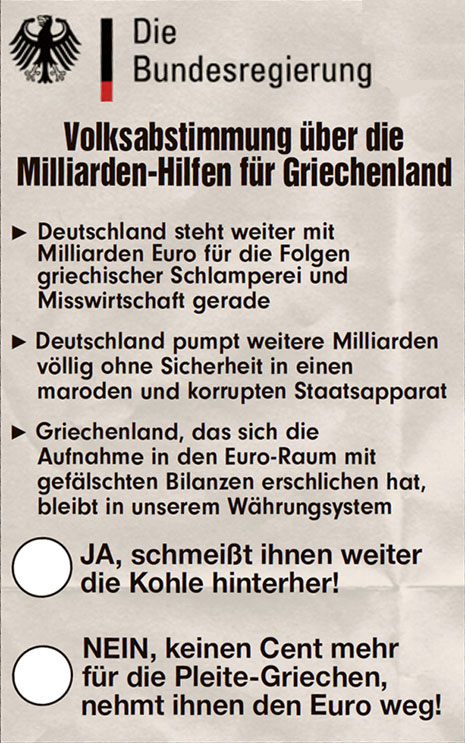
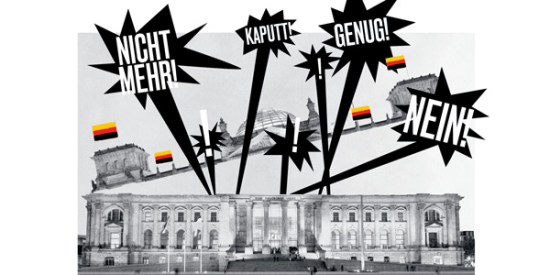
“We’ve had enough!” Germany’s Bildzeitung readers read. “We’re spending hundreds of billions of euros to save the Greeks and now a referendum there should make clear whether they want to be saved at all. Now we want our own referendum: no more billions for the Greeks, Greece out of the euro!”

Place your vote here: “Yes, keep throwing money at them!” or “No, not another cent for bankrupt Greece, take the euro away!”

Die renommierte FAZ fragte gestern, „warum eigentlich die Griechen darüber abstimmen dürfen, ob sie gerettet werden wollen, nicht aber die Deutschen, ob sie und ihre Kinder für solche Zwecke Bürgschaften in Milliardenhöhe schultern möchten“.

Consulting the population? Are you crazy?

German politicians everywhere were shocked at Greek prime minister George Papandreou’s shocking decision yesterday to call a referendum on the latest greatest financial rescue package just put together by EU bureaucrats after marathon summit talks held in Brussels.

“One can’t help but think that the Greeks should be more grateful to selfless Europeans like ourselves who are only trying to help,” said one distraught Berliner politician. “Everybody knows that if you’re dumb enough to actually ask the people what they think about our grand European rescue visions they are very likely to speak their minds.”

A poll at the weekend showed nearly 60 percent of Greeks had a negative or partly negative view of the rescue.

What Identity Do I Wear Today?

So what do you want, Germany? The Germans don’t even know themselves what they want with Europe and/or Germany: In a survey this September by Der Spiegel, clear majorities of Germans said that it wasn’t right to help Greece and other countries with the bailout fund and that Germany was not benefiting from the euro zone. But a clear majority also believed that European institutions should be given more power in a crisis. Classic German schizophrenia again or what?

Not that it matters or anything. In the final analysis nobody is asking you what you want: The European Union is a union not of peoples but of heads of state. “General Franco was a head of state, too.”

Nope, I still don’t know what “Europe” is supposed to mean here, but I keep getting the sneaking suspicion that I’m not the only one living in Europe who feels that way. It’s just that I, as a non-European, have the luxury of being able to admit that I don’t get it and that I don’t really care.

But as this latest crisis develops, one thing seems certain. Whatever Europe may be, it clearly has something to do with illusion.  Illusion with an s on the end. With lots of illusions. One illusion after the next. Here’s one, for example:

Europe is founded on the illusion of German money without German control. And that bargain has worked, until now, because of the way Germany sees itself within Europe (which itself, as the polls suggest, is an illusion).

“As a good German one has to be a good European.”

My Big Fat Greek Divorce

“To stabilize the euro, there can no longer be any taboos. That includes, if necessary, an orderly bankruptcy of Greece.”

You know, like an “orderly” divorce? Only this time nobody is getting the house because there’s no house to get (unless a house of cards counts).

It is not clear who is in the stronger position in the latest round of brinkmanship between Greece and the German bloc. If pushed too far, Greece can set off a powderkeg. The International Monetary Fund says European banks are highly vulnerable and need to raise their capital by €200bn. Many of the weakest are in Germany.

Pirouettes and Unpredictability

We Germans call the shots here in Europe, sort of.

It’s just that we don’t know what we’re going to be calling next.

“Anybody out there still think Germany is running Europe — or for that matter can or will dominate it in time?

The question fits the moment after the German refusal to vote in favor of allied military intervention in Libya, the government’s pullout from nuclear energy largely for reasons of emotion and domestic political calculation, and its willingness last week to put off possibly decisive steps to end Greece’s debt misery.

Over a period of just about three months, that is a lot of unpredictability and policy pirouettes for allies who might have thought German leadership, on the upside, would be rational, competent and closely bound to the West.”

Debt Expert Deutschland

SPIEGEL ONLINE: Mr. Ritschl, Germany is coming across like a know-it-all in the debate over aid for Greece. Berlin is intransigent and is demanding obedience from Athens. Is this attitude justified?

Ritschl: No, there is no basis for it.

SPIEGEL ONLINE: Most Germans would likely disagree.

Ritschl: That may be, but during the 20th century, Germany was responsible for what were the biggest national bankruptcies in recent history. It is only thanks to the United States, which sacrificed vast amounts of money after both World War I and World War II, that Germany is financially stable today and holds the status of Europe’s headmaster. That fact, unfortunately, often seems to be forgotten.

SPIEGEL ONLINE: What happened back then exactly?

Ritschl: From 1924 to 1929, the Weimar Republic lived on credit and even borrowed the money it needed for its World War I reparations payments from America. This credit pyramid collapsed during the economic crisis of 1931. The money was gone, the damage to the United States enormous, the effect on the global economy devastating.

SPIEGEL ONLINE: The situation after World War II was similar.

Ritschl: But right afterwards, America immediately took steps to ensure there wouldn’t be a repeat of high reparations demands made on Germany. With only a few exceptions, all such demands were put on the backburner until Germany’s future reunification. For Germany, that was a life-saving gesture, and it was the actual financial basis of the Wirtschaftswunder, or economic miracle (that began in the 1950s). But it also meant that the victims of the German occupation in Europe also had to forgo reparations, including the Greeks.

“He warns the country should take a more chaste approach in the euro crisis or it could face renewed demands for World War II reparations.”

Über Euro Über Alles?

Time for a new European currency yet?

“The real threat to the euro isn’t that a weak peripheral country like Greece might withdraw in an effort to devalue its way to competitiveness, but rather that Germany might want to pull out.”

This guy makes a very interesting point. He goes into what he defines as the three main problems that have led Greece, Portugal, Ireland and Spain (not yet, but soon) to the dismal position they are now in and suggests that because of the coming bailout fatique, the only way to save the union is, well, to divide it. This could best be done by introducing an Über Euro in the non-bailout nations.

“Germany’s incentive to leave grows with each bailout, and Berlin could ultimately make a simple calculation that extrication will be less costly than continuing the sacrifice needed to keep the euro.”

To avoid this, one could strike a grand bargain by creating this new currency. “These nations then announce that all obligations between their citizens will henceforth be denominated in the new currency, the Über Euro, which would eventually be managed by the Bundesbank. The Über Euro would initially be set at a value of perhaps 1.3 euros, setting the stage for an export boom for countries that continue to use the euro. This would allow the remaining eurozone members to restore their competitiveness without having their financial systems go bankrupt; it also would allow Germany to sell the plan as saving Europe without breaking up the EU.”

“Should the remaining euro countries continue irresponsible fiscal policies, the European Central Bank (which would continue to be their central bank), would slowly monetize their debt. The euro would continue to depreciate against the Über Euro and perhaps end up as junk currency. …The ECB’s stature would be diminished and its balance sheet probably trashed.”

Sounds like a good plan to me (for world domination?). But I’m not very good with money, either.

There is no inherent reason the European project cannot proceed with two currencies and the citizenry may force this outcome.

PS: Beware, Greece. As the Wall Street Journal puts it, there’s a Wolfgang at your door.