German Of The Day: Abschwung

That means downturn.

Downturn

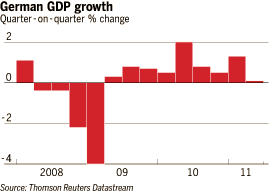
German industry hit by biggest downturn since 2009 – Output falls 5.3% in year to October, weighing on eurozone growth outlook.

Germany’s sprawling industrial sector is suffering its steepest downturn for a decade, underlining how the engine of the eurozone’s biggest economy is sputtering.

In der deutschen Industrie geht der Abschwung mit einem schwachen Start ins vierte Quartal weiter. Im Oktober haben die Betriebe ihre Gesamtproduktion erneut deutlich zurückgefahren.


Germany’s Growth To Be Removed

I mean cut. Yuk. Talk about your gross national product.

Growth

Actually, I mean have its economic-growth forecast for 2014 reduced to 1.2 percent from 1.8 percent.

Jeepers creepers. Is this the end of the beginning of the party or the beginning of the end of the party? Let’s ask two economists and get their five answers and find out.

Inequality For All

That seems to be what most Germans think their country provides them with these days. They are forever moaning and groaning about how the German “social divide” keeps widening.

Germans can be pretty innumerate, you see, believe it or not (when the media hype wants them to be). Nobody ever stops to consider the numbers here, either (just like everywhere else). You have to go to professional-like people on the outside (like at The Economist) for that.

DIW, an economic think-tank in Berlin, says that inequality rose significantly after German reunification; but that it has fallen a bit since 2005 (see chart). Awkwardly for the left, that is when Angela Merkel became chancellor, in coalition first with the SPD, then with the FDP.

Numbers

This is the opposite of what the public believes. According to a study by Allensbach, a polling institute, 69% of Germans think wealth and income are unfairly distributed, and almost two-thirds believe inequality has risen in the past few years. That is good for the left.

Germany remains a huge social and economic success, something that it often seems unGerman to savour.

The Worst Is Over

Or something.

Growth

For much of the financial crisis that started in 2007, Germany remained strong and held the envy of modern economies around the world.

In 2010, the industrious country known for its fiscal discipline had GDP growth of 4.2%, followed by respectable 3% GDP growth in 2011.

Unfortunately, for Germans and the world, there are increasing signs the German economy is being marred by the global crisis. In 2012, GDP growth was a meager 0.7%. More significantly, GDP actually contracted by 0.5% in the fourth quarter.

Währung – Deutschland: Devisen: Euro gibt nach – IWF prognostiziert auch für 2013 Rezession im Euroraum

Change has come to Germany

Not yet.

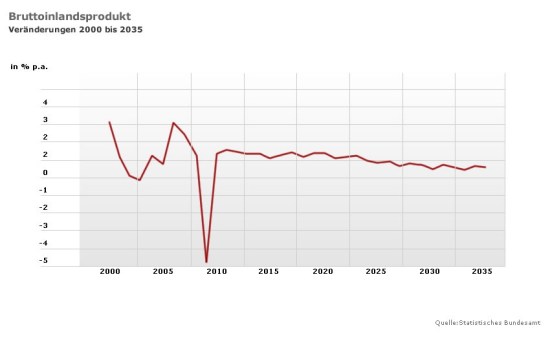
According to a Swiss study entitled “Germany Report 2035”, if the demographically challenged German nation does not modernize it’s act real pronto – raising the retirement age, letting in more immigrants, putting more women to work and increasing the number of hours worked each week – the country’s average annual growth rate will only reach an anemic 1 percent over the coming 25 years.

So hey, the change that’s about to happen here is going to start spinning everybody’s heads, right? Right.

Besides, this is a Swiss report. 

Die Zahl der Arbeitsfähigen sinkt um mehr als acht Millionen.