Germany Will Lead!

But only from behind. It’s another one of those German schizoid personality disorder things.

When history dictates humility, and modesty proves so profitable, reticence endures.

Germans tell the pollsters they fear for their money—and then add that they like both Europe and the euro. They sense that it is cheaper to throw up firewalls than to pay for the devastation of the blaze. They bridle at rewarding the vices of the “Club Med” countries. But their real horror is to be left alone in Europe once more.

Referendum For Referendum On Referendum Called

It’s getting ugly here, folks. Ugly and angry (and that makes everybody happy here).

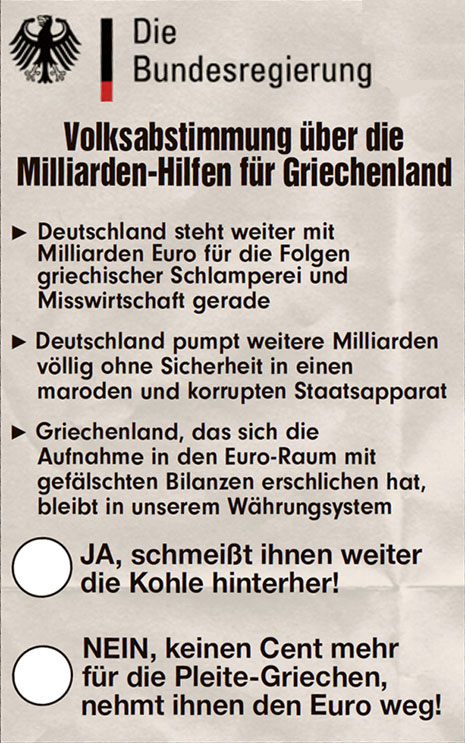
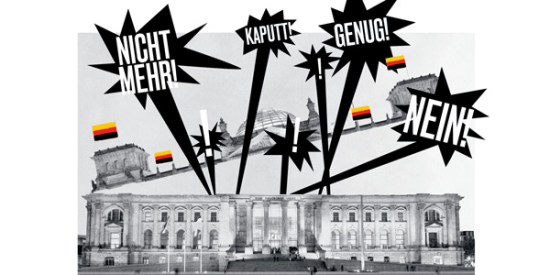
“We’ve had enough!” Germany’s Bildzeitung readers read. “We’re spending hundreds of billions of euros to save the Greeks and now a referendum there should make clear whether they want to be saved at all. Now we want our own referendum: no more billions for the Greeks, Greece out of the euro!”

Place your vote here: “Yes, keep throwing money at them!” or “No, not another cent for bankrupt Greece, take the euro away!”

Die renommierte FAZ fragte gestern, „warum eigentlich die Griechen darüber abstimmen dürfen, ob sie gerettet werden wollen, nicht aber die Deutschen, ob sie und ihre Kinder für solche Zwecke Bürgschaften in Milliardenhöhe schultern möchten“.

Consulting the population? Are you crazy?

German politicians everywhere were shocked at Greek prime minister George Papandreou’s shocking decision yesterday to call a referendum on the latest greatest financial rescue package just put together by EU bureaucrats after marathon summit talks held in Brussels.

“One can’t help but think that the Greeks should be more grateful to selfless Europeans like ourselves who are only trying to help,” said one distraught Berliner politician. “Everybody knows that if you’re dumb enough to actually ask the people what they think about our grand European rescue visions they are very likely to speak their minds.”

A poll at the weekend showed nearly 60 percent of Greeks had a negative or partly negative view of the rescue.

We Hate Being The Hegemon

But somebody has to do it.

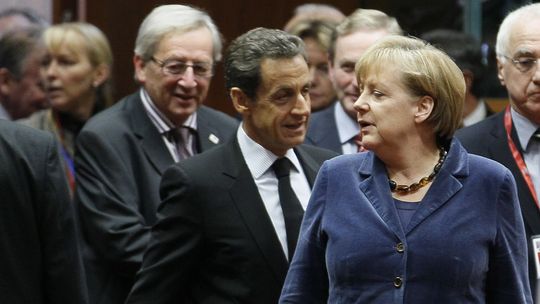
It wasn’t all that long ago that Germany knew how important it was in Europe but kept its mouth shut about it (while pulling the strings behind France’s back). Those days of semi-credible falsche Bescheidenheit (false modesty) are over, sort of. Now they continue to refuse to lead openly, but still pull the strings. Only France isn’t standing there anymore.

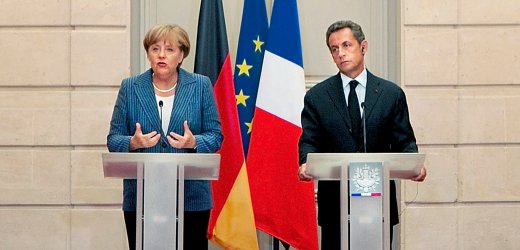
As shown once again during yesterday’s latest “rescue” of Europe, Germany makes the decisions while France still holds the press conferences, but the absurdity of this show is starting to lose a lot of its regular viewers. This formula has jumped the shark, in other words.

But as long as major contradictions keep on coming, everybody here in Germany is happy. You remember, don’t you? Germany fled into the EU to protect itself from itself (there was something about World War II a few years ago). Now it dominates Europe through its sheer economic power anyway, but still psychologically/socially/institutionally traumatized (and loving it), refuses to openly take the role history has assigned it. It prefers instead to publically turn its back on Europe (nobody on the street in Germany truly undestands or much cares about Europe) and concentrate instead on more important things at home like solar energy, local elections and not hurting coalition partners’ feelings.

In other words, Germany may clearly call all the shots now, but it still refuses to lead. Which is kind of clever, if you think about it. When everything ends up going tango uniform later, it wasn’t Germany’s fault.

Mit politischer Macht verhält es sich wie mit Millionen von Euro auf dem Konto: Man spricht nicht darüber.

What Identity Do I Wear Today?

So what do you want, Germany? The Germans don’t even know themselves what they want with Europe and/or Germany: In a survey this September by Der Spiegel, clear majorities of Germans said that it wasn’t right to help Greece and other countries with the bailout fund and that Germany was not benefiting from the euro zone. But a clear majority also believed that European institutions should be given more power in a crisis. Classic German schizophrenia again or what?
Not that it matters or anything. In the final analysis nobody is asking you what you want: The European Union is a union not of peoples but of heads of state. “General Franco was a head of state, too.”

Nope, I still don’t know what “Europe” is supposed to mean here, but I keep getting the sneaking suspicion that I’m not the only one living in Europe who feels that way. It’s just that I, as a non-European, have the luxury of being able to admit that I don’t get it and that I don’t really care.

But as this latest crisis develops, one thing seems certain. Whatever Europe may be, it clearly has something to do with illusion.  Illusion with an s on the end. With lots of illusions. One illusion after the next. Here’s one, for example:

Europe is founded on the illusion of German money without German control. And that bargain has worked, until now, because of the way Germany sees itself within Europe (which itself, as the polls suggest, is an illusion).

“As a good German one has to be a good European.”
Do as I say, not as I do

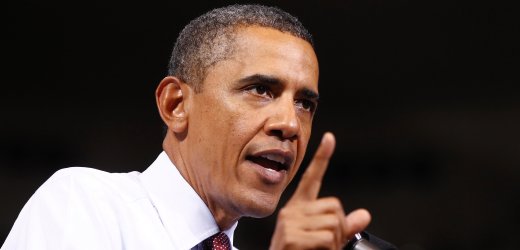
Believe you me, Europe, President Barack Obama knows what he’s talking about when he’s talking about debt.

And that is why he wants YOU to solve your eurozone debt crisis pronto. He is, after all, “deeply engaged” with European nations about solving the eurozone debt crisis, if less so about solving the American one, and is deeply convinced that European countries need to coordinate fiscal policies just like the American administration and Congress have not.

“Right now you have a single currency but you don’t have a single set of economic policies, and that’s created great difficulty,” the President said. “Like duh, we know all about that. Just look at us if you want to see what that kind of clueless leadership gets you.”

“Europa hat derzeit zwar eine geeinte Währung, aber es verfügt über keine gemeinsame Wirtschaftspolitik. Und das schafft große Probleme.”

My Big Fat Greek Divorce

“To stabilize the euro, there can no longer be any taboos. That includes, if necessary, an orderly bankruptcy of Greece.”

You know, like an “orderly” divorce? Only this time nobody is getting the house because there’s no house to get (unless a house of cards counts).

It is not clear who is in the stronger position in the latest round of brinkmanship between Greece and the German bloc. If pushed too far, Greece can set off a powderkeg. The International Monetary Fund says European banks are highly vulnerable and need to raise their capital by €200bn. Many of the weakest are in Germany.

New Angst Study Producing More New Angst

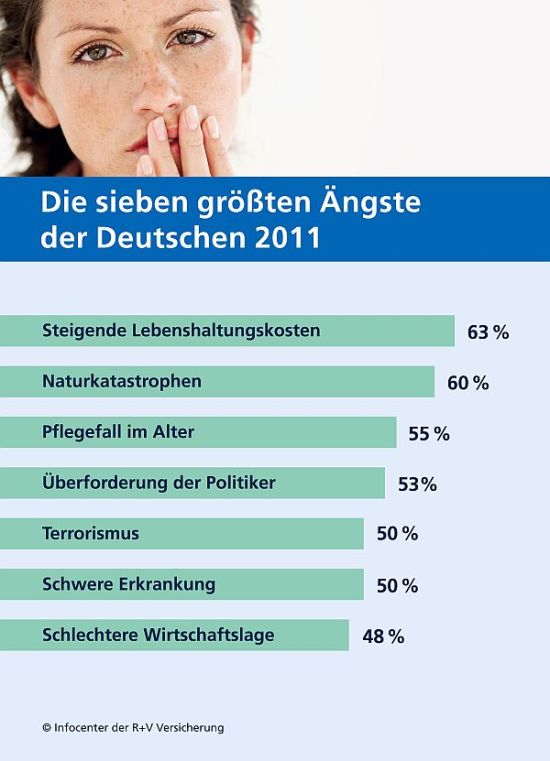
A new study from the R+V Insurance Company (hmmm, an insurance company) indicates that Germans have a whole new list of things to scare the Hosen off them that they didn’t have last year. Is there a pattern developing here or something?

Some of this year’s top favorites (so far) are ecological catastrophes (a perennial hit), the “super worst case scenario” that took place after the earthquake in Japan, the so-called EHEC scandal (go organic sprouts!) and those bloody and yucky revolts still going on down there in the Arabian World.

But what really scares them most is, well, their money. Or the thought of losing it, I should say. Along with their fear of rising energy costs (hmmm, where might those rising energy costs be coming from?), over 70 percent of Germans asked are scared to death of the imminent bankruptcy of a few of them there EU countries down south which will cost the German taxpayer dearly.

Hey. No angst, no fun.

70 Prozent der Deutschen befürchten, dass die drohende Pleite einiger EU-Länder den deutschen Steuerzahler teuer zu stehen kommt – keine Angst erreichte 2011 höhere Werte.

Two Speeds for Saving Europe: Slow and Slower

Breaking up is hard to do. But it’s about freakin’ time already, don’t you think?

Now that it is becoming clearer and clearer that the euro crisis is not going to get fixed with the institutions at hand and the will that isn’t, Chancellor Merkel HERSELF has finally had enough and appears ready to do the one thing that will finally make everyone out there happy: Create new institutions and a “two-speed Europe” that won’t work either, but still.

What this means is, uh, I’m not sure really (can someone out there please explain this plan to me?), but I think it means creating something called a “core Europe” (the countries that haven’t filed for bankruptcy yet) run by Germany and then a “rotten to the core Europe” (all the other loser countries that nobody wants anymore) run by nobody. I mean, running on empty.

This won’t really solve anything, of course, but it’s an elegant European way of tossing in the towel and passing the buck on to someone else, in this case someone with absolutely no accountability who nobody out there has ever even heard of before: European Council President Herman Van Rompuy.

Are we having late Roman decadence yet? This divide and conquer stuff, I mean divide and save, makes me wonder sometime.

Van Rompuy doesn’t seek the limelight and enjoys writing haikus about nature in his free time.

A New Currency Order

Are we having a Reichseuro yet?

“Conceived as a tool for integrating Germany into Europe, and preventing Germans from dominating others, it (the euro) has become the opposite.”

Germany’s neighbors and allies are growing increasingly concerned about Berlin’s foreign policy direction. Some even fear that efforts to export its fiscal ideas could mean the prosperous country has lost sight of the European idea. Or worse yet, that it wants to dominate the currency union.

You will save until it hurts, I tell you! Sign ze papers old man!