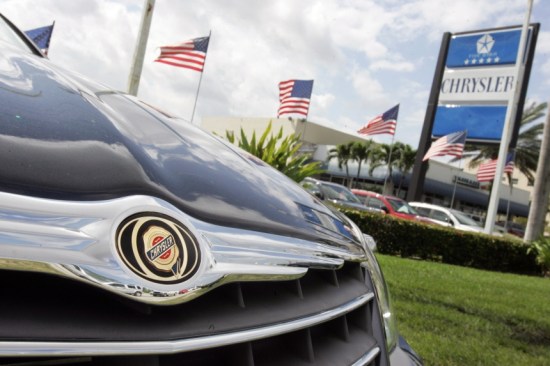
Germans Won’t Buy The Right Gasoline

Actually, it’s the left gasoline, but still.

Strange, isn’t it? On the one hand, you probably won’t be able to find a nation more vocal when it comes to saving the environment and/or planet than Germany. On the other hand, it would be hard to imagine a nation of car freaks more freakish about their big German cars than Germans are (the dirtiest in Europe – the cars not the drivers).

Anyways, car freaks everywhere in Germany have united and are absolutely positively refusing to buy the latest thing that is good for them, an “organic” fuel called E10 that contains 10 percent ethanol. The reason? Rumor has it that this stuff can cause motor damage on some car models. Everybody’s buying super instead and now there’s a super shortage, which is anything but super.

I guess you have to ask yourself one question, punks: Your planet or your car? You know, kind of like that old Jack Benny gag where the armed thief asks “Your money or your life?” and Jack Benny won’t answer at first and finally replies “I’m thinking.”

Bisher sind die Autofahrer überwiegend nicht bereit, den neuen Bio-Kraftstoff E10 mit zehn Prozent Ethanol zu tanken.

Are these the sanctions you were talking about, Guido?

The issue of German exports is more complex. After the embargo was lifted, Germany’s arms business with Libya was quickly put back on track. German exports to Libya were worth €53 million in 2009, the third highest in Europe.

The Gadhafi regime has been blocking the mobile phone and GPS networks in Libya for days — possibly with the help of German technology — to prevent protesters from being able to communicate with each other.

And there is also controversy over the radar technology that Germany supplied to Libya to help it secure its borders. In 2010, the EU pledged to give the dictator €50 million so that Libya could prevent African refugees from reaching Europe’s coasts. But this and other deals like it are now coming back to bite the EU.

“The situation in Libya illustrates the fundamental problem that the long-term effects of arms transfers are not taken into account.”

Germany Talks Tough To Gaddafi Now That He’s Gone

He is gone by now, right? No matter. Libya has left him so it comes down to the same thing.

After recently flying to Tehran to meet with Iran’s otherwise quite isolated president, Mr. Laugh-A-Minute Mahmoud Ahmadinejad–a condition made by the Iranians in order to secure the release of two German hostages–German foreign minster Guido Westerwelle wants the world to know that he can also be a real toughy too and has threatened the now irrelevant Libyan dictator Muammar Gaddafi with “sanctions” should the violence in Libya continue.

Well, if The Artist Formally Known As Gaddafi isn’t gone by now, the threat of German sanctions will certainly be the last straw that will break his camel’s back, right?

“We are still absolutely clear about the fact that the situation in Iran concerning human rights and political freedoms is unacceptably bad.”

Hot Dog It Another Baader-Meinhof Film!

The Berlinale is always good for a surprize. But it’s always the same one: No surprizes.

How original, sort of. Hopeless romantics that they are, politically correct Germans everywhere will be as enamored as they should be in this latest “political love story” about (with?) the RAF, “If Not Us, Who?”

Specifically, it’s about two fine young terrorists who fell in love, made love and then went on to become key figures in that wacky and fun-loving leftist group that carried out a bloody campaign of kidnappings and murders in the 1970s. You know, kind of like the Manson clan only, this being Germany, their madness was more political?

It’s a film that wants us to truly understand these folks with, I dunno, understanding, understanding how their political consciousness arose, with a special emphasis being placed on the conflict between the Nazi and postwar generations–an aspect that has never ever, ever been addressed here in this country before, ever, not once, honest. In other words, they were the victims (again).

Be sure to see it. It’s so… Political. And Romantic with a big R. If it doesn’t win the Golden Bear than… If not them, who?

The New Narrative

Ever read The Black Swan: The Impact of the Highly Improbable by Nassim Nicholas Taleb?

It covers a whole lot of stuff but what really interested me was his handling of history. It really struck a chord with me. History is basically a series of improbable and completely unpredictable events. There is no “flow” to it, at least not that we can recognize, we only see these periodic erruptions (kind of like earthquakes or sudden volcanic erruptions) that come out of nowhere and are therefore unforseeable.

What we then do, however (we are human and simply demand an explanation), is quickly assign them meaning, a new narrative in the broader narrative we had made up before. We don’t have an explanation but we pretend that we do. And THEN, strangest of all, we quickly delude ourselves into thinking that the given event was actually predictable, that the people who lived through it somehow knew it was going to happen, or should have.

Think 9/11, the fall of the Berlin Wall, Hitler, World War I, etc. Get the “flow” now?

Anyway, when it comes to Egypt, we’ve already passed the narrative stage and Egypt isn’t finished being Egypt yet.

Suddenly it seems everyone knew all along that President Mubarak was a villain and the US, who supported him until recently, was even worse.

Dumb Americans buying big cars again

But some of them aren’t all that dumb because they are the ones buying the big German ones. That’s the essence of the article anyway.

Inexplicable, really. German intellectuals everywhere are aghast at the United States failing to do what it is supposed to do yet again. Despite Der Spiegel‘s recent pronouncemnt of the end of US-Amerika as we know it (in black and white and color too), US-Amerikaner are suddenly buying big fat politically correct automobiles as if there were no tomorrow.

Or maybe that is the explanation. Perhaps this is our last collective gasp as a nation before the whole culture (excuse me, I meant lack of culture) implodes with a tremendous groan and rolls over to die, I dunno, in Nevada or someplace. Everybody must sense instinctively that this will be our last chance to drive off into the sunset of our American oblivion in our monstrous ‘merican automobiles in hyper-heroic, High Noon style.

Or maybe… Maybe the experts at Der Spiegel (and experts in general) are just too stupid to poor piss out of a boot.

Der Autoabsatz in den USA boomt.

“The United States of Hate”

This is the seventh article like this I’ve seen just today. I guess they’re going to be milking this one for the next week or two at least.

“In the crosshairs of hate,” “rightwing preachers of hate,” “Sarah Palin in particular has been taking aim at her,” blah, blah, blah.

I find this obsessive need to politicize a tragedy like this beneath contempt.

This is all too Kindergarten for me, in other words–only kids in kindergarden behave better. I’m taking a few days off.

“Hier tobt der hysterische Kampf zwischen Rechts und Links besonders heftig.”

What do Mark Twain and Germany have in common?

I dunno. Mark Twain liked that awful German language, I guess. And of course the German language has often been “sanitized” in the past, just like Mark Twain’s English is getting sanitized right now.

This makes me angry. And sad. Because, well, it’s so sad. And the people doing it are so clueless. Or, worse still, they are perfectly aware of what they are doing.

Just in case you might care, here are some thoughts on Politically Correct English from David Foster Wallace that I, for one, find very interesting indeed:

“Traditionally, Prescriptivists tend to be political conservatives and Descriptivists tend to be liberals. But today’s most powerful influence on the norms of public English is actually a stern and exacting form of liberal Presciptivism. I refer to Politically Correct English (PCE).”

“The same ideological principles that informed the original Descriptivist revolution–namely, the rejections of traditional authority (born of Vietnam) and of traditional inequality (born of the civil rights movement)–have now actually produced a far more inflexible Prescriptivism, one largely unencumbered by tradition or complexity and backed by the threat of real-world sanctions (termination, litigation) for those who fail to conform.”

“PCE’s various pre- and proscriptions are taken very seriously indeed by colleges and corporations and government agencies, whose institutional dialects now evolve under the beady scrutiny of a whole new kind of Language Police.”

“PCE is not just silly but ideologically confused and harmful to its own cause.”

“PCE’s core fallacy is that a society’s mode of expression is productive of its attitudes rather than a product of these attitudes.”

“PCE purports to be the dialect of progressive reform but is in fact–in its Orwellian substitution of the euphemisms of social equality for social equality itself–of vastly more help to conservatives and the US status quo than traditional prescriptions ever were.”

If interested, take a look at Authority And American Usage (pages 110 and 111 or thereabout) in Consider The Lobster.

“Many thinkers and bloggers are understandably aghast at this Ministry of Truth-style fiddling with a classic text.”