German of the day: “mach den Biden”

That means to do the Biden. To a politician.

To toss him out, in other words.

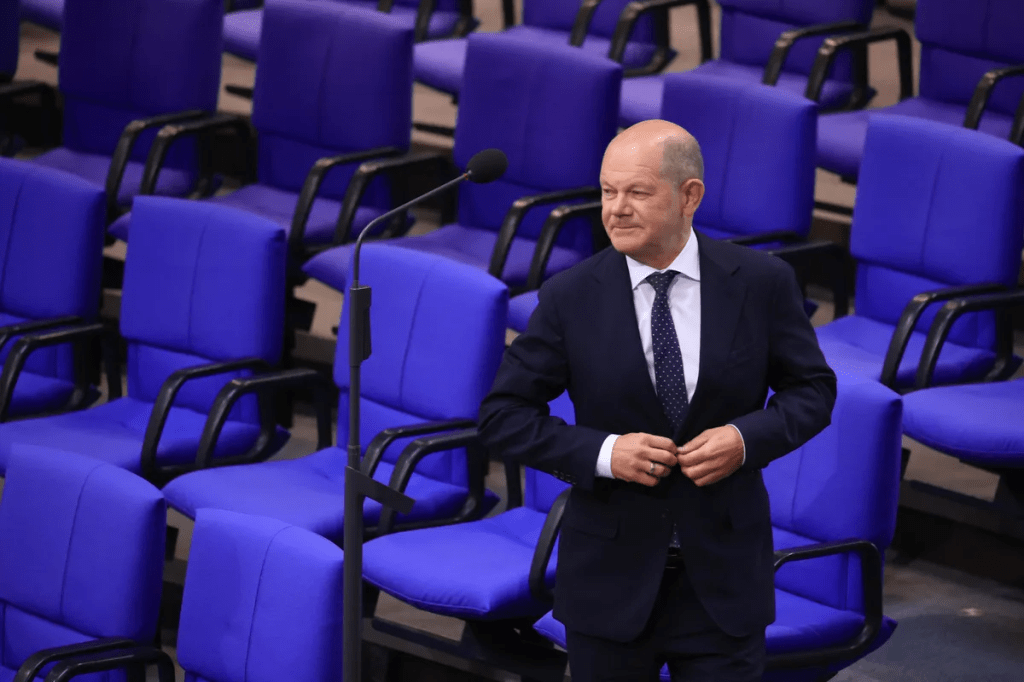
Germany’s Scholz risks Biden’s fate – If the chancellor’s SPD party loses a crucial regional election to the far right on Sunday, it could lead to his ouster from the top spot.

As German Chancellor Olaf Scholz attends the U.N. General Assembly in New York on Sunday, his political future will likely be decided at home in a regional election 6,000 kilometers away.

One more defeat at the hands of the far right this weekend will almost certainly spell the end, and Scholz could very well share the fate of U.S. President Joe Biden — thrust aside by his panicking party to make way for a candidate who can avoid a massacre in a national election next year.

German arms exporters suddenly worried about “humanitarian law”

Silly me. I thought that was the only kind of law there was.

Germany has stopped approving war weapons exports to Israel, source says – Germany has put a hold on new exports of weapons of war to Israel while it deals with legal challenges, according to a Reuters analysis of data and a source close to the Economy Ministry.

A source close to the ministry cited a senior government official as saying it had stopped work on approving export licences for arms to Israel due to legal and political pressure from legal cases arguing that such exports from Germany breached humanitarian law.

German of the day: Stichproben

That means spot checks or spot controls.

German police reintroduce spot controls at all borders – Germany is reintroducing border checks at all its borders for at least six months. The aim is to help restrict migration.

Checks are being temporarily reintroduced at Germany’s borders with France, Belgium, Luxembourg, the Netherlands and Denmark. They are due to run until March 15, 2025. Such controls have already become part of daily life at the borders with Poland, the Czech Republic, Austria and Switzerland.

Temporarily? We’ll see about that.

German of the day: LAF

That stands for Landesamt für Flüchtlingsangelegenheiten Berlin. And that stands for Berlin’s State Office for Refugee Affairs.

And it’s a been a LAF a minute over at the LAF these days, having now run out of room to house the growing number of refugees.

Berlin plans new mass accommodation for refugees – Immigration has become a hot-button issue in Germany. Refugee accommodation centers in Berlin are full to overflowing, but there’s a desperate lack of housing. Now, authorities are coming up with bright ideas…

Over 30,000 refugees in Berlin are living in accommodation facilities run by the LAF. Many have already had their asylum claims approved but are stuck in state-run facilities because they can’t find affordable accommodation on the capital’s fiercely competitive real estate market.

Irregularity

And it shows.

Germany steps up controls at borders in response to ‘irregular migration’ – New regulations come into force next week following spate of suspected Islamist attacks.

Germany’s interior minister has announced that controls at all of the country’s land borders are to be stepped up in an attempt to confront what it called “irregular migration” after a recent spate of suspected Islamist attacks.

The new regulations are due to start next Monday and to be in place for an initial six months, before being reviewed, Nancy Faeser (SPD) said in a statement.

The move comes after Alternative für Deutschland (AfD), campaigning heavily against migration, this month became the first far-right political party since the Nazi era to win a state election in Germany. It comes ahead of a second round of emergency talks on migration policy due to be held on Tuesday in Berlin between the coalition government, opposition parties and federal states.

The Stasi wasn’t all bad

They were good at secret house searches, for instance.

Will German police get to do secret house searches?

Germany’s Federal Criminal Police Office wants to secretly break into homes as part of anti-terrorism measures. That is currently prohibited, but the interior minister has far-reaching plans.

At first glance, Interior Minister Nancy Faeser’s (SPD) proposal is reminiscent of a method practiced by the “the Stasi,” the Ministry for State Security of the former communist East Germany, whose secret police infiltrated the homes of suspected regime opponents in order to tap their phones.

At second glance too.

Let’s not jump to conclusions

He’s just a suspect for now.

Just because he was already known to Austrian authorities as an Islamist and purchased his weapon illegally the day before in Salzburg and his shooting rampage in Munich occurred on the anniversary of the Palestinian terror attack at the 1972 Munich Olympics in which 11 Israeli athletes were murdered and in the immediate vicinity of the Israeli consulate doesn’t really mean that he was a real Islamist terrorist or anything. Let’s wait until all the facts are in.

German police kill suspected Islamist gunman in shootout near Israeli consulate – German police shot dead an Austrian suspected Islamist gunman in Munich on Thursday in an exchange of fire close to the Israeli consulate, prompting politicians to stress the importance of protecting Israeli sites in the country.

Help me Rwanda

Help, help me Rwanda.

Help me Rwanda yeah. It’s time for them to depart!

Germany: Migration commissioner proposes Rwanda deportations – Joachim Stamp accused Russia and Belarus of encouraging migration to the EU as part of their “hybrid warfare.” These migrants should be sent to a third country such as Rwanda, he suggested.

Last one out turn off the lights

Oh, sorry. Green energy already turned the lights off for you.

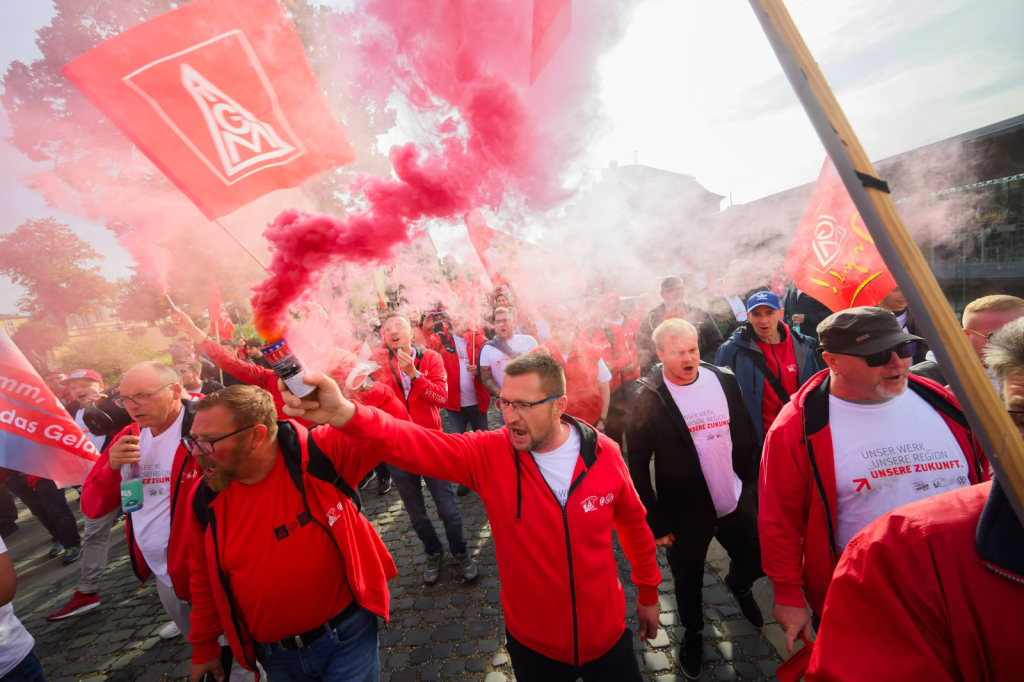
Germany in crisis: Intel and Volkswagen mull a multibillion-dollar withdrawal from the country.

For the first time in its 87-year history, Volkswagen is considering shutting down plants in Germany, where it employs around 300,000 people, as the company ramps up efforts to save €10 billion in costs…

Reuters reports that Intel will consider pausing or halting plans for its €30 billion ($33 billion) factory in the east German city of Magdeburg as the semiconductor manufacturer looks for cost savings. Germany had committed €9.9 billion ($10.9 billion) to the project when it was announced in June last year.

It’s kind of like the 80-20 rule

Only different.

Whereas with the 80-20 Rule (aka Pareto Principle) 80% of a company’s revenue is generated by 20% of its customers, when it comes to German elections, 80% of voters are very conservative regarding certain issues (“irregular” migration, for instance) but are ruled by 20% of those who aren’t.

German government reeling after state election defeats – The results of state elections in Saxony and Thuringia are disastrous for the parties that make up Germany’s coalition government. What will be the nationwide consequences from the regional votes?