Time to say goodbye?

“Lieber ein Ende mit Schrecken als ein Schrecken ohne Ende.”

“Better to have an end with fright than fright without end.”

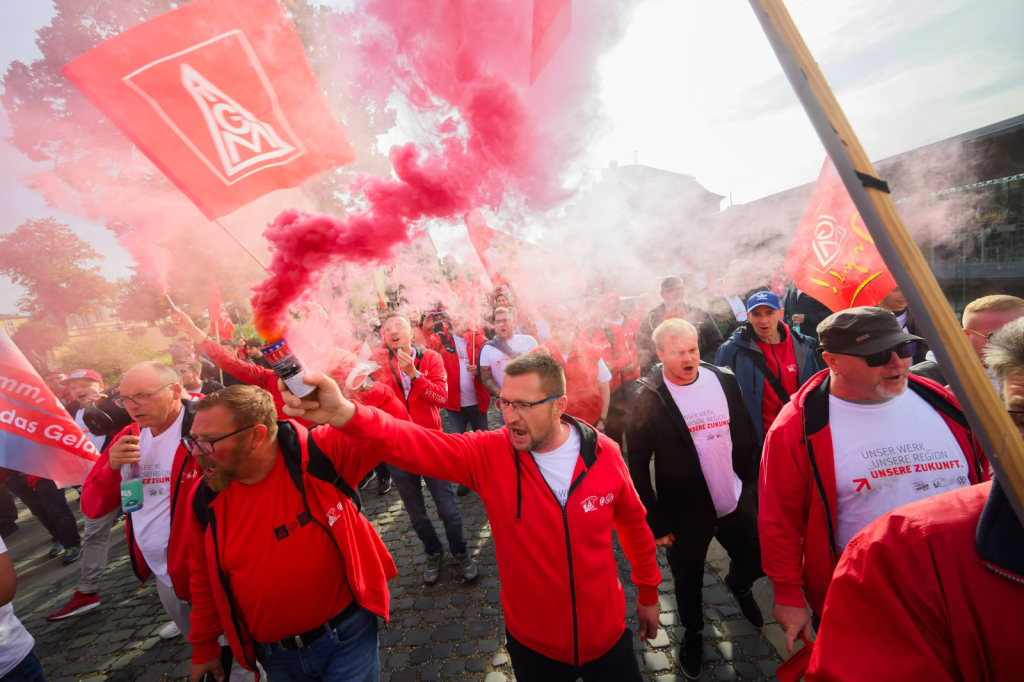
Migrants say Germany’s ‘welcome culture’ has soured as far-right parties rise – On Sunday, voters in the eastern German state of Brandenburg will vote for a new regional parliament. The anti-migrant far-right Alternative for Germany, or AfD, could win the most votes. On 1 September the AfD won a major German election for the first time, coming first in the eastern state of Thuringia. In Brandenburg polls show the AfD leading with 28%.

To undermine support for the AfD, Chancellor Olaf Scholz’s left wing-led government on Monday introduced checks for migrants on all of Germany’s borders. He also wants to increase deportations of people whose application for asylum is unsuccessful. Opposition conservatives meanwhile want the borders closed to asylum seekers altogether.

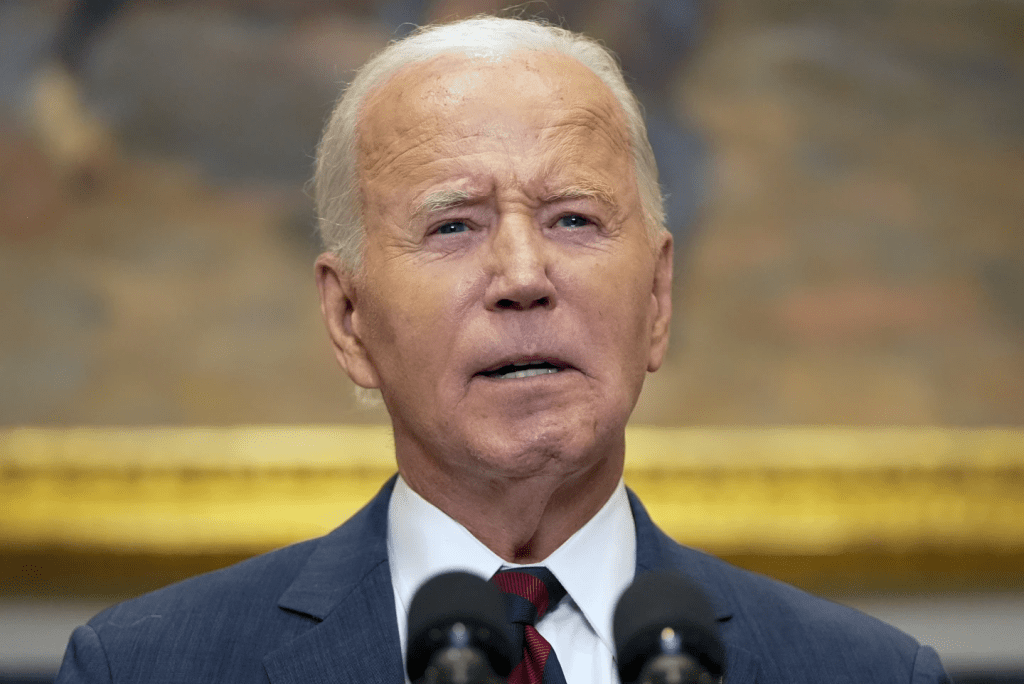
German of the day: “mach den Biden”

That means to do the Biden. To a politician.

To toss him out, in other words.

Germany’s Scholz risks Biden’s fate – If the chancellor’s SPD party loses a crucial regional election to the far right on Sunday, it could lead to his ouster from the top spot.

As German Chancellor Olaf Scholz attends the U.N. General Assembly in New York on Sunday, his political future will likely be decided at home in a regional election 6,000 kilometers away.

One more defeat at the hands of the far right this weekend will almost certainly spell the end, and Scholz could very well share the fate of U.S. President Joe Biden — thrust aside by his panicking party to make way for a candidate who can avoid a massacre in a national election next year.

German arms exporters suddenly worried about “humanitarian law”

Silly me. I thought that was the only kind of law there was.

Germany has stopped approving war weapons exports to Israel, source says – Germany has put a hold on new exports of weapons of war to Israel while it deals with legal challenges, according to a Reuters analysis of data and a source close to the Economy Ministry.

A source close to the ministry cited a senior government official as saying it had stopped work on approving export licences for arms to Israel due to legal and political pressure from legal cases arguing that such exports from Germany breached humanitarian law.

German of the day: Stichproben

That means spot checks or spot controls.

German police reintroduce spot controls at all borders – Germany is reintroducing border checks at all its borders for at least six months. The aim is to help restrict migration.

Checks are being temporarily reintroduced at Germany’s borders with France, Belgium, Luxembourg, the Netherlands and Denmark. They are due to run until March 15, 2025. Such controls have already become part of daily life at the borders with Poland, the Czech Republic, Austria and Switzerland.

Temporarily? We’ll see about that.

German of the day: Auf Eis legen

That means to put on ice. As in put on hold.

Intel postpones construction of chip factory in Magdeburg – Haseloff against abandonment of the project.

The chip company Intel has put its plans to build a factory in Magdeburg on hold. According to company boss Gelsinger, construction will probably be delayed by two years due to cost-cutting measures. A total of 3,000 direct jobs were to be created on Magdeburg’s Eulenberg. Saxony-Anhalt’s state government assures that the semiconductor plant will nevertheless go ahead.

Or not.

German of the day: Abfallwirtschaft

That means waste management.

And some waste managers really mean business over here.

A work of art by the “Sprayer of Zurich” at the Museum Church of St. Cecilia in Cologne has already been restored once. Now the spray-painted skeleton by Harald Naegeli has to be renewed once again – because workers overdid it with the cleaning.

German of the day: Sprengung

That means blasting, the blasting or demolition of.

Another section of the Carola Bridge in Dresden collapsed during demolition work on Friday night.

It is the section of the bridge near the riverbank that had already collapsed into the Elbe on Wednesday night, according to a police spokesperson in the morning. Streetcar tracks and a cycle and footpath run over the so-called bridge span. It had collapsed over a length of around 100 meters. Two other bridge sections (A and B), including lanes for cars, are still standing.

German of the day: LAF

That stands for Landesamt für Flüchtlingsangelegenheiten Berlin. And that stands for Berlin’s State Office for Refugee Affairs.

And it’s a been a LAF a minute over at the LAF these days, having now run out of room to house the growing number of refugees.

Berlin plans new mass accommodation for refugees – Immigration has become a hot-button issue in Germany. Refugee accommodation centers in Berlin are full to overflowing, but there’s a desperate lack of housing. Now, authorities are coming up with bright ideas…

Over 30,000 refugees in Berlin are living in accommodation facilities run by the LAF. Many have already had their asylum claims approved but are stuck in state-run facilities because they can’t find affordable accommodation on the capital’s fiercely competitive real estate market.

Irregularity

And it shows.

Germany steps up controls at borders in response to ‘irregular migration’ – New regulations come into force next week following spate of suspected Islamist attacks.

Germany’s interior minister has announced that controls at all of the country’s land borders are to be stepped up in an attempt to confront what it called “irregular migration” after a recent spate of suspected Islamist attacks.

The new regulations are due to start next Monday and to be in place for an initial six months, before being reviewed, Nancy Faeser (SPD) said in a statement.

The move comes after Alternative für Deutschland (AfD), campaigning heavily against migration, this month became the first far-right political party since the Nazi era to win a state election in Germany. It comes ahead of a second round of emergency talks on migration policy due to be held on Tuesday in Berlin between the coalition government, opposition parties and federal states.