And this one was hard to believe. And hard to follow.
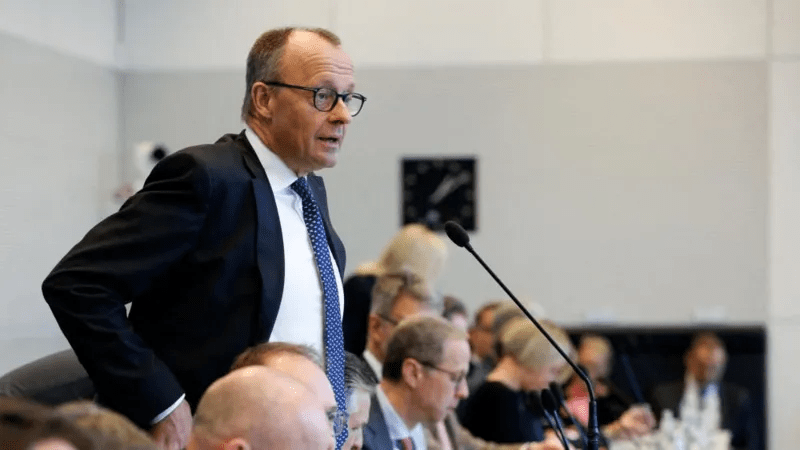
Germany’s Merz becomes chancellor after surviving historic vote failure – Conservative leader Friedrich Merz has won a parliament vote to become Germany’s next chancellor at the second attempt.
Merz had initially fallen six votes short of the absolute majority he needed on Tuesday morning – a significant blow to his prestige and an unprecedented failure in post-war German history.
As it was a secret ballot in the 630-seat Bundestag, there was no indication who had refused to back him – whether MPs from his centre-left coalition partner or his own conservatives.
Most Germans Have Had Enough of the Firewall Against AfD – While establishment parties continue to ostracize the party, only a third of the country supports the cordon sanitaire, with half wanting AfD to be treated as any other democratic party.
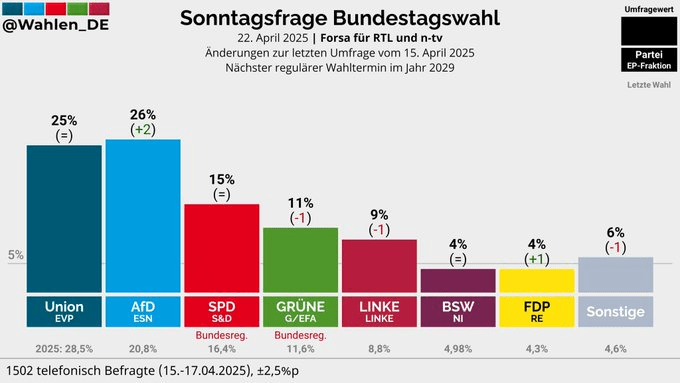
After a turbulent election season dominated by the establishment’s demonization of the national conservative AfD—now Germany’s most popular party—the plurality of Germans believe that ending the undemocratic cordon sanitaire against them is long overdue, regardless of who they vote for.
Germany is not back. And it won’t be coming back until its politicians respect the will of the German electorate. This is not the government Germans voted for.
Germany is back, says Merz after historic spending deal – Germany’s conservative leader, Friedrich Merz, has clinched an enormous financial package to revamp defence and infrastructure, ahead of a crunch vote in parliament next Tuesday.
Merz, who aims to lead a government with the Social Democrats in the coming weeks, is in a rush to push through a big boost in spending on defence and creaking infrastructure…
“This is nothing less than a financial coup.”
PS: And who says they have the votes to push this through next Tuesday?
So we can’t have that vote of confidence and early election you voters want. Even though our government doesn’t have a majority anymore and is more non-functioning than ever. Sorry, fellow citizens. It’s out of our hands.
Geez. These German SPD guys would make good Democrats.
Germany: Paper questions punctuate election date debate – As lawmakers jostle over the timing of a vote of confidence after Germany’s coalition collapse, preparations are already being made for a snap election. Officials have warned of logistical issues with ballot printing.
I’m at least as popular here as Nicolás Maduro is in Venezuela.
German opposition parties and business groups on Thursday urged Chancellor Olaf Scholz to trigger a new election quickly to minimize political uncertainty after his rocky three-way coalition collapsed…
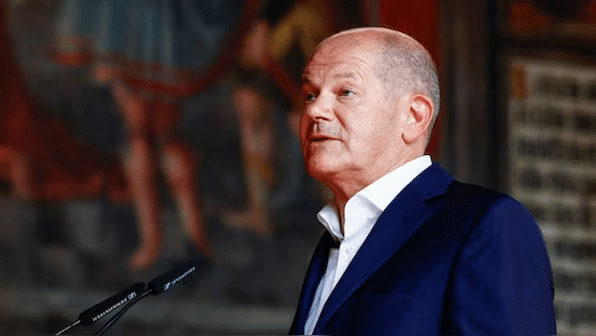
The chancellor said he would hold a confidence vote in January, which he would probably lose, triggering a new election by the end of March — six months ahead of schedule.
Germany’s loveless coalition teeters on brink of break-up – Chancellor Olaf Scholz snubs partners, fuelling speculation of early elections in spring.
Chancellor Olaf Scholz held a much-vaunted “industrial summit” on Tuesday, sitting down with business leaders and union bosses to figure out how to pull Germany out its current malaise. Pointedly left off the guest list: his own finance and economy ministers.
Robert Habeck, the economy minister, responded by unveiling plans for a multibillion-euro, debt-financed investment fund — an idea not previously discussed with cabinet colleagues — while finance minister Christian Lindner simply scheduled his own, rival business summit on the same day…
Speculation is growing in Berlin that the alliance could soon collapse, pulled apart by its own internal contradictions. Several German media outlets have even named a possible date for snap elections — March 9, more than six months ahead of schedule.
I know, it doesn’t ryhme as well as with “woke” but it’s OK. They’re woke too.
We’ll see for how much longer, though.
Nearly two-thirds of Germans want new government, poll says – A survey shows nearly two-thirds of voters want to pull the plug on Germany’s ruling coalition. The poll comes immediately after figures that show most Germans are unhappy with Chancellor Olaf Scholz and his government.
As many as 64% of Germans who answered in the survey released on Saturday said a change of government would make the country a better place…
Pollsters also asked about the so-called “traffic light” coalition of center-left Social Democrats (SPD), the Greens, and the neoliberal Free Democrats (FDP). Voters were asked how it measured up against Chancellor Angela Merkel’s “Grand Coalition” of conservative Christian Democrats/Christian Socialists (CDU/CSU) and the SPD.
Sidelined Greens lose faith in the German coalition – Governing partners accuse each other of ‘crowbar’ politics and ‘exploiting social qualms’
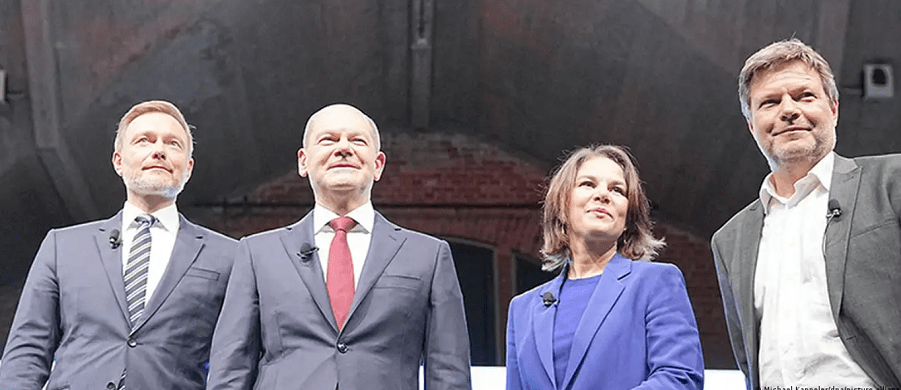
The German Greens once thought they were in the driving seat of Olaf Scholz’s coalition. Some now feel like back-seat passengers on a political road to nowhere.
“There’s a lot of frustration,” said Rasmus Andresen, a Green member of the European parliament. “This coalition promised progress and a fresh start, but, to be honest, I don’t see much evidence of that now.”
The source of their anger is the series of painful concessions forced on them late last month by their coalition partners, Scholz’s Social Democrats and the liberal FDP, which dismayed senior Green leaders and enraged the party’s rank and file.
Scholz is for many Greens the cause of their plight. They once saw him as a natural ally — he had, after all, campaigned at the last election to become Germany’s “climate chancellor”. But these days they increasingly see him as an obstacle, ready to sell out Green interests for the sake of political peace.
“Scholz has sided with the FDP,” said Reinhard Bütikofer, another Green MEP. “The FDP and SPD obviously decided they could score political points by exploiting social qualms about climate policy. But that’s populism.”
That means “blockade politics” or conducting a policy of obstruction.
Geez. The EU is getting really frustrated with Germany these days because it still acts as if it were a sovereign country from time to time.
Germany Is Becoming a Roadblock for More and More EU Business – Row over combustion-engine ban symptomatic of wider problem, Conduct seen as especially unhelpful during period of upheaval.
The unpredictable behavior of Germany’s ruling coalition is becoming a disruptive influence in Europe and raising hackles across the continent.
A last-ditch move this month to block a European Union push to phase out combustion-engine vehicles was only the latest example. On issues ranging from financial aid for Ukraine to reform of state-aid and budget rules, Germany’s EU partners and officials in Brussels have become increasingly frustrated with Chancellor Olaf Scholz’s center—left alliance of his Social Democrats, the Greens and the business-friendly Free Democrats.
It seems pretty clear to me who the next German Finance Minister will be.
Their boss, Christian Linder, will get the job. If he doesn’t, it won’t come to this odd coalition of SPD, Greens and FDP.
Lindner and the FDP stand for low taxes, debt limitation and a hard line towards Germany’s European partners. The climate crisis is to be addressed by private investment and carbon pricing. The Greens, by contrast, have put climate first – and for that reason advocate large-scale investment, lifting Germany’s “debt brake”, and a pro-European policy that continues the steps taken in 2020 towards common, debt-financed investment policy. It is precisely in these policy areas – where the differences between the Greens (and the SPD) and the FDP are greatest – that the finance ministry is critical.





 Observing Hermann