No One Can Explain German Power Grid Instability

But as far as I can tell, it seems to have begun sometime shortly after the Fukushima nuclear disaster in Japan.
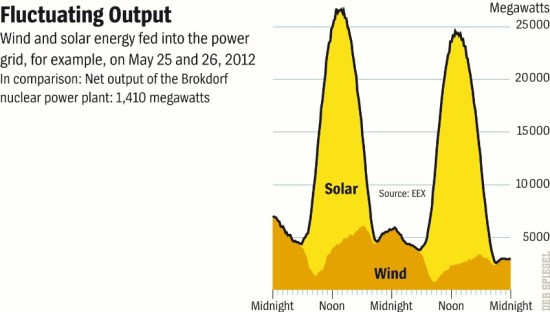
Sudden fluctuations in Germany’s power grid are causing major damage to a number of industrial companies. While many of them have responded by getting their own power generators and regulators to help minimize the risks, they warn that companies might be forced to leave if the government doesn’t deal with the issues fast…

The problem is that wind and solar farms just don’t deliver the same amount of continuous electricity compared with nuclear and gas-fired power plants. To match traditional energy sources, grid operators must be able to exactly predict how strong the wind will blow or the sun will shine.

“Every company — from small businesses to companies listed on the DAX — are buying one (APC emergency power generators) from us.” 

Clean Power Cleaning Us Out

The German textile industry, among others, is mad as hell and isn’t going to take it anymore. Not when it comes to having to pay billions into the governments way cool Ökoenergie-Förderung (clean energy surcharge = tax).

That is why three companies now plan to challenge this surcharge subsidizing renewable energy in court.

More good government in action again, I guess. Energy companies have to pay the price for electricity generated through renewable technologies, and transfer the extra cost on to their customers. While energy-intensive industries like aluminum or steel are free from the surcharge, most of the textile industry has to pay.

“You cannot get an energy turnaround for free.”

Germany Confused About Japan’s “Retreat” From A Nuclear-Free Future

And here we thought that Germans were good at math.

Until Fukushima, Japan satisfied about 30 percent of its electricity demands with nuclear power, while renewable energy made up about 10 percent of the power supply. If one leaves out hydroelectric power, renewables hardly make up more than 1 percent.

“Japan needs a vision.”

We Must Save The World But It Must Be Affordable

Cheap, in other words.

Germans everywhere are slowly waking up to the fact that their revolutionary switch to renewable energy sources is going to cost way too way much more than they ever thought they would ever have to pay – and the German government has now woken up to this.

That is why they have now begun a quiet backpedaling policy designed to prepare the German population for a slow turnaround from the energy turnaround that hasn’t even begun to turn around yet.

“For me it’s a priority that electricity remains affordable,” Germany’s new Environment Minister Peter Altmaier says, for instance.

He also says he doubts that Germany will be able to reach its goal of introducing one million electric cars by 2020.

Nor does he think that Germany will be able to cut its energy consumption by 10 percent that year, a precondition for reaching the illusory goal of 35 percent renewables the government is still aiming for, sort of.

This is the German Environment Minister talking here, folks. So you get the message, don’t you? And if you don’t get it now, you’ll get it later.

Regierung fürchtet die Strompreis-Wut der Wähler

German Ecological Energy Turnaround Working!

As long as power plants that burn fossil fuels remain in operation, that is.

The Federal Network Agency warns that if ecologically questionable coal-fired power stations do not stay in operation, the German power grid will crash. Especially in Southern German “assured capacities” are missing.

Power stations old as dirt (and at least as dirty), ready to be shut down due to the high environmental pollution they cause, will have to remain in operation.

Details, details. The main thing is that Germany’s ideologically-fired power elite stay in power long enough to keep that visionary progress of theirs a comin’.

Die ökologische Energiewende in Deutschland scheint ohne umweltschädliche fossile Kraftwerke nicht zu funktionieren.

German Offshore Wind Farms More Deadly Than Fukushima

Nobody promised the Germans a rose garden when the so-called “energy turnaround” turned around the corner here last year.

So that’s why the three deaths and 80 serious accidents that have taken place so far while building Germany’s so badly needed offshore wind farms are being registered here with such stoic equanimity (or are being ignored altogether). Progress must march on or something. Keine Widerrede (no talking back)!

Do me a favor and wake me once this energy turnaround nonsense has finally turned around (as in over) and died itself.

Der Leiter des Havariekommandos in Cuxhaven, Hans-Werner Monsees, forderte gegenüber FOCUS ein „besseres und dichteres Rettungssystem“. Sonst drohe die Zahl der Toten und Schwerverletzten weiter zu steigen – in den nächsten Jahren werden bis zu 7000 Windräder vor der deutschen Küste installiert.

Unterdeckungen

That’s German for deficient coverage. And German readers might be reading that word a lot in the weeks to come, at least when it comes to the electricity supply in Germany.

„We have been observing for weeks now that something with the system just doesn’t seem to be right,” one market expert said.

And in a letter from Germany’s Federal Network Agency to the power traders it deals with, it makes clear its concern about the rather volitile situation going on at the moment and has even warned of the collapse of the German power network. It almost happened on Febuary 6, already, they wrote, as “substantial undercoverage continuing over several hours” nearly brought the system to its knees.

Hmmm. Last year at this time, during one of the coldest winters ever, there wasn’t any problem with the German electricity supply at all. What on earth could have possibly happened since then and now to have caused this disturbing situation?

Nach dem Reuters vorliegenden Schreiben stand das Stromnetz in den vergangenen Tagen mehrfach vor dem Kollaps.

Not One, Not Two…

But three films about Fukushima are being shown this year at the Berlinale.

That was to be expected, I guess. Especially now since Fukushima hysteria has all but disappeared from the Bildfläche (screen), even here in Germany.

It’s hard to keep people scared for months on end, now matter how important you think your agenda is. They just get tired and want to move on with their lives. The latest media stunt I just barely heard about had a lot of potential, for a few minutes, but then it rolled over and died, too.

I am looking forward to the big one-year anniversary media terror show bombardment to be held here in Germany next month, of course. But what are they going to be able to scare us with then? The German nation threatening to shut down all it’s nuclear power plants? Been there, done that. It makes you wonder sometimes why they even take the trouble to keep on agitating at us like they do. Now that the war is over and all, I mean. There’s just no place else to agitate at the moment, I guess (thanks for nothing, “Occupy Movement”). It must be hard being progressive sometimes. Much less all the time.

The 11-day film festival, which prides itself on its generally edgier and more politically-overt line-up over other film showcases, was perhaps a fitting backdrop for the documentaries.

Phase Out vs. Cash In

“Fukushima changed my attitude towards nuclear energy,” she said.

Now, though, it would appear that German industry is relying on government assistance to pursue the construction of nuclear power plants abroad.

Four applications for government export guarantees on nuclear power plant projects are currently under consideration. Known as Hermes guarantees, the program protects German companies from non-payment on overseas deals. The four projects are located in Finland, Great Britain, China and India.

“The nuclear phaseout must also apply to export guarantees.”

Germans Puzzled By Rising Electricity Prices

They are also puzzled about the increased number of “mini-blackouts” taking place across the land.

And no one can properly explain these mysterious phenomena, although the Internet portal Verivox gave it a halfhearted try: The increased share in the costs for renewable energy and the ten percent wholesale energy price increase which resulted after the shutdown of eight nuclear power plants this sommer are responsible.

To be fair, electricity prices rise here very year. To be unfair, most German media and the poltical elite refuse to admit that the price increases now taking place are a direct result of their hysterical nuclear phase-out Aktionismus (politicking).

Als Grund gab Verivox die gestiegene Umlage für die erneuerbaren Energien sowie die Erhöhung der Großhandelspreise an, die für rund 15 Euro Mehrkosten im Jahr verantwortlich sein werden. Die Großhandelspreise waren nach der Abschaltung von acht deutschen Atomkraftwerken im Sommer um rund zehn Prozent nach oben geschossen.