German of the day: Veteranentag

That means Veterans Day.

Germany’s first since, well, ever. Breaking taboos is hard to do.

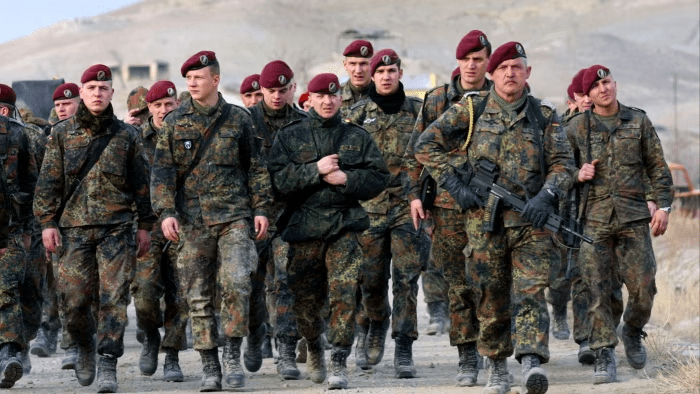
Germany will hold its first celebration of veterans since the second world war on Sunday, as the nation recalibrates its complex relationship with the armed forces in the wake of Russia’s invasion of Ukraine. Germany breaks taboo with first celebration of veterans since second world war

Russian aggression in Ukraine has helped drive a historic shift in attitudes towards military.

Defence minister Boris Pistorius will join current and former soldiers and members of the public taking part in a day of events across the country — including at a “veterans’ village” constructed in front of the Reichstag in Berlin.

It marks a historic shift in a nation where anything that could be viewed as a display of militarism was for years seen as taboo.

German Of The Day: Vertrauensfrage

That means a question of trust – or a vote of confidence.

Happy German Unification Day or something.

Democracy thrives on trust. But especially in eastern Germany, this trust is dwindling – in politics, in the state. Why?

And it’s better in western Germany? Not really.

Only 39 percent of East Germans are satisfied with democracy as it functions in Germany. In the west, the figure is 59 percent. In the east, only about 32 percent believe that politicians care about the good of the country. In the west, the figure is 42 percent.

Official Holiday In Berlin – “What Are We Celebrating On May 8?”

Officially, it’s the 75th anniversary of the city’s “liberation” (Befreiung) as World War II ended. They couldn’t call it “Boy Did We Ever Get Our Ass Kicked Day,” I suppose.

Liberation

Or  maybe you could say it’s a day to commemorate the biggest daylight savings time reset ever. It’s when all the clocks in Germany were set to “zero hour.”

May 8, 1945, was ‘zero hour’ for Germany in multiple ways – Adolf Hitler was merely ash among the rubble when World War II ended in Europe. The desolate aftermath was dubbed “zero hour” by Germans — a more prescient term than they realized, for it also paved the way to rebirth.

Feiertag in Berlin – Was feiern wir am 8. Mai?

Happy Potato Day

Just in case you didn’t know, Germans have this thing with patatoes. That’s why a group of German agi-taters lobbied to make August 19 Potato Day.

Potato

I guess that makes the rest of us speck-taters.

Not that I’m complaining or anything, I’m just a commen-tater, folks.

The Germans’ insatiable love affair with potatoes – They were once guarded by the king and are sometimes eaten with apple sauce. For Potato Day on August 19, here are some things you maybe didn’t know about potatoes in Germany…

By the way, how can you tell how fast a German potato is going? Check its spud-ometer.

German Of The Day: Andere Länder Andere Sitten

That means other countries other customs.

Vatertag

Finally, a holiday for the rest of us.

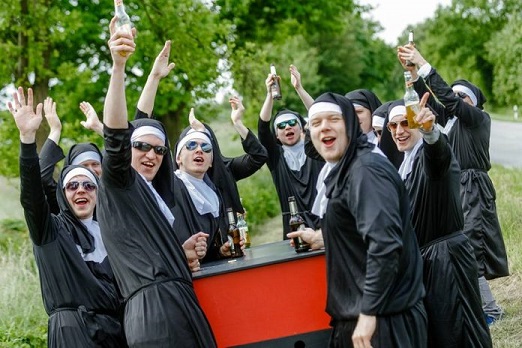
German Oddity 391. Only in Germany is Vatertag or Father’s Day commemorated by hordes of oddly dressed men pulling little wooden wagons overloaded with beer and snaps through wooded areas (or right through the middle of your town) roaring and swearing and pissing all over the place until they vomit on themselves and pass out but not before having called their wives to pick them up and drag them back home again.

https://www.youtube.com/watch?v=aokhLhZqXBc

German Of The Day: Bollerwagen

That means handcarts. Handcarts filled with beer.

Booze

And if a handcart isn’t available on German Father’s Day (Ascension Day) then you can always use a baby buggy or a shopping cart to put your booze in.

https://www.youtube.com/watch?v=aokhLhZqXBc

Es ist kompliziert. Warum aus Christi Himmelfahrt auch der Vater- und Herrentag geworden ist, lässt sich nicht mehr so recht nachvollziehen. Es wird spekuliert, dass die Prozession der Jünger Jesu zu einem Berg als Vorbild für die Männer mit Bollerwagen dienten.

What Germans Brought To Amerika?

Other than bitching and moaning, you mean?

TTIP

Whah? There’s a German-American Day? I had no idea, again. Too bad I missed the celebrations this year, too.

Hmmm. What did they bring to us (as in US), anyway? Well, there’s aspirin for one thing, for when the bitching and moaning gets to be too much. Gimme a minute. Gimme a minute, I said. OK, there’s the ring binder. That’s pretty cool. They also brought us the hair perm – and the Easter Bunny himself! Then there’s German chocolate cake. Ha, ha. Just kidding. A German doesn’t know what the hell German chocolate cake is, people. That’s as American as apple pie. Anyway, yeah. You know. They brought us stuff like that. And a lot of bitching and moaning, too. Happy holiday.

From Kindergarten and Christmas trees to hamburgers and hotdogs, German-Americans are credited with some of the most recognizable features of US culture to have emerged in the past 300 years.

Less than 5% now speak German themselves.