German of the day: Stellenabbau

That means job cuts.

German business groups expect job cuts in 2026 as economic crisis drags on – A majority of German business associations expect job cuts in 2026 as the country’s economic crisis persists, with industry hit hardest by global protectionism and weak exports, a survey by the German Economic Institute IW showed on Monday.

Of 46 business associations surveyed, 22 anticipate workforce reductions next year. Only nine expect to increase hiring and 15 foresee stable employment levels.

There’s always a first time

Then a second, then a third…

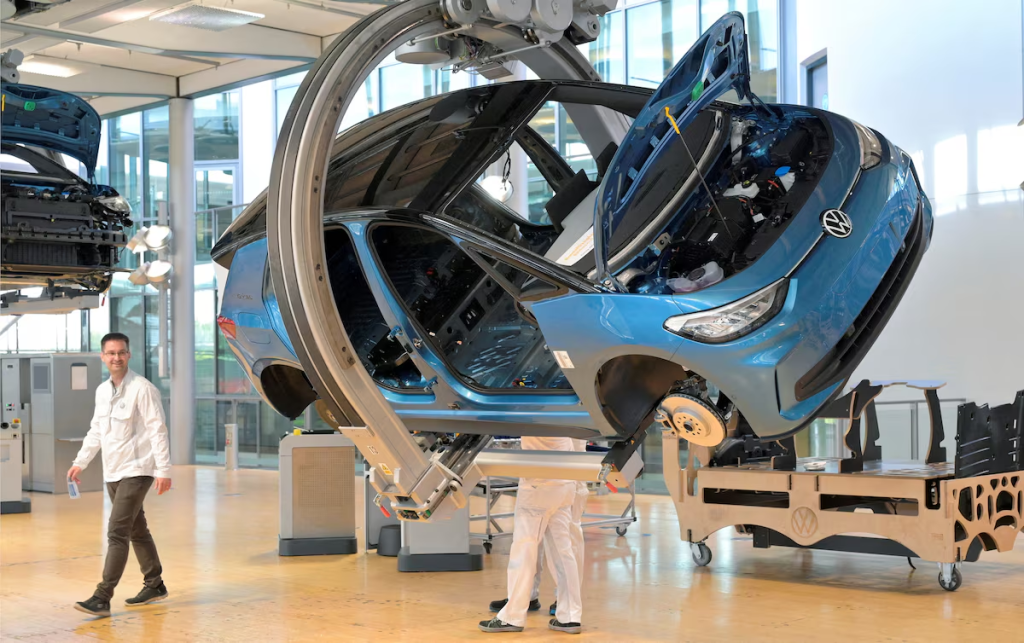
Volkswagen shutters a German plant for first time ever as Trump tariffs squeeze car giant – Volkswagen is ending vehicle production at its Dresden factory — the first time in the automaker’s 88-year history that it has closed a plant in its home country — as weakening demand and punishing US tariffs squeeze the German car giant.

The last vehicle rolled off the line Tuesday at the Dresden site, known as the “Transparent Factory” because of its glass-walled design, capping 24 years of production that began in 2001.

Output kaputt

To put it nicely.

German industrial output posts biggest decline in more than three years – German industrial output fell much further than expected in August, pushed down by a sharp decrease in car production as frontloaded demand ahead of U.S. tariffs dried up.

Industrial production fell by 4.3% compared with the previous month, the federal statistics office said on Wednesday, the biggest fall since March 2022, just after Russia’s invasion of Ukraine. Analysts polled by Reuters had predicted a 1.0% fall.

13,000 jobs here, 4,000 jobs there…

Progress marches on.

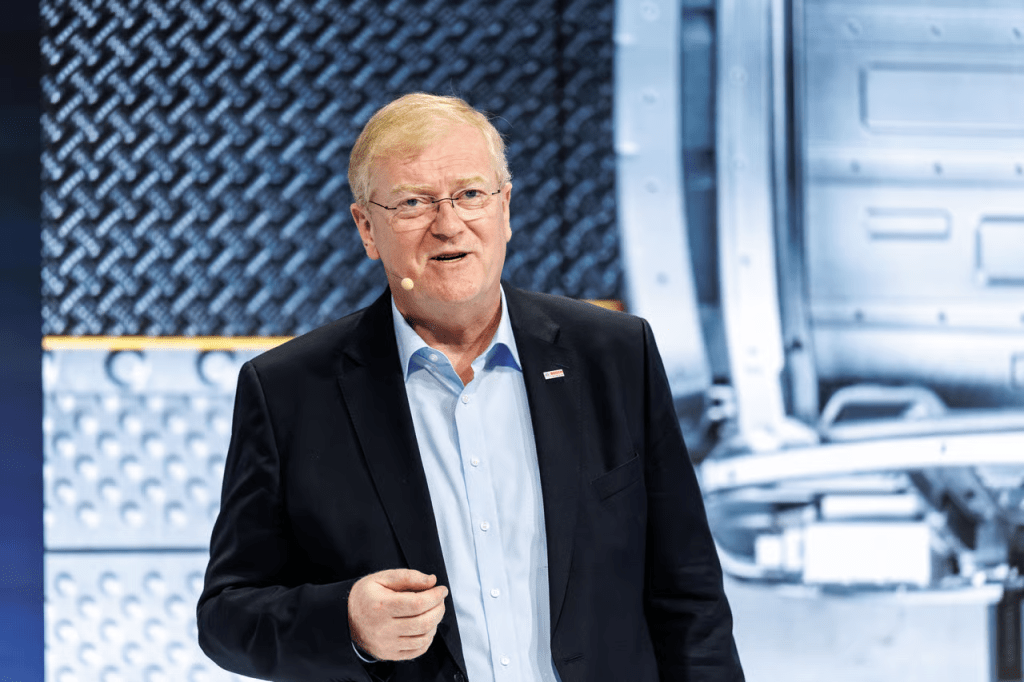
Industrial giant Bosch shocks Germany with plans to cut 13,000 jobs – The Bosch group, one of Germany’s leading industrial players, has announced a far-reaching job cut programme. On 25 September the company said it would cut an additional 13,000 positions by 2030.

Germany’s Lufthansa To Cut 4,000 Jobs By 2030, Targetting Admin – Lufthansa set new financial targets for 2028-2030, including an adjusted operating margin of eight to 10 percent.

Work more than 34 hours a week?

Not with us!

Does Germany need to work harder? Its government seems to think so – The average workweek in Germany last year was about 34 hours, according to Eurostat data, less than France and Greece as well as the average across the European Union, which was 36 hours. In addition, German labor productivity per hour has also been essentially flat since 2009.

A study by the Organization for Economic Co-operation and Development reports that Germans work the least among its member countries, clocking in at 1,335 hours per person per year in 2023, compared to 1,496 hours in the U.K. and 1,805 hours in the U.S.

Shock treatment about to begin in Germany

China shock treatment.

If the Chinese can’t displace the American workforce anymore, then they’ll displace another one (or two, or three…).

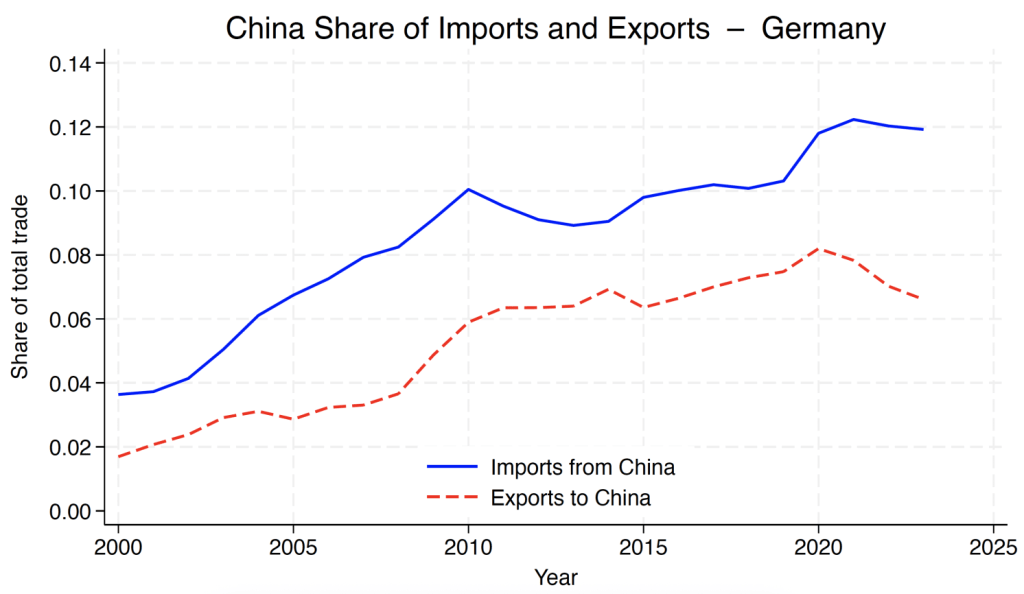
The China shock hits Germany – Trade with China displaced large parts of the American workforce in the 2000s, but Germany did not experience a similar shock at the time…

“Free money”

Brilliant. This is better than free lunch!

Why didn’t anyone ever think of this before?

Free money for all: Germany’s basic income experiment – One of the world’s most extensive studies on unconditional basic income was held in Germany. What does the experiment reveal?

… It is seen as a redistribution of wealth through taxes. In the activists’ calculation, Germany’s top earners — 10% of the population — would end up contributing a part of their income to everyone else. They estimate that 83% of the population would thereby have access to more money. The remaining 7% mid-earners would be unaffected by the redistribution scheme.

In times of rising populism, the basic income activists believe that this is a way to combat the population’s dissatisfaction due to wealth inequality.

Investing in Africa may be too risky…

But it’s not as risky as investing in Germany.

German Fortune 500 companies have announced over 60,000 layoffs this year, but the biggest employee cull is still to come – German companies in the Fortune 500 Europe have announced over 60,000 layoffs this year, in a sign of the country’s ongoing economic malaise that has left manufacturers reeling.

Major German employers, including Bosch, Thyssenkrupp, Deutsche Bahn, and Siemens, have this year announced plans to lay off thousands of workers in a bid to combat falling profits following a rocky post-COVID economic landscape.

Sorry, we’re only firing at the moment

Hiring war gestern (was yesterday).

German companies’ hiring plans drop to four-year low, Ifo finds – German companies are less willing to hire new staff than at any point in more than four years, data from the Ifo institute showed on Monday, as weakness in Europe’s largest economy has left its mark on the country’s labour market.

Ifo’s employment barometer fell to 93.7 points in October from 94.0 points in September, the lowest level since July 2020.