Now it’s much too wet, wet, wet! All it does is rain in Germany these days. But don’t worry, because you’re still allowed to worry. Ask any climate activist. In both cases “the Climate Crisis” is to blame. It’s science. I mean, pseudoscience.
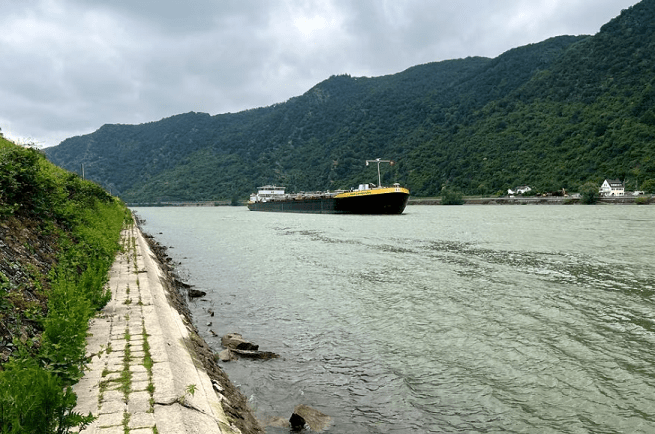
Rhine river levels in Germany back to normal after rain – Heavy rain has raised water on the river Rhine in Germany to levels allowing cargo vessels to sail fully loaded, data from German inland waterways agency WSA said on Wednesday.
Data from the WSA’s website Pegelonline showed that the last shallow sectors of the river around Cologne had now reached levels generally permitting full vessel loads.
Dry weather in June meant the river became too shallow for vessels to sail fully loaded and ship operators imposed surcharges on freight rates to compensate for vessels sailing partly empty, increasing costs for cargo owners.
Because Germany is definitely suffering from that.
Is Germany’s great economy sinking into ‘slowcession’? Key data this week will offer a hint as to whether the eurozone’s powerhouse can shake off recent stagnation.
Engine of the eurozone, industrial powerhouse, export world champion – just some of the ways Germany’s economy has been described over the years.
However, recent figures have indicated that the good times have come to an end, with Europe’s largest economy stuck in recession.
The “Nazi” name-calling strategy doesn’t seem to be working anymore (see the photo – get it?), all ye established, fat and sassy German political parties and media manipulators.
You might have to finally consider giving the German electorate what it actually wants. An end to mass illegal immigration, for example, or affordable energy. To name just two.
AfD: German voters shift toward far right – The AfD continues to gain ground in opinion polls amid high dissatisfaction with the government. Support for ending the taboo on cooperating with the populists is growing.
The far-right Alternative for Germany (AfD) has received another boost in the polls: If federal elections were held this week, the populist party would win 21% of the vote, putting it firmly in second place behind the center-right bloc of Christian Democratic Union and Christian Social Union (CDU/CSU), which remain the strongest force at 27%, despite taking some small losses.
That is according to the latest edition of the representative “Deutschlandtrend” survey, for which pollster infratest reached out to 1,297 eligible voters via phone or email between July 31 and August 2.
As in the previous months’ surveys, Germany’s center-left government again failed to win a majority. Chancellor Olaf Scholz’s Social Democratic Party (SPD), the largest party in the three-way coalition, would garner 17% — down from 25.7% when it came to power in the last general election in 2021.
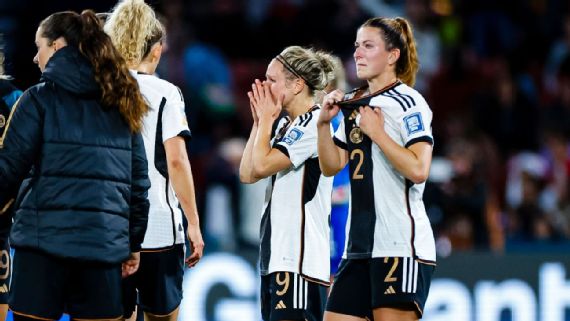
Germany ‘speechless’ after earliest-ever Women’s World Cup exit – An opening 6-0 win over Morocco makes Germany’s earliest exit ever at the Women’s World Cup even harder to fathom for a No. 2-ranked team that won’t be advancing out of the group.
A 1-1 draw with South Korea in a dramatic end to the group stage Thursday left Germany in third place in Group H behind Colombia and Morocco. In the end, it was Morocco who inflicted the damage with an unexpected win over Colombia in a game being played at the same time but on the other side of the Australian continent.
It’s one of the heaviest metals there are. Even though it’s mud.
Wow. I heard a lot of these fans were wondering why their coffee tasted so muddy. Turns out it was freshly ground… A lot of them used to be addicted to mud wrestling, I’m told. But they’ve been clean now for years… Also heard about this big male cow that got stuck in mud near the stage. Terra-bull… I’ll be here all week, folks.
Germany’s Wacken metal festival halts admissions after persistent rain turns site to mud – The Wacken Open Air heavy metal festival in northern Germany is opening on Wednesday with a reduced audience after persistent rain turned the grounds to mud and forced organizers to order a halt to all new arrivals.
Organizers of the famed music festival in the village of Wacken, in a rural area northwest of Hamburg, had already told fans on Tuesday that no more cars and trucks could be admitted to the site because camping areas, the grounds and access roads were in poor condition because of heavy rain in recent days, and more was expected.
German mainstream media (state TV) doesn’t even try to hide it.
A woman they interviewed as a random customer in a supermarket to get the “correct” response to a question about “justified” higher grocery prices was one of the channel’s own regional news presenters. This was kept secret from TV viewers, of course. TV viewers who are forced to pay a TV tax to view such high-quality, non-biased news reporting, I might add, whether they actually view it (or even own a TV) or not.
Real cars. And with that, the fun for Germany has only just begun.
What if Germany stopped making cars? Imagine Volkswagen goes the way of Nokia.
“The future of the vw brand is at stake.” When Thomas Schäfer, the mass-market marque’s newish boss, gave a presentation to his management team in early July, he did not sugarcoat its problems. High costs, falling demand, growing competition—the list goes on. “The roof is on fire,” he warned, echoing one of the most noted alarm calls in recent business history—from Stephen Elop, who in 2011 compared his company to a “burning platform” shortly after taking the helm at Nokia, then the world’s largest maker of mobile phones…






 Observing Hermann