Europe’s Sleeping Giant Awakes?

Uh, believe me. Germany is still sleeping. Sound asleep. And a giant is the last thing it is. Certainly not when it comes to its military.
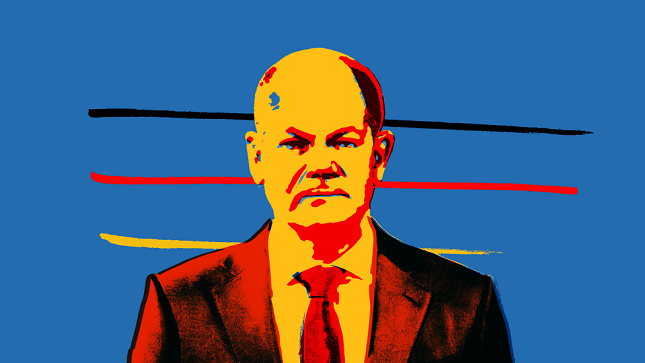
Europe’s Sleeping Giant Awakens – Politics in Berlin has undergone a cataclysm that no one saw coming.

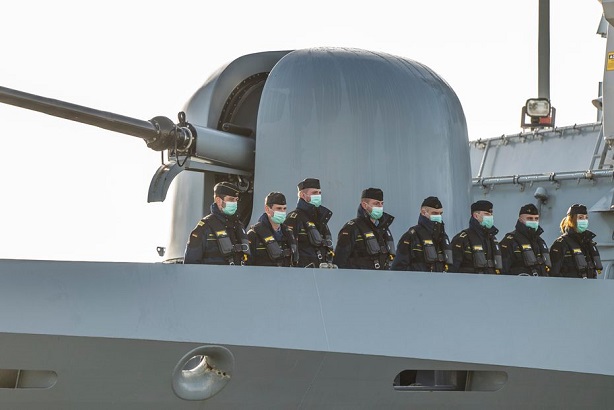
Scholz announced that Germany would end its dependence on Russian gas (no, they won’t), spend an additional 100 billion euros on its military (a lot but not nearly enough), and deliver hundreds of anti-tank weapons and Stinger missiles to Ukraine in order to help its overmatched military counter Russia’s all-out assault (nice symbolic gesture). Germany may also be forced to extend the life of its nuclear plants to fill the energy gap created by the halt to Russian gas supplies (ha, ha, ha).

“Freedom does not mean as much in Germany as it might in other places,” this person told me, speaking on the condition of anonymity in order to candidly discuss German political mores. “If the trade-off is between economic decline and an erosion of freedoms, Germany could well choose the latter.”

Any Other Country Could

And would, of course. But Germany? Planet Germany? German Renewable Energy Disneyland itself? Do NOT place any bets on that one.

Explainer: Could Germany keep its nuclear plants running?

Of the 17 nuclear power plants Germany had at the time, only three remain in operation now: Isar 2, Emsland and Neckarwestheim 2, which are operated by German energy firms E.ON (EONGn.DE), RWE (RWEG.DE) and EnBW (EBKG.DE), respectively.

Under current plans, the plants, with combined capacity of 4,200 gigawatts (GW), will be shut down by the end of 2022.

Good Times

The old days. When Germany could elegantly or less elegantly wiggle out of paying for its own defense (spending 2% GDP for defense like it had promised to pay many, many years ago).

Suddenly, inexplicably, now it’s possible after all. Mysterious, don’t you think? We need to find some experts to explain to us just how this change of heart was made possible.

Putin Accidentally Started a Revolution in Germany – The invasion of Ukraine is triggering a dramatic reversal of Berlin’s grand strategy.

In seven days, Germany has axed its biggest Russian energy project, imposed sanctions that will cause significant pain at home, and instituted a course that will make Germany the largest European defense spender, with the most advanced aircraft and a growing forward presence in Central and Eastern Europe. One can wonder whether Germany’s dedicated detractors in Washington will notice. How did it happen so quickly, when German officials had so tenaciously defended their status quo policies for so long?

German Of The Day: Kehrtwendung

That means u-turn.

In U-Turn, Germany Will Send Weapons to Ukraine – Germany will send weapons to Ukraine including antiaircraft missiles and tank-busting rockets in a reversal of earlier policy, German Chancellor Olaf Scholz said Saturday.

The U-turn was triggered by the Russian invasion, which Mr. Scholz said marked a turning point. “It is our duty to support Ukraine to the best of our ability in defending against Putin’s invading army,” Mr. Scholz said in a statement. “That is why we are delivering 1,000 antitank weapons and 500 Stinger missiles to our friends in Ukraine.”

Tough As Nails

Or as Jell-O, at least. Here’s the latest “Money Makes The World Go Around” going around in Germany (some still refer to it as “the EU”).

Cutting off Russia from the SWIFT global interbank payment system should not be part of the second EU sanctions package against Russia that EU leaders will decide upon at a meeting on Thursday in Brussels, German Chancellor Olaf Scholz said.

He’s right, of course. Doing that would be one of the only things that would actually hurt Putin & Co. and that would be counterproductive.

Die Swift-Keule kommt nicht zum Einsatz.

This Will Show Them Russkies

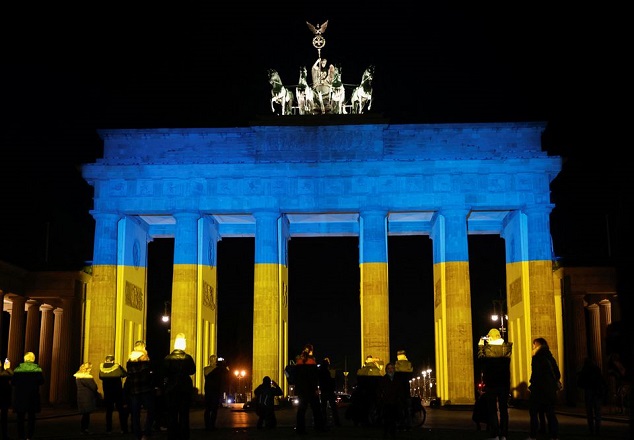
And if lighting up stuff in the national colors of Ukraine doesn’t help, we may have to consider building a Menschenkette (a chain of people holding hands). As a last resort, we MIGHT even ask them to sing We Shall Overcome. So, like watch it, Putin. Give peace a chance, or something.

Berlin and Paris illuminate buildings in Ukrainian colours in show of unity – The German capital lit up the Brandenburg Gate, Berlin’s most famous landmark in blue and yellow, the national colours of Ukraine, on Wednesday evening in a show of unity with Kyiv as the crisis with Russia deepens.

Money Makes The World Go Around

And there’s a big demand for military machinery in Russia these days.

So German business can just jump right in to fill that gap.

Germany indicts man for sale of military machinery to Russia – Germany has indicted a businessman on suspicion of breaking arms control laws by helping Russia purchase sophisticated machinery that could be used to make chemical weapons...

Prosecutors allege that a Russian company the suspect had business relations with was a front controlled by the intelligence agency to cover up purchases by Russia’s military industry.

Bundesanwaltschaft klagt Deutschen wegen Lieferungen an russischen Geheimdienst an.

“Historically Low Levels”

Regulate the gas you failed to store in advance? Because of your insistance to remain dependent on Russian gas – even after the Russians refused to give you more? For months now? Yeah. Go ahead and regulate that.

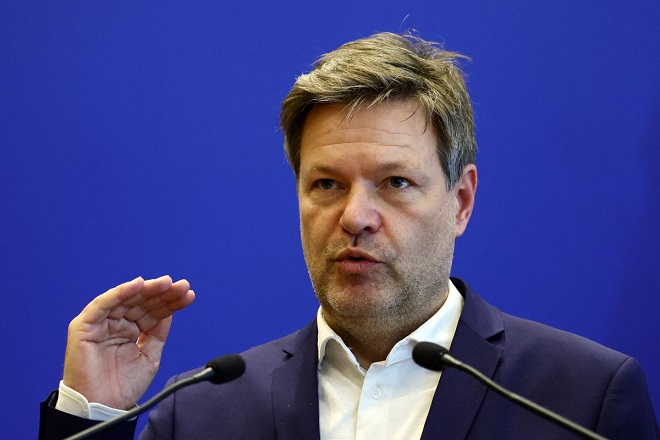
Germany must regulate gas storage to secure supplies – Habeck (The Greens).

Germany’s gas storage facilities are at historically low levels and fears that a possible war between Russia and Ukraine could worsen an energy crisis in Europe has raised the pressure on Chancellor Olaf Scholz to secure supplies.

German Of The Day: Luftraum

That means airspace.

As in: Time To Acknowledge Ukrainian Airspace Is As Dangerous As 1961 Berlin.

The tools are different, and the location has changed, but NATO and Russian President Vladimir Putin are engaged in a repeat of an epic October 27, 1961, Cold War standoff, when combat-ready American and Soviet tanks faced off in Berlin. Back then, the Soviets were reneging on Post World War II agreements that guaranteed the wartime allies unfettered access to East Berlin, and America successfully sent tanks to the border crossings to maintain those rights.

Today, the Ukraine border is a modern-day Checkpoint Charlie, and, instead of tanks, American reconnaissance platforms are confronting Russian anti-aircraft missile batteries and fighter aircraft. And, rather than backing out of post-World War II access agreements, Russia is set to renege on a guarantee of Ukraine’s sovereignty.