What a great step forward!

Into the brave new renewable energy future. The German government has announced it will spend €16 billion to build four major natural gas plants to meet the electricity demand their beloved renewable energy technology simply can’t meet.

A brilliant move, and long expected. Overdue, actually. You see, wind and solar power are so unreliable that you must always build a second “dirty” system (CO2 is a BAD “pollutant,” remember?) to back them up. This way you get to spend twice as much as you would have if you had only used the dirty system to begin with. Or, heavens forbid, if you had used nuclear energy to begin with (it doesn’t produce any CO2). This way, in other words, you can save the planet with one hand while you continue to pollute it with the other.

After scrapping nuclear reactors, Germany to spend billions on new gas power plants – The fossil fuel expansion is needed to ensure long-term energy security, according to industry and the government.

In a statement Monday, officials said the new strategy came “in addition to the consistent expansion of renewable energies,” and was key to ensuring steady power supplies “even in times where there is little sun and wind.”


Time to say goodbye

To your latest Green fantasies.

The money. She is gone, señor.

Germany’s Greens thought their moment had finally come… But then, last month, Germany’s top court handed down a ruling that effectively stripped the ruling coalition of the full financial firepower it needs to make those ambitions a reality.

The bombshell ruling by Germany’s Constitutional Court blew a €60 billion hole in the country’s finances, leaving the government scrambling to fill the gap. At the same time, the ruling sharply limits the government’s ability to draw from special funds created to circumvent the country’s constitutional debt brake, which restricts the federal deficit to 0.35 percent of GDP except in times of emergency.

These special funds were supposed to help finance several projects which are core to the Greens’ agenda — such as the transition of steel plants to hydrogen energy, subsidies for battery and microchip production, and the modernization of the country’s railway network.

Isn’t Anyone Going To Do Anything About This?

The great German beer crisis? Demand is falling, people. And I can only drink so much on my own.

Beer

Demand is falling in a country where there are more than 6,000 different brands of beer. The theory goes that you could drink a different one each day for more than 16 years without having to taste the same one twice. In fact, today fewer Germans regularly drink beer at all. Since the early 1990s, domestic consumption has dropped by more than a quarter. Consumption per head peaked in 1976 and has been falling ever since. The result has left mass-market brewers suffering from overcapacity and fighting a long-running price war. More than two-thirds of all the beer sold in supermarkets is offered at a discount.

“How is it that one of the world’s biggest export nations, and one so obsessed with beer quality, fails to woo international drinkers?”

You Say You Want A Revolution?

An energy revolution? Then pay up front, Germany. It’s going to cost you a zillion dollars and you may not be able to come up with the cash for it later.

Germany

Germany spent 25 billion euros ($26 billion) on renewable energy in 2016, most of which—23 billion euros—consumers paid through a surcharge on their electricity bills. The rise in that surcharge is the single biggest reason that the amount the average German household spent on electricity rose to 1,060 euros in 2016, up 50% from 2007.

When Black Zero Comes

I’m gonna dig myself a hole…

Black Zero

When Germans refer to a “black zero” these days they mean a balanced fiscal budget with no red ink. What a concept. If it weren’t so unthinkable (I am from US-Amerika and we’re clearly too smart for that) I would have a “quasi-religious fixation” with it, too. More power to you, Wolfgang.

In his aversion to the pursuit of full employment through fiscal policy, Mr Schäuble is an obvious heir to Eucken. This is also true of prominent German economists who, during the eurozone crisis, have ignored the effects of austerity on demand, out of a deep-seated belief that structural reforms can solve all problems.

The Guy YOU Love To Hate

I pour moi think he’s the greatest. Weiter so (keep it up), Wolfgang!

Schäuble

Despite bitter opposition in many quarters to the austerity-first policies Germany has imposed on Europe’s poorer nations, Chancellor Angela Merkel’s government has hung on to its role as champion of integration on the Continent through deft use of diplomacy and the country’s economic clout.

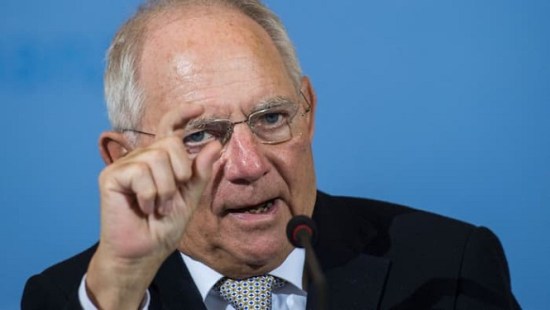
But in negotiating a new deal this week to bail out Greece, Germany displayed what many Europeans saw as a harder, more selfish edge, demanding painful measures from Athens and resisting any firm commitment to granting Greece relief from its crippling debt. And that perception was fueled on Thursday when the German finance minister, Wolfgang Schäuble, suggested that Greece would get its best shot at a substantial cut in its debt only if it was willing to give up membership in the European common currency (they mean Grexit here, of course, they just don’t like to use the word).

“Ich werbe nur dafür, dass Sie heute nicht meinen – jetzt ist das Thema erledigt, jetzt haben wir noch mal einen da zum Bösewicht erklärt. Ich bin so abgehärtet in einem langen politischen Leben, dass mich das nicht aus der Bahn wirft.”

Little Oskar Thinking Out Of The Box Again

Well known for his refreshing viewpoints, Mr. ex-SPD, ex-Left, ex-Bolshevist, ex-you-name-it Oskar Lafontaine himself has come up with a brilliant new idea to save Greece from its upcoming euro Grexit exit: Get rid of the euro first.

Oskar

Being the true radical thinker that he is, he seems to have devised a radical new European economic system by which goods or services are directly exchanged for other goods or services without having to use a medium of exchange like dirty, filthy, old (or in his case new) money. And the way things look right now, Greece will be the first country to get the chance to test this out in a big way.

“Der Euro ist ein Rückschritt im historischen Projekt der europäischen Integration. Der Euro ist schon gescheitert, wir dürfen uns da keinen Illusionen hingeben.”

Germany’s Growth To Be Removed

I mean cut. Yuk. Talk about your gross national product.

Growth

Actually, I mean have its economic-growth forecast for 2014 reduced to 1.2 percent from 1.8 percent.

Jeepers creepers. Is this the end of the beginning of the party or the beginning of the end of the party? Let’s ask two economists and get their five answers and find out.

Speaking Of The Energiewende…

Or German energy turnaround… It’s really working great!

Strom

The price of electricity for private households in Germany has gone up 38 percent since 2008.

It’s easy to do, all you other countries out there. Just follow Germany’s example and shut down all of your nuclear power plants in a panic and then force through the construction of renewable wind and solar energy plants that are neither energy nor cost-efficient enough and then have them heavily subsidized by these households. That turns things around in no time.

Der Bundesverband der Energie- und Wasserwirtschaft (BDEW) erklärte, der starke Anstieg der staatlich verordneten Steuern, Abgaben und Umlagen in den vergangenen Jahren sei der Grund für den Anstieg der Strompreise für Haushaltskunden. «Hinzu kommen die gestiegenen Kosten für den Netzausbau, der mit dem weiteren Ausbau der erneuerbaren Energien notwendig ist», sagte ein Sprecher des BDEW in Berlin.

Best Paid Pilots In The World Need More Money

And more early retirement.

Strike

Lufthansa has now been grounded by a three-day pilot strike.

Lufthansa pilots belong to the best paid pilots in the world. At some American airlines the pilots only earn a fraction of what they get, an international comparison shows.

Die Piloten der Lufthansa gehören zu den bestbezahlten Flugkapitänen weltweit. Bei einigen amerikanischen Fluglinien wird nur ein Bruchteil dessen verdient, wie ein internationaler Vergleich zeigt.

“We’ll first see out the strike and then we’ll think about talks.”

PS: The belief that labor unions can substantially raise real wages over the long run and for the whole working population is one of the great delusions of the present age. This delusion is mainly the result of failure to recognize that wages are basically determined by labor productivity