Seven Years Of Famine Or Something

No short-term pain, no long-term gain.

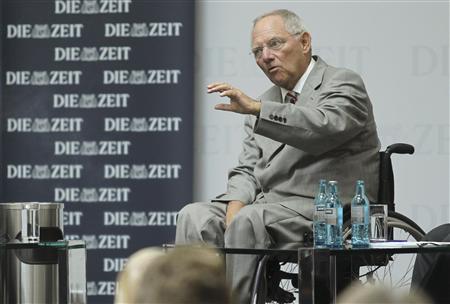
“There might well be seven lean years ahead for the world economy,” German Finance Minister Wolfgang Schaeuble said in a speech at a meeting of Nobel laureates at the University of St. Gallen in Switzerland.

What he really meant was seven years of fiscal consolidation (austerity measures) in Europe (and elsewhere?). This is the key to long-term growth, he says. My, how, uh, German or something.

Jiminy Crickets. As if the ten plagues of late hadn’t been bad enough already, now the Germans themselves (they own Europe, you see, and are recreating it in their own image) are going to inflict the Pharaohs of the EU with seven years of boils, hail, locusts and darkness. In the form of austerity measures, I mean. Or maybe they won’t. Hard to say for sure. Could be that monkeys will fly out of their butts instead.

Muddy Waters knew the deal:

On the seventh hour, of the seventh day,
on the seventh month, the seventh economic witch doctor say:
“He’s born for good luck, and I know you see;
Got seven hundred euros, and don’t you mess with me.

Ain’t no “might” about it, Fareed

If push comes to shove over here, I mean.

Why Germany might let Europe fall

The old structure of Europe rested on an extraordinary degree of German abnegation of its own interests.  The Germans believed their national interest lay in subordinating itself in every way to Europe’s broader interest.  That was what Europe was built on.

Today what people are basically asking is: “Is Europe’s debt going to be centralized or not?” In other words, is Europe going to be willing to say, “All our debt is pooled together and theoretically, as a single entity, we’ll pay it back.”

The key to this commitment is Germany. Germany is the only country that can pay.

The key to Europe’s future is how Germany conceives of its interests.

So once it gets real ugly, and it’s going to get a whole lot uglier yet, the last guy out please remember to turn off the lights.

PS: This gives “Old Europe” and “New Europe” a whole new meaning, don’t it?

Greeks Don’t Work Enough

Talk about your vacation nation. No, not Greece. Germany.

This isn’t really news, of course. “Germans may accuse spendthrift euro zone southerners of too much play and not enough work, but they enjoy the most generous annual holiday time in the European Union, a study released on Wednesday showed.”

Hey, it’s nice to be the king.

Keine anderen Europäer haben mehr freie Tage im Jahr – insgesamt sind es jeweils 40.

Pirouettes and Unpredictability

We Germans call the shots here in Europe, sort of.

It’s just that we don’t know what we’re going to be calling next.

“Anybody out there still think Germany is running Europe — or for that matter can or will dominate it in time?

The question fits the moment after the German refusal to vote in favor of allied military intervention in Libya, the government’s pullout from nuclear energy largely for reasons of emotion and domestic political calculation, and its willingness last week to put off possibly decisive steps to end Greece’s debt misery.

Over a period of just about three months, that is a lot of unpredictability and policy pirouettes for allies who might have thought German leadership, on the upside, would be rational, competent and closely bound to the West.”

Germans Meant “Work Harder”

Down south (in battling the Greek debt crisis, for instance). Not longer. A study based on OECD and Eurostat figures has determined that Germans work less annually than their no good and lazy Southern European neighbors.

The study indicates that “a German’s average annual work duration (1,390 hours) was substantially lower than for a Greek (2,119), an Italian (1,773) a Portuguese (1,719) and a Spaniard (1,654).”

But at least for that the Germans work more intensely, right? Not according to that study, they don’t.

But at least they mean well, or something?

“Germany’s productivity per head remains close to the average of southern European countries. Its hourly productivity rate is above average but not better than France or Greece,”

Remember when it was European Germany?

Now it’s German Europe.

Huh? Where did this come from all of a sudden? Out of the blue like that?*

It was another “good day for Europe” when, as usual, nothing was actually resolved during the latest EU summit the other day, other than the fact that that nothing had a big Made in Germany stamp on it. The times they are a changed. The country that used to moan about being the paymaster for so long (and still does, of course, don’t get me wrong)  is now “the taskmaster of the entire community” and doesn’t even have the decency to make a secret about it anymore.

But don’t complain about it, my (as in Germany’s) fellow Europeans. This is only what the “fathers of Europe” had envisioned right from the start. Think of  what Jean Monnet had to say about the plan, for instance:

He wanted to guide European countries into a super-state “without their people understanding what is happening. This can be accomplished by successive steps, each disguised as having an economic purpose.”

I admit that this wasn’t quite the purpose he had envisioned but, well, now you “have the salad,” as the Germans like to say (the fat is in the fire). It doesn’t really matter that Berlin has a lack of vision when it comes to dealing with the current euro crisis, Germany calls the shots now and doesn’t need a vision if it doesn’t want one. So get used to it already.

“This is all about Germany, and it’s all about the end of the German appetite for writing checks to the periphery of Europe.”

*Have any of you ever read Philip K. Dick’s The Man in the High Castle? Germany and Japan win World War II. This is kind of like that.

“Good European pieties and delirious anti-American phantasms”

It’s all here. Ya gottcha European Film Academy Awards, your European Director, your European Screenwriter, your European Actor, your European Composer, your European Production Designer and even your European Oscar, all right here in Europe. Financed primarily by Germany, of course (where all the shots get called these days), but still. Germany is part of Europe too, you know.

Now all you need is your appropriate inappropriate European Film with your suitably anti-American fantasy exposing that country for the “fundamentalist totalitarian state” it is (as put so diplomatically by European Film Academy Presidente por Life Wim Wenders–he’s a European too, by the way) and the recipe is complete.

So this year’s wiener (or is it weiner or even whiner?) is: Roman Polanski for “Ghost Writer.” It’s the heart-warming story of an Iraq War-related assasination of a CIA-controlled US-Amerikan imperialist Tony Blair robot or puppet dude, take your pick he’s both (I knew I always liked that guy for some reason).

Gee, I wonder who got the Best Foreign Language Film Language European Oscar Award this year? I’m going to go way out on a limb on this one and say German.

German-funded “European” film prize goes to German-funded anti-American film.

Thanks for the link, Joe.

It’s OK when Germany goes alarmist, I guess

As expected, now that stuff is happening HERE, the Germans start getting all nervous and fidgety and s#*!t and suddenly want the EU to agree to tighter air freight security and are basically hyperventilating all over the place, which is fine with me (it’s about time). The alarmists.

Although Europeans certainly do have enough to hyperventilate about these days. When it comes to planes, I mean.

Germans at 87%

My, this really is significant. The Germans have finally come down from the mid to high 90s (no, not the temperature – or not precisely, anyway). I mean the Obama Worship Index or whatever the hell you call it. The rest of Europe brings the average down a bit lower to 78%, but still.

Wow. Who would have ever thought that? Finally, a real news item. The survey says: “Obama far more popular in Europe than America.” I had no idea. Uh, been there, done that, haven’t we?

And of course there are bound to be reasons for why this is so back home, but nobody over here would be particularly interested in those reasons because, well, “Obama far more popular in Europe than America.” And the bad stuff can still be attributed to Bush anyway, right? I don’t believe that there’s a statute of limitations on that one.

Obama’s approval rating stands at an enviable 78% among them, compared to a more mediocre 52% among the US public.

Divided we stand

But at least divided we stand together, in “broad agreement.”

It goes like this: Tim Geithner is all for imposing more conservative rules on financial institutions too, Germany, as long as they’re not too conservative. Germany’s Wolfgang Schäuble, on the other hand, wants kind-of-sort-of the same thing, he says, as long as it’s more conservative than not too conservative and, above all else, international. And as long as it’s German unilateral at the same time too, of course.

Other than that though, they couldn’t agree on much of anything.

“We have a lot in common. We are going to have slightly different approaches. I don’t think we’ll know what separates us until we get to the next stage.”