The End With Horror

No horror here. Or terror, if you prefer. How does that German proverb go? Lieber ein Ende mit Schrecken als ein Schrecken ohne Ende?

That is, better an end with horror than a horror without end. And that’s where we’re at with Greece now, finally.

German Vice Chancellor Philipp Roesler said he’s “very skeptical” that European leaders will be able to rescue Greece and the prospect of the country’s exit from the euro had “lost its terror.”

Get it over with already, people, and move on.

Inferiority Superiority Complex

North, south. Inferiority, superiority. It’s all the same to me.

Germans export more to their European partners than they consume, benefiting from this asymmetrical situation even as they expect everyone else to be exporters and savers like them.

Our Debt Still Doesn’t Stink

German government debt keeps climbing relentlessly higher and reached an all-time high during the first three months of this year. The federal, state and local governments then reached a debt to the tune of 2 trillion euros.

That was 2.1 percent or 42.3 billion euros higher (deeper?) than  in the previous year’s quarter, reported the Federal Office of Statistics in Wiesbaden on Monday.

Now if only Greece and Co. could learn to control their government spending like the Germans do. Oh, wait. They already have. Or do. Or whatever.

Deutschlands Staatsschulden auf Rekordhoch gestiegen

Heretics Verboten!

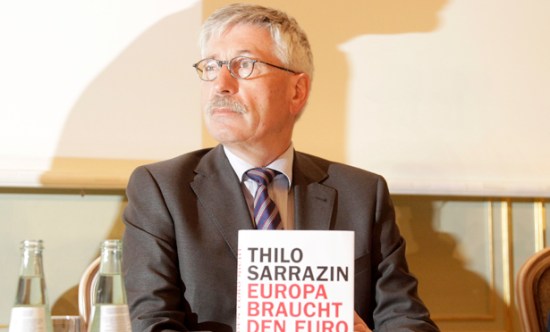
Europe Doesn’t Need the Euro? Another religious tract to study on Sundays.

All of this is kind of like religion, don’t you think? First you’ve got some prophets who come out of the wilderness (the political class preaching the virtues of the euro, come hell or high water), then what they say gets labeled as heresy by the faithful (by the “man on the street” who wants to keep his deutschmark), then the euro faith overcomes this persecution, establishes itself as the true universal teaching and becomes orthodoxy. Then the next voice out of the wilderness comes along and the game starts all over again, etcetera and so forth already.

Don’t get me wrong, I don’t beleive that Thilo Sarrazin is a full-fledged prophet or anything (I just think he wants to make a buck, I mean euro). But he’s not a full-fledged heretic, either. And that’s something the euro high priests could never admit to.

The euro, in Sarrazin’s view, is just the old German deutschmark extended to a lot of countries with less robust currencies.

Germany, in other words, is being used as a guarantor of other countries’ debts.

“The German political class bet that the political union would follow shortly thereafter almost as a matter of natural law, because without that the common currency wouldn’t be stable. That bet has failed.”

Germans are hostage to their sense of not wanting to be responsible for Europe’s failure.

Germans are hostage to their sense of historical guilt.

“Pro-euro Germans are driven by that very German reflex, that we can only finally atone for the Holocaust and World War II when we have put all our interests and money into European hands.”

“Angela Merkel to like the friendly woman on the navigation system in my car.”

The Great European Divide

There’s Germany, it seems. And then there’s (practically) everybody else in Europe.
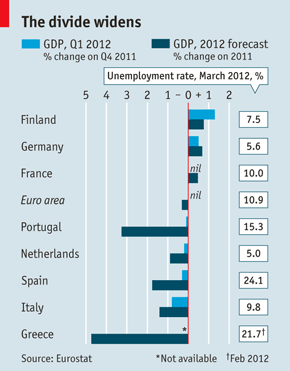
The Economist notes: The hope is that Germany, which produces over a quarter of euro-zone output, can pull along the rest. But the worry is that the latest bout of euro sickness may sap confidence even in Germany, aborting a broader recovery.

With unemployment at 6% compared with a 15-year high of 11% across the euro zone and over 20% in Spain and Greece, Germans feel less pressure to save in case they lose their jobs. And a more confident Germany helps everyone by spending more on imports. German inflation at 2.2% is now below average.

German resilience reflects several strengths. Although growth in the first quarter was helped by exports, the usual mainstay, it has increasingly been backed by domestic demand, which accounted for three-quarters of GDP growth in 2011. This reorientation has happened because Germany avoided the debt excesses (? hmmm, relatively speaking perhaps, but I’ve seen some other numbers here), both private and public, that inhibit growth elsewhere. With relatively low debt, German households and firms can borrow more. What is more, they can do it at rock-bottom rates. Paradoxically, Germany is benefiting from the euro crisis, as investors seek a haven. Yields on ten-year German government bonds have fallen below 1.5%.

Paradoxically, Germany is benefiting from the euro crisis, as investors seek a haven. Yields on ten-year German government bonds have fallen below 1.5%.

And yet, after having read all these impressive figures up there, there’s another German paradox I keep running into here all the time: Germans on the street aren’t nearly as confident as this article wants to imply, at least not when it comes to the euro and the euro-zone. How else do you explain the fact that nearly every second German now thinks that the introduction of the euro was a big honking mistake in the first place?

Die Euro-Einführung war ein Fehler, glauben knapp die Hälfte der Deutschen.

German Tourists Avoiding Greece This Year For Some Reason

German tourists may gladly zip off to some of the most dangerous places on earth you can imagine, but not even they are crazy enough to be heading down to Greece any time soon.

“The Germans aren’t coming here this year but there’s no reason for them to be afraid,” one Greek guy said. “Honest,” he should have added.

“We don’t have a problem with the German people, only their government,” another guy added, who forgot to say “Really.”

“That’s just the way Germans are: if there’s trouble in some country, then Germans just don’t go there on their holidays.”

German Austerity Still Quite A Rarity

Despite all the talk to the contrarity.

The German government didn’t reach even half of its planned savings in the federal budget in 2011. Only 42 percent of the spending cuts named by Merkel’s coalition government, comprised of the conservative Christian Democrats and the business-friendly Free Democratic Party, were actually not implemented…

The government is also falling behind on its targets for this year. Of the originally planned €19.1 billion in savings, less than half has been implemented…

This lapse (in reaching savings targets) is particularly embarrassing for the German government because the news comes just after 25 European Union member states agreed in early March to an international fiscal pact obliging them to adhere to greater fiscal discipline…

The aim of the pact is to make EU countries maintain binding austerity measures that leaders hope will contain the debt crisis and prevent countries like Greece from being able to pile up massive debts again.

And countries like Germany will show them how to do it, see? Next year, maybe. Or the year after that. Hard to say for sure.

 “It (the pact) is a milestone in the history of the European Union.”

We’re Helping Greece To Help Ourselves

It’s undeniable that Germany has great interest in helping Greece. Why just look at the great interest they’re getting back by doing so.

Despite all the perpetual bitching and moaning about having to foot the bailout bill for their bankrupt buddies in the bottomless pit, German tax payers raked in some 380 million euros on Greek aid interest payments in 2011 and are likely to pull in a whole lot more this year. It’s good to be the king, I mean lender.

Geez. With generosity like this, who needs extortion?

Im Rahmen des ersten Griechenland-Hilfspakets hat die Bundesrepublik dem Euro-Partner Darlehen von insgesamt 15,17 Milliarden Euro gewährt, um das Land vor der Pleite zu retten. Der Zinssatz habe zwischen 3,423 und 4,528 Prozent gelegen.

Thanks But No Thanks

Undank ist der Welten Lohn (nothing is so hard as man’s ingratitude).

What were you expecting, Germany? The Greeks have politely but firmly said no to a recent offer made by 160 German tax collectors who were ready, willing and able to fly down to Greece and help their Greek tax collector buddies gather Greek taxes in a more efficient and Teutonic-like manner.

The Greeks may be broke, but they’re not crazy. Not even Germans can stand German tax collectors

Als Begründung müssen die “hart arbeitenden griechischen Beamten” herhalten.

“Tax Advice Mission” Impossible

How about a little more sensitivity here, Greece? Germans are only trying to help.

And it doesn’t look like they’re going to stop trying to help you anytime soon, either. That’s why if they can’t get that “budget commissioner” they proposed to help monitor the Greek government’s (lack of) management of its finances, some 160 German tax collectors have now selflessly volunteered for assignments in Greece to help gather Greek taxes more efficiently. And as you can imagine, when it comes to taxation and tax collection, German efficiency can really hurt.

A recent flurry of acrimonious exchanges between Athens and Berlin reflect deepening doubts among mainly northern members of the 17-nation euro zone about Greece’s ability and willingness to overhaul its economy to satisfy lenders’ demands.