German defense minister lambasted over NYE Ukraine message – German media has mocked a “tone-deaf” video put out by Defense Minister Christine Lambrecht. She was slammed for discussing the war in Ukraine as people set off fireworks.
“The speech about the war with New Year’s Eve firecrackers in the background only crowns her series of embarrassments.”
And defense for free (from Dire Straits, sort of).
Our German Ally: Tanking.
Putin has given any number of reasons (all of them nonsense) to justify Russia’s invasion of Ukraine. One of them was that Russia was “threatened” by NATO’s expansion. That is, to put it mildly, unconvincing. Russia’s grumbling about Ukrainian independence dates back to the Yeltsin era, long before (the special case of the vanished East Germany aside) NATO had expanded to include any countries in the former Soviet bloc.
A more convincing explanation (so far as the Kremlin’s attitude to NATO was concerned) was that Putin had seen the alliance’s weakness and concluded that it would present Moscow with no problems in the event that Russia took back control over its neighbor. An important reason why the Kremlin might have seen things that way was the position of Germany, a supposedly key member of NATO, but one that had a distinctly, uh, nuanced view of what membership of the alliance meant.
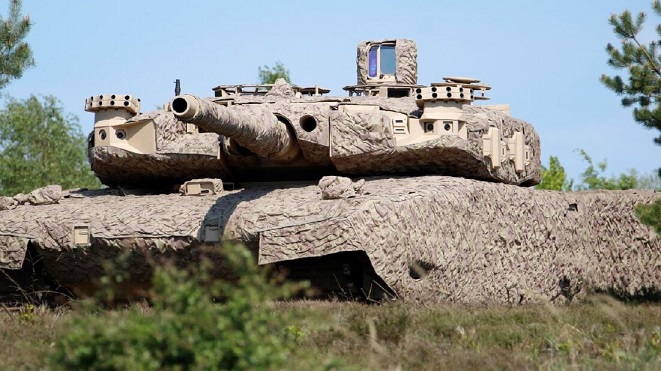
One obvious sign of that was the country’s neglect of its armed forces throughout Angela Merkel’s dismal chancellorship.
I still recall the sardonic, patronizing response I received in the German Chancellery around 2010, when I tried to warn my interlocutors about the danger of Russian hybrid warfare tactics—the cocktail of disinformation, economic coercion, subversion, espionage, and threats of force that Russia uses against its neighbors. “You are not seriously saying that Russia would conduct these operations against the Federal Republic of Germany?” my hosts asked, incredulously.
“Duh, yes,” I replied.
Scholz publicly hankers for a return to Europe’s “pre-war peace order,” suggesting that the lessons of 2022 have yet to sink in.
German politicians hail capture of suspected Russian ‘mole’ – The capture of an alleged Russian spy in Germany’s intelligence agencies has been called a “wake-up call” by politicians who are concerned by the threat of hybrid warfare.
“The fact that there are Russian espionage activities in Germany is well known and hardly surprising. But if now even in the ranks of the BND an employee is said to have spied for Russia, then this would be a completely new and frightening quality. Of course, this also raises the question of the effectiveness of the BND’s own security.”
While making this mistake again. The dependency mistake. See the Russian energy dependency mistake. This time it’s the hooked on China mistake.
China is a key market for German automakers including Volkswagen, BMW and Mercedes-Benz. If not the key market. And it will remain that way, despite the German government’s latest public relations move.
German auto industry could face tougher rules over China relations – Germany’s auto industry could face tougher rules on disclosing information over its China relations.
Germany’s foreign ministry plans to tighten the rules for companies including automakers that are deeply exposed to China, making them disclose more information and possibly conduct stress tests for geopolitical risks.
Some say it means “ring exchange” (not the wedding kind). Others say it means being chicken shit.
With Slovakian deal, Germany expands three-way ‘Ringtausch’ dance to arm Ukraine – Under the Ringtausch program, Germany has sent newer equipment to Slovakia, Greece, Slovenia and the Czech Republic, with those countries shifting older gear to Ukraine.
The Germans have a specific word for an exchange between at least three parties: “Ringtausch.” So it makes sense that is what the German government has named its procedure to gift modern military equipment to former Soviet-bloc countries who, in turn, gift their Soviet-era equipment to Ukraine.
Germany’s Continued Illusions About China and Russia – Berlin’s pursuit of economic and political ties with Beijing and Moscow has created dangerous dependencies. A change in strategy would benefit both Germany and the EU
Over the years, these two authoritarian regimes embedded themselves in the German economy and ingratiated themselves with the elites. Such developments prevented the EU from forging a coherent, critical strategy toward both Moscow and Beijing.
It wasn’t our fault, Mom. The other kids were jumping off the bridge too. That’s why we’ve got this recession now, see?
Germany blames Putin for pushing economy towards recession – Vice-chancellor Robert Habeck signals ‘substantial downturn’ in the coming quarters.
Habeck (Greens) blamed the gloomy forecast on Vladimir Putin’s attempts to use energy as a tool to destabilize Europe. Habeck said forecasts would have been worse if Berlin had not taken action to soften the blow.
Literally, to wave with a fence post. That is, to make a very broad hint, a wake-up call.
German Diplomatic Building in Kyiv Damaged by Russian Attack – Germany said a Kyiv building housing the German visa office had been damaged in the barrage of missiles that hit the Ukrainian capital on Monday and said Berlin would deliver the first of four modern air defense systems to Ukraine within days.
“Since the beginning of Russia’s war of aggression, these offices have not been used by our embassy,” Germany’s foreign ministry said in a tweet. “Our colleagues at the embassy in Kyiv are well.”








 Observing Hermann