Our Energy Turnaround Will Work

But only as long as we keep using the nuclear energy we supposedly turned around from.

Energy

According to an analysis by the Breakthrough Institute, Germany’s current installed solar panels will end up costing ratepayers $130 billion over the next 20 years through above-market-rate feed-in tariff contracts, compared to $15 billion for a state-of-the-art nuclear reactor that will generate over half the electricity of Germany’s entire solar fleet over a similar 20-year period…

The largest advantage of nuclear power is its ability to provide reliable, baseload power year-round 24 hours a day. Solar and wind can be economical as distributed energy resources, whose greatest value is suppressing demand load on the grid. But nuclear power provides baseload power and will therefore be the most technically optimal replacement for large fossil-fueled power stations like coal plants.

The Green Shirts vs. The Environment

Guess who’s going to win?

Green

One would assume that ecology and the Energiewende, Germany’s plans to phase out nuclear energy and increase its reliance on renewable sources, were natural allies. But in reality, the two goals have been coming into greater and greater conflict…

Since the party’s founding in 1980, it has championed a nuclear phaseout and fought for clean energy. But now that this phaseout is underway, the Greens are realizing a large part of their dream — the utopian idea of a society operating on “good” power — is vanishing into thin air. Green energy, they have found, comes at an enormous cost. And the environment will also pay a price if things keep going as they have been.

“We should overcome the temptation to sacrifice environmental protection for the sake of fighting climate change. Preserving a stable natural environment is just as important.”

Speaking Of Sinking Ships

EnbW Energie Baden-Wuerttemberg AG (EBK), Germany’s third-largest power supplier, postponed a decision to invest more than 1.5 billion euros ($1.9 billion) in a wind farm in the North Sea.

“We need legislative clarity and reliable conditions before we make an investment decision of considerably above 1.5 billion euros.”

Phase-Out Fizzling Out

Support for Germany’s Atomausstieg (nuclear phase-out) ain’t what it used to be, it seems. And it seems to have something to do with Geld (money), or something. With reality, in other words.

According to an Emnid survey, 77 percent of German voters asked say it is very important that energy costs remain affordable while only 53 percent care if the nuclear phase-out succeeds or not.

Welcome back to the real world, volks, I mean folks. Hey, you are here in Germany after all. And there is a clearly discernable pattern here. Once the first wave of hysteria is over, it always goes back to es darf eben nichts kosten (OK, but only as long as it doesn’t cost anything).

Für sie ermittelte Emnid auch, dass zwei Drittel der Bürger maximal 50 Euro pro Jahr mehr für Strom zahlen wollen.

What Are 20,000 Jobs?

If they are being offered for the sake of Germany’s beloved Energiewende (energy turnaround), I mean (and if you’re not one of the 20,000, of course)?

There is a certain logic here. I think. First you phase out German nuclear power plants because of the Fukushima disaster in Japan (I still haven’t figured out this part yet), then you phase out thousands of Japanese jobs due to the loses incurred by the energy companies due to this hasty (as in immediate) phase-out.

Oops, sorry. I just took a closer look at the article. Those are German jobs that are about to be phased-out, of course. Duh. Look folks, I’m not a German energy turnaround expert here you know. Forgive me for the confusion. Technically, it’s not even mine. I’m just trying to pass it on as best I can.

Branche verliert durch Atomausstieg Geld – Eine Reihe von Studien hatte in früheren Jahren bereist festgestellt, dass der Netto-Effekt der Ökostrom-Subventionen auf dem Arbeitsmarkt bestenfalls Null ist.

German Wind Offensive More Offensive Than The Rest Of Us Thought It Was

Well that didn’t take very long. Now it’s “Germany’s offshore fiasco.”

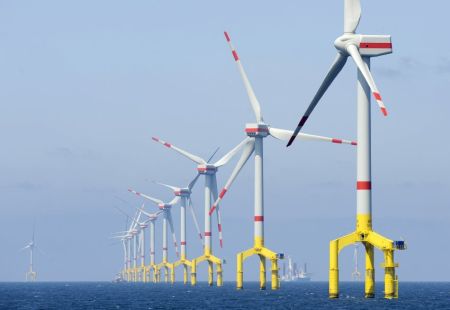
Germany wants to pepper its northern seas with offshore wind turbines as part of its ambitious energy revolution. But strict laws, technology problems and multiple delays are turning the massive enterprise into an expensive fiasco. Investors and the public are losing patience.

The 30 Percent Solution

That’s how much more German households will likely have to pay for energy in the coming years due to the country’s way cool “energy turnaround.”

Investments of at least 150 billion euros will be needed in the next few years and that’s just the beginning and absolutely positively nothing is working out reibungslos (smoothly) as not planned. And that’s the crux of the biscuit: This is what happens when you do your panicked decision making first and your planning later.

“Wir müssen davon ausgehen, dass die Gestaltung der Energiewende länger dauert als geplant.”

No One Can Explain German Power Grid Instability

But as far as I can tell, it seems to have begun sometime shortly after the Fukushima nuclear disaster in Japan.

Sudden fluctuations in Germany’s power grid are causing major damage to a number of industrial companies. While many of them have responded by getting their own power generators and regulators to help minimize the risks, they warn that companies might be forced to leave if the government doesn’t deal with the issues fast…

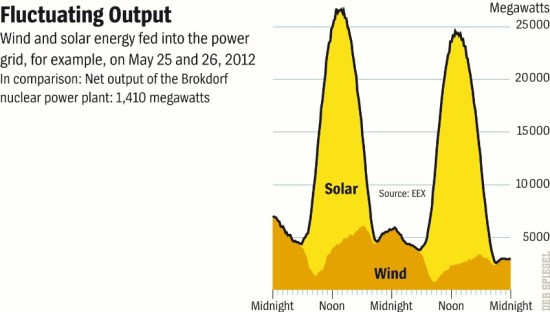
The problem is that wind and solar farms just don’t deliver the same amount of continuous electricity compared with nuclear and gas-fired power plants. To match traditional energy sources, grid operators must be able to exactly predict how strong the wind will blow or the sun will shine.

“Every company — from small businesses to companies listed on the DAX — are buying one (APC emergency power generators) from us.” 

Germany Confused About Japan’s “Retreat” From A Nuclear-Free Future

And here we thought that Germans were good at math.

Until Fukushima, Japan satisfied about 30 percent of its electricity demands with nuclear power, while renewable energy made up about 10 percent of the power supply. If one leaves out hydroelectric power, renewables hardly make up more than 1 percent.

“Japan needs a vision.”

We Must Save The World But It Must Be Affordable

Cheap, in other words.

Germans everywhere are slowly waking up to the fact that their revolutionary switch to renewable energy sources is going to cost way too way much more than they ever thought they would ever have to pay – and the German government has now woken up to this.

That is why they have now begun a quiet backpedaling policy designed to prepare the German population for a slow turnaround from the energy turnaround that hasn’t even begun to turn around yet.

“For me it’s a priority that electricity remains affordable,” Germany’s new Environment Minister Peter Altmaier says, for instance.

He also says he doubts that Germany will be able to reach its goal of introducing one million electric cars by 2020.

Nor does he think that Germany will be able to cut its energy consumption by 10 percent that year, a precondition for reaching the illusory goal of 35 percent renewables the government is still aiming for, sort of.

This is the German Environment Minister talking here, folks. So you get the message, don’t you? And if you don’t get it now, you’ll get it later.

Regierung fürchtet die Strompreis-Wut der Wähler