Where Have All The Exports Gone?

The ones that used to go to the euro zone, I mean. Wo sind sie geblieben?
German imports tumbled at their fastest rate in two years in April and exports fell, adding to evidence that Europe’s largest economy is beginning to feel the chill from the euro zone debt crisis.

Hey, I’m all for austerity, too, Germany. But when your European partners are too austere to buy your German products, what happens then?

That’s when Plan B kicks in (the German master plan is well thought out, you know, the diabolical #!?§#!s): Exports to non-EU markets are now on the rise.

“German companies feel that foreign demand isn’t as dynamic as it used to be as the global economy is entering a weaker phase. The weakness originates in the euro area, where the debt crisis can no longer be felt only through budget cuts and austerity but increasingly creates uncertainty about economic prospects, which is reflected in weaker investment.”
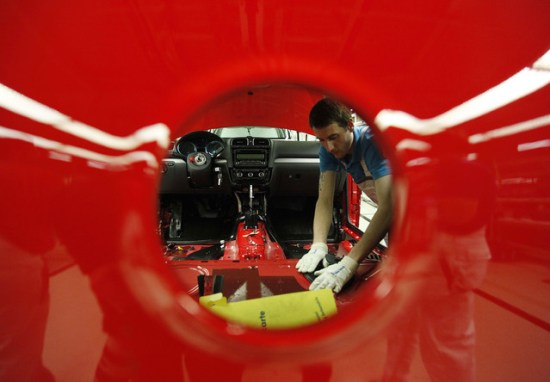
What Do You Mean You Won’t Buy Our Stuff Anymore?

Europe’s largest economy, may slow to a near standstill next year as the region’s debt crisis saps demand for exports.

You know that scene in Austin Powers when Dr. Evil says an evil funny and he and his evil cronies start laughing loudly in a sinister fashion and just laugh and laugh and laugh and then finally stop laughing because, well, you just can’t keep on laughing like that forever, no matter how evil the joke?

Well it’s the same thing with German Schadenfreude about being fein raus (off the hook) and everybody else out there doing the suffering, economically speaking. You can only enjoy that Schadenfreude for so long, folks. So like export a few more good chuckles out of this while you can.

“The global economic recession triggered by the international financial crisis will be long-term.”

Pro-Iranian Business Conference Great Success In Berlin

Although having been in a bit of a slump recently for some inexplicable reason, business opportunities appear to be picking up once again with Iran for mid-sized German firms.

Something called the “Iranian Business Women Power Economic Congress,” specifically designed to violate the sanctions put in place against the Iranian regime (established by Germany, the European Union, the United States and the United Nations), is successfully promoting trade with the Islamic Republic while simultaneously honoring Iranian women’s rights or something, although some of the women attending haven’t dressed according to forced Islamic dress codes (well they’re forced in Iran) “but we will address that later,” one miffed bearded organizer noted.

“And no, we are not allowing Iranian women to be used as a pretext here in Germany to defy the so-called sanctions you speak of,” another organizer added. “How could we? We like women. The humiliation, silencing, repression and stoning of them that takes place back home is grossly exaggerated in the West. And for the record, once again: We’re not developing any nuclear detonators, warheads or weapons of any kind either, just in case you were wondering.”

“Wir sind wie Wasser – wir finden immer einen Weg”

A Leaner Non-Fighting Force

Germany has announced 31 military base closures and the significant scaling back of 90 others as part of a major overhaul of the country’s armed forces which everybody here knows will never be used in any real combat situations anyway.

“Cuts or not, the German military must remain able to not deploy in an entire range of situations,” one high-ranking, unnamed Bundeswehr official said.

“This includes in particular missions in dangerous armed conflicts as well as high-intensity combat missions our government will regularly forbid us to participate in.”

When asked if these cuts might have a negative effect upon German defense industry firms involved in the extremely lucrative production of systems like the Eurofighter combat jet, the A400M military transport plane and the Leopard 2 and Puma tanks, to name just a very few, the official reassured all who cared to listen that the German military will do all in its power to seek other options to extend the orders for such weapons and will most certainly continue to order more of the same in the future.

“Our function as alibi army for the German defense and weapons export industry will continue to be our number one priority,” the official said, clicking his heels loudly or something.

The elimination of the draft will require making a career in the military more attractive in a country where part of the population is skeptical of military interventions. Germany didn’t support the international campaign in Libya.

Germany’s Latest Contribution To The Arab Spring

These must be special Panzer for Peace or something, these 200 ultra-modern Leopard battle tanks Germany is now prepared to supply to Saudi Arabia.

This is a dramatic reversal of Germany’s decade-long policy of not furnishing that zany authoritarian kingdom with heavy weapons and is clearly designed to send a strong message to freedom-loving Arab protesters everywhere (the Saudi military recently helped put down protests in Bahrain, if you recall).

Whether that is the right message or not, that’s another question.

According to the Stockholm International Peace Research Institute (SIPRI), the main buyers of German weapons systems in the years 2006 through 2010 were:

    Greece (with a share of 15 percent)

    South Africa (11 percent)

    Turkey (10 percent)

    South Korea (nine percent)

    Malaysia (seven percent)

SIPRI said that Germany advanced from fifth to third place among the biggest arms sellers between 1998 and 2009, even though a previous center-left government pledged in 2000 to pursue a “restrictive'” policy on exporting defense technology.

But We Mentioned Human Rights

You got your values, then you got your interests. Then you have the value of your interests. Then you have the interest you get on the value of those interests.

So, in other words, always look after your own interests if you want good value.

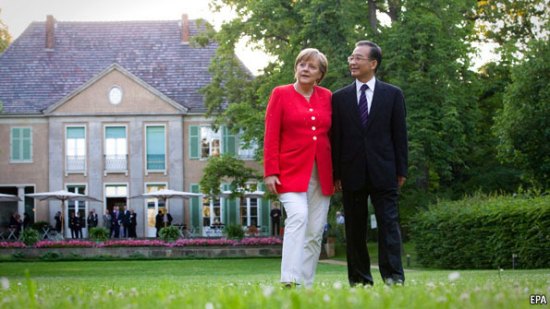
Chinese Premier Wen Jiabao and German Chancellor Angela Merkel also targeted an increase of bilateral trade to 200bn euros ($284bn; £178bn) over the next five years.

Germany is by far China’s biggest trading partner in the European Union.

China and Germany are the two biggest exporters in the world. 

Are these the sanctions you were talking about, Guido?

The issue of German exports is more complex. After the embargo was lifted, Germany’s arms business with Libya was quickly put back on track. German exports to Libya were worth €53 million in 2009, the third highest in Europe.

The Gadhafi regime has been blocking the mobile phone and GPS networks in Libya for days — possibly with the help of German technology — to prevent protesters from being able to communicate with each other.

And there is also controversy over the radar technology that Germany supplied to Libya to help it secure its borders. In 2010, the EU pledged to give the dictator €50 million so that Libya could prevent African refugees from reaching Europe’s coasts. But this and other deals like it are now coming back to bite the EU.

“The situation in Libya illustrates the fundamental problem that the long-term effects of arms transfers are not taken into account.”

Maybe history does repeat itself

At least when it comes to Germany’s interest in benefitting from currency troubles, I mean. Hey Greece, Ireland, Portugal, Spain, Italy… Stay hard-up or shut-up.

”The key principle of German economic policy was to persuade the French and Italians to lower the value of the D-mark so as to make Germany more competitive.”

“The Berlin government’s intransigence over the debt issue, while politically understandable from a German point of view, seemingly pays little heed to the realities of the euro economy, which are heavily tilted towards Germany.”

“In pre-EMU days, if the German economy were growing at an estimated 3.7% as it is this year, the German currency and interest rates would both come under upward pressure – damping exporters’ performance and the growth outlook. Now, however, with all EMU economies shackled together, and devaluation an impossibility for the peripheral countries, the hard-up states have nowhere to hide. Germany continues to profit from excellent export performance — and it can self-righteously point the finger of blame for the euro area’s woes at those debt-ridden peripheral states.”

Ah! Scenic Lake Constance…

The charming landscape, the panoramic views, the armaments industries booming everywhere…

Of course none of these companies (or the communities that live off them) use terms like that if they can avoid it. They prefer calling them “security engineering” or “defense technology” businesses instead, for some strange reason. Maybe because like everwhere else in Germany, they’re all pacifists down here too? Interesting article.

“Genuine pacifists are hard to find around Lake Constance. Most have turned more pragmatic long ago–or maybe their name is Nena. The pop singer performed here last year at MTU’s 100th year anniversary company celebration. And she sang her peace song 99 Luftballons too, of course, and 14,000 guests sang along with her. Before Nena arrived, the celebration’s main attraction had been a Leopard II tank.”

“Laut dem schwedischen Friedensforschungsinstitut Sipri liegt die Bundesrepublik auf Rang drei hinter den USA und Russland–und das, obwohl die deutschen Exportkontrollen zu den strengsten der Welt zählen.”