And What About The Illegal Aliens From Outer Space?

World famous for opening their borders to illegal aliens from anywhere and everywhere else in this world, German Green politicians were recently stunned to discover that their government has failed to adequately prepare for the possible arrival of illegal aliens from other worlds.

Aliens

“So how do you organize a welcome party for an alien race?” asked a flustered CDU politician during intense questioning. “You planet!” the Greens shouted back.

The German government says it has made no preparations for the possibility that aliens might land in the European country.

In a response to questions from opposition Green Party lawmaker Dieter Janecek, the government said “there are no protocols or plans for a possible first contact with alien life.”

“A first contact on German territory is extremely unlikely, based on today’s scientific knowledge.”

German Of The Day: Vergewaltigung

That means rape. And three in a row popped up in the news today

Rape

Strange, they never used to be in the news this much. Now hardly a day goes by without a report or two. It’s been, I dunno, two or three years now. Times seem to have gotten a little rougher here in Germany – and elsewhere in Europe – for some reason.

Nach Vergewaltigung in Hamburg Politiker fordern Aufklärung – und Härte… Der Verdächtige ist vorbestraft und sein Asylantrag abgelehnt.

Agreement Kind Of Reached About Actually Sort Of Enforcing A Law That Has Already Been In Effect For Years

Remember when laws used to have to be followed? Me, neither.

Spain

Berlin and Madrid are demonstrating unity with a joint agreement on returning migrants from Germany to Spain. Now Germany wants to seal similar deals with other countries…

Isn’t this already determined by the Dublin Regulation?

Yes, in principle it is. According to the Dublin Regulation, a migrant is supposed to become the responsibility of the country where he or she is first registered. As a rule, it should be the country where they first set foot on European soil. If a refugee comes to Germany and it turns out that he’s already registered in Italy, the German government could send him back there. However, European law also requires it to consider whether it makes more sense for a refugee to stay in Germany — if, for example, they have relatives living here…

Many EU countries consider the Dublin Regulation impracticable. The transfer of migrants from one country to another is extremely time-consuming. Furthermore, many migrants are not even registered at the point when they first set foot on European soil. During her visit to Spain, Merkel too described the Dublin Regulation as “unworkable.”

German Of The Day: Anstieg

That means surge. An example would be “As remarkable as Spain’s rise in irregular migration activity has been through 2018, even more important is its recent surge.”

Surge

Germany considers tough response to Spain migration ‘surge’ – A German official has warned that Berlin may impose fresh controls on the borders with France and Switzerland. With a surge in migrant arrivals to Spain, Germany is hoping to avoid a repeat of the 2015 migration crisis.

“Over the year’s first five months, a total of 8,150 men, women and children were rescued in Spanish waters after leaving Africa — an average of 54 per day,” the IOM reported. “In the 55 days since May 31, a total of 12,842 have arrived — or just over 230 migrants per day.”

Left Now Right?

No, let’s call it Right Goes Left. How about Left Right Left?

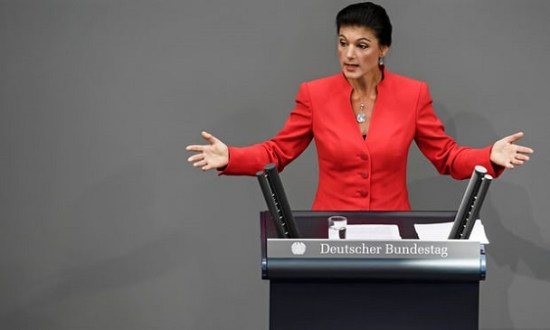
Wagenknecht

This perennial leftist Frontfrau (lead singer) has just thrown up her hands in desperation about what to call her new collective (collectivist?) lefty movement of malcontents (there’s a big demand for movements like that these days) and finally settled for #aufstehen (stand up, rise up).

Leftwing politicians are singing the praises of border control while rightwingers call for expanding the welfare state. Old political certainties could be turned upside down in Germany this summer as the far ends of the country’s political spectrum both moot a “national social” turn.

A new leftwing movement soft-launching in Germany in August aims to part ways with what one of its founders calls the “moralising” tendency of the left, in an attempt to win back working-class voters from the far-right Alternative für Deutschland (AfD).

SPD-Vize Stegner kritisiert das Projekt als “Egotrip notorischer Separatisten.”

German Of The Day: Allzeittief

That means all-time low.

Trend

According to the “Germany trend” survey taken by the ARD, the popularity of Germany’s dominant sister party union of CDU/CSU (Angela Merkel/Horst Sehofer) has dropped to 29 percent, its all-time low. Meanwhile, the ostracized right-wing populist party AfD has climbed to 17 percent, its highest rating so far. If an election were held this Sunday, the union and the SPD (the current grand coalition government) would no longer have a majority and land at 47 percent.

Now I’m going to go way out on a limb here but I think all of this has something to do with Germany’s still unresolved migrant crisis.

Union sackt auf Allzeittief – AfD steigt auf Rekordhoch.

One Small Step For Europe

One giant leap for Europe-kind?

Migrants

An operation in which an Italian towboat rescued more than 100 people in the Mediterranean and returned them to Libya may have been in breach of international law, the United Nations has said.

According to the Spanish charity Proactiva Open Arms, the Asso 28, an oil rig support vessel, rescued 108 people from international waters on Monday and took them to Libya, their country of departure.

Die “Asso 28” hat Migranten in Seenot an Bord genommen – und nicht nach Italien gebracht, sondern zurück nach Libyen. Die Regierung in Rom jubelt, doch die Aktion war vermutlich illegal.

Good Deportees Are Hard To Find In Germany These Days

In fact, any kind of deportees are hard to find in Germany these days.

Deportees

But at least we know that they are here in Germany, authorities assure the worried public. What other country would put up with this madness?

A German federal police report says that deportation orders were up 17 percent, but that actual deportations were down 4 percent. Meanwhile, the labor minister argues that some of those being deported shouldn’t be.

More than half of the ordered migrant deportations failed to be carried out through May, in almost all cases because the individual could not be located, a German newspaper reported on Sunday.

Through the first five months of the year nearly 24,000 people were ordered to be returned to their home country but only about 11,000 deportations were completed, according to an internal report by the federal police that was first reported by the Welt am Sonntag.

“How we deal with the migration issue will determine whether Europe will last.”

We Can Do It

Sure we can. As in you can. At least that’s what she said. But she never said how long it would take.

Wir schaffen das“: we can do it. That was German Chancellor Angela Merkel’s mantra three years ago, when Germany welcomed more than a million asylum seekers. This week, she was forced to find a compromise that included strengthening borders and promising to send migrants back. Hundreds of thousands of cases are currently before the courts. At one Berlin courthouse, two-thirds of procedures involve asylum seekers and the workload has increased significantly. Our correspondents report.

Wir schaffen das.

It’s not like you have any choice. Nobody gave you one.

German Of The Day: Transitzentren

That means transit centers – for migrants entering Germany through Austria. And these transit centers are the price Angela Merkel (CDU) had to pay Horst Seehofer (CSU) to keep her government together, at least for a little longer.

Tranzitzentren

The CSU-CDU compromise:

1. A new border regime at the German-Austrian border that prevents asylum seekers from entering Germany if it is the responsibility of other EU countries to process their asylum claim.

2.  Transit centers from which asylum seekers are returned directly to the country where they first arrived in the EU (if that country agrees)

3. In cases of refusal by the country of first arrival to sign up to the deal with Germany, the rejected asylum seeker will be turned away at the  German-Austrian border under an agreement with Austria

Man hätte es fast nicht mehr für möglich gehalten. Aber Edmund Stoiber ist immer noch da. Oder wieder. Und er sieht noch mürrischer aus als er es früher oft getan hat.