German Of The Day: Handelskrieg

That means trade war.

Handelskrieg

A trade war between the United States and Europe is coming and the fallout could tip Germany into recession, according to analysts at German lender Commerzbank…

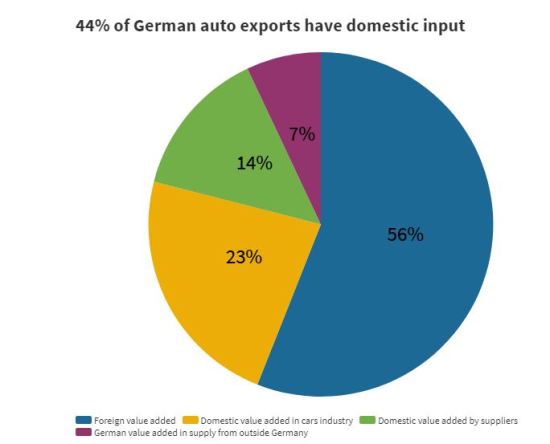
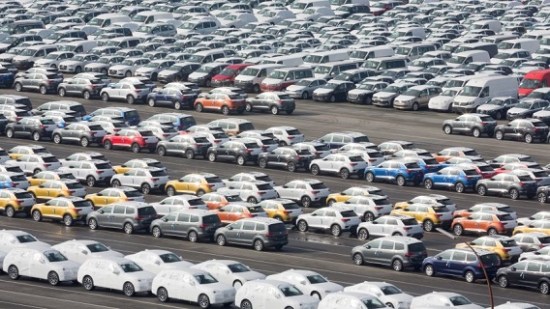
Official German statistics supplemented by the bank’s own research show that in 2018, the United States was the top export destination for German cars, accounting for about 12% of the total with a value of 27 billion euros of parts or finished vehicles.

The bank estimated that a Trump-ordered tariff increase of 25 percentage points on EU auto imports would slash that figure for Germany down to around 14 billion euros per annum.

When factoring in how much of that export figure is actual German “added value,” the bank estimated that total economic output for the country could fall by around 0.25 percentage points.

“All the more dangerous in a situation where the German economy is only just managing to avoid a recession,” it read.

German Of The Day: Naivität

That means naivete, as in being gullible or simple-minded.

China

Here’s an example: Industry Leaders Accuse Europe of Naivete with Respect to China – China’s aggressive approach in extending its economic power is causing concern among European companies. They demand a tougher approach from Brussels – and a convincing vision.

Good luck with that, European industry leaders. “Europe” doesn’t have time to deal with little issues like that at the moment, nor will it have any time in the near future. It is too occupied with self-inflicted problems like uncontrolled migration and Brexit (and the ensuing financial crisis) and placing the next batch of non-elected and unaccountable EU eurocrats in power. But once all that is taken care of, who knows? That little Chinese issue might just get tackled, too.

Die aggressive Vorgehensweise Chinas bei der Ausdehnung seiner Wirtschaftsmacht bereitet europäischen Unternehmern Sorgen. Sie fordern eine härtere Gangart von Brüssel – und eine überzeugende Vision.

German Of The Day: Unsicherheit

That means uncertainty. You know, like economic uncertainty?

Export

German exports fell by 1.3% in February compared with the month before, the Federal Statistics Office said on Monday. The figure represents the biggest drop in export revenue for a year…

Economists say that uncertainties surrounding Britain’s exit from the EU, the ongoing trade dispute between the US and China as well as weakening demand for industrial products are weighing on economies across the world.

“Die Ungewissheit aufgrund der vielen ungelösten Konflikte schlägt sich in den Auftragsbüchern nieder.”

Political Paralysis?

That’s my thing now. That’s what I do.

Merkel

On the one hand, I could screw it up with this side. On the other hand, I could screw this up over here first. Decisions, decisions…

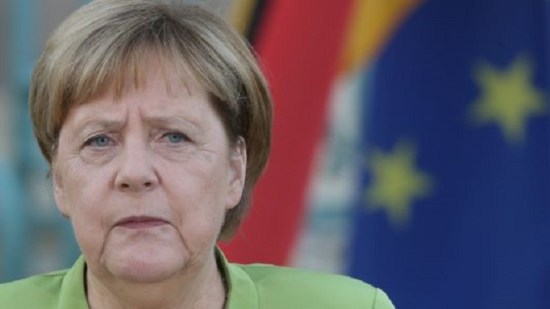
The global order that underpins German prosperity is unraveling, and Angela Merkel doesn’t know what to do. President Donald Trump’s America First policy is forcing Germany to make an impossible choice between the U.S. and China — pitting the force behind the country’s modern economic success against the key to its future growth…

For decades, the country profited from an international trading system run by the West and backed up by the military might of the U.S. The government just got out of the way and watched exports roll. Those days are over…

“Germany is caught up in a dilemma of changing trade patterns and doesn’t know how to react.”

Trump hin oder her – die USA bleiben Deutschlands wichtigster Absatzmarkt.

We’re All Going To Die!

When the Brexit hits the fan, remember?

Brexit

It’s quite odd. Germans, notoriously nervous by nature, don’t seem terribly worried about Brexit these days at all. I guess there’s only so much you can worry about at any given time. Even if you’re a German.

Dead calm: Brexit not in top 10 of German businesses’ priorities – With five weeks to March 29th, Germans are worried – about everything but Brexit.

Commuters fear inner-city bans on diesel cars. Politicians are fighting over renovating – and digitising – German schools. Police are battling criminal Arab clans.

“I don’t know why Germany, all in all, is so relaxed about this.”

Are You Feeling The Security Risk Yet?

European automobile tariff regulators?

Import

The U.S. Commerce Department is set to meet a Sunday deadline to deliver its recommendations to President Donald Trump on whether imported vehicles and parts pose a national security risk, and to outline options on how to address the issue, officials said on Thursday.

Trump would then have 90 days after Commerce’s recommendation to decide whether to impose tariffs…

Trump has urged the EU to drop its 10 percent tariff on imported vehicles. The U.S. passenger car tariff is 2.5 percent, while it imposes 25 percent tariffs on pickup trucks.

The Alliance of Automobile Manufacturers, whose members include General Motors, Volkswagen AG, Toyota Motor Corp, has warned tariffs would boost imported car prices nearly $6,000 on average.

Deutsche Autobauer verstehen die Welt nicht mehr.

German Of The Day: Auftragsschwund

That means a decrease in orders.

Auftragsschwund

Did the boom just go boom?

Orders slid 1 percent from October, and posted a year-on-year decline of 4.3 percent, the biggest in more than six years. The monthly decline was partly due to aircraft orders, which had jumped in October, as well as weakness in the euro area.

While there are questions over the outlook for the German economy, the euro area’s biggest, the Bundesbank has long expressed confidence that it will overcome the slump seen in mid-2018. Responding to the factory data on Monday, Commerzbank said the decline “should not be over interpreted.”

“Wir blicken abwärts.”

It’s Good To Be The Queen

Of extracting wealth from the rest of the European Union.

Merkel

While few European states can pretend to share Germany’s distinction of being a “country of poets and thinkers,” none can rival German abilities to extract so much wealth from the rest of the European Union.

Last year, Germany posted a 159.3 billion euro surplus on its goods trade with other countries in the EU — one of the world’s largest free-trade areas and a region with privileged access to German goods and services.

That’s the way it’s been since 1958, when Europe’s common market opened up.

Statistisches Bundesamt: Deutsche Exporte im Juni 2018 um 7,8% höher als im Vorjahr.

Soyprise Soyprise

Just when you thought they soyrendered… The trade relationship between the United States and Europe is improving, German Agriculture Minister Julia Kloeckner said on Saturday, but there is no guarantee the bloc will buy the quantity of soybeans that Washington expects.

Soy

U.S. President Donald Trump and Jean-Claude Juncker, president of the European Commission, the EU’s executive body, struck a surprise deal on Wednesday that ended the risk of an immediate trade war between the two powers.

After the talks, Trump highlighted benefits for U.S. farmers. “The European Union is going to start, almost immediately, to buy a lot of soybeans,” he told reporters.

Kloeckner, speaking to Reuters on the sidelines of a G20 meeting in Buenos Aires, said the amount of soy Europe will import is yet to be determined.

“Will we be able to do whatever President Trump wishes for? I don’t know. Let’s see whether this will be the case or not,” she said.

Soy its back to the drawing board, folks. We’ve got another European insoyrection on our hands. Yup, another resoygence of European protectionism. But if they want a trade war then their destruction is assoyed. We’ll see who has the better chance of soyvival.

When Had We Left The Jungle?

I wasn’t aware that we had.

Jungle

WTO Faces Existential Threat in Times of Trump -U.S. President Donald Trump has set his sights squarely on the World Trade Organization in Geneva. Even its critics are worried that without the organization, the world of trade would revert to the law of the jungle.

The U.S. and other industrialized nations made several concessions to developing economies when the WTO was founded in 1995 and significantly reduced their tariffs. In return, they were able to push through stronger protections for intellectual property. They hoped that the strategy would help slow China’s rise.

But from the U.S. perspective, the system has not been beneficial. And once China joined the WTO in 2001, that dissatisfaction only grew, partly because the Chinese proved adept at taking advantage of the rules. Even today, there is significant dissent within the WTO because the economic superpower China is still classified as a “developing nation” by the organization, which gives it certain privileges. On the other hand, China is fighting for recognition as a market economy, to which both the U.S. and the European Union are opposed because it would mean they could no longer defend themselves against state-subsidized Chinese exports with anti-dumping duties.

On top of all that, the WTO is facing a more fundamental problem: its size and its sluggishness. Negotiating rounds focused on removing tariffs have become increasingly complex. And because everything is up for negotiation at the same time, every member state can paralyze the process by simply exercising its veto. The Doha Round, launched in 2001, is a perfect example: It never achieved any results and has become symbolic of the WTO’s failure.

“The problems are coming from the behavior of a single country that would like to return to the jungle.”