Provide affordable housing for ordinary Germans?

That ought to be easy enough.

I mean, how many ordinary Germans can there be?

Chancellor Merz pledges affordable housing for ordinary Germans – German Chancellor Friedrich Merz said on Wednesday that the government wants to do more to make housing affordable for ordinary people again.

“Anyone earning a normal income in Germany should be able to buy a normal home,” Merz said at the Construction Industry Conference in Berlin.

“We are determined to … get things moving so that building in Germany becomes faster, easier and cheaper, enabling the average family in Germany to afford their own home as a rule,” Merz asserted.

German of the day: LAF

That stands for Landesamt für Flüchtlingsangelegenheiten Berlin. And that stands for Berlin’s State Office for Refugee Affairs.

And it’s a been a LAF a minute over at the LAF these days, having now run out of room to house the growing number of refugees.

Berlin plans new mass accommodation for refugees – Immigration has become a hot-button issue in Germany. Refugee accommodation centers in Berlin are full to overflowing, but there’s a desperate lack of housing. Now, authorities are coming up with bright ideas…

Over 30,000 refugees in Berlin are living in accommodation facilities run by the LAF. Many have already had their asylum claims approved but are stuck in state-run facilities because they can’t find affordable accommodation on the capital’s fiercely competitive real estate market.

German of the day: Zusammenbruch

That means collapse.

German homebuilding collapse threatens wider economic damage – Once-thriving residential construction industry has slumped, posing drag on EU’s largest economy.

Across Germany, homebuilders are facing such a sharp reversal in their fortunes that the downturn in residential construction is threatening to have broader repercussions across Europe’s largest economy.

Many have declared themselves insolvent, dampening Chancellor Olaf Scholz’s target of building 400,000 new homes a year to tackle a housing affordability crisis in several of the country’s largest cities.

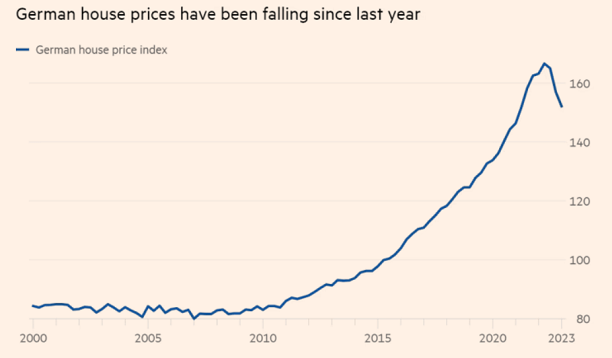
Largest housing price drop in 2000 years?

Damn. That’s a big drop.

Oh. Since the year 2000. But still.

German housing prices show sharpest drop since 2000 year over year, statistics office says – German housing prices fell by the most since records began in the second quarter as high interest rates and rising materials costs took their toll on the property market in Europe’s largest economy, government data showed on Friday.

Residential property prices fell by 9.9% year-on-year, the steepest decline since the start of data collection in 2000, the federal statistics office said. Prices fell by 1.5% on the quarter, with steeper declines in larger cities than in more sparsely populated areas.

Step One: Do everything you can to make it difficult to build new housing…

Step two: Once rent prices explode due to step one, introduce a rent freeze to end the few meager building projects still in operation.

Go Social Democracy!

Germany’s ruling party plans to curb rent increases – SPD set to unveil measures to tackle soaring costs facing tenants, says senior lawmaker.

Germany’s ruling Social Democratic party is set to propose a three-year rent break across the country, as tenants struggle to cope with the soaring cost of housing in Europe’s largest economy.

“We need to create breathing room — we need a rent freeze for the next three years,” senior SPD lawmaker Verena Hubertz told Bild am Sonntag, adding that Chancellor Olaf Scholz would outline measures on Monday to tackle the country’s cost of living crisis.

We’re From The Berlin City Government

The “red-red-green” city government. And we’re here to help.

Control

A disaster foretold – After a year, Berlin’s experiment with rent control is a failure. Rents may be down, but so is the supply of homes.

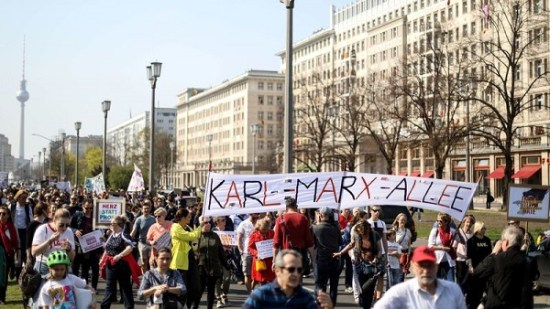
”I WORRY ABOUT Berlin,” says Rolf Buch, a born and bred Rhinelander. The chief executive of Vonovia, Europe’s biggest residential-property firm, thinks that the city’s policy of capping rents has achieved very little good, but caused severe collateral damage. Even if the federal Constitutional Court declares the rent cap unconstitutional in the next few months, as many expect it to do, Berlin will not go back to the status quo ante. Protests are here to stay, Mr Buch reckons.


The Rents Won’t Be the Only Things That Will Freeze

Building will come to a complete standstill in Berlin too.
Berlin

But Berlin’s red-redder-green politicians (SPD, the Left Party, the Greens) don’t know anything about building (look at the state the city of Berlin is in). They can only tear things down. Oh, yes. And redistribute. They will redistribute for as long as it takes to get anybody who’s got anything to get out of town.

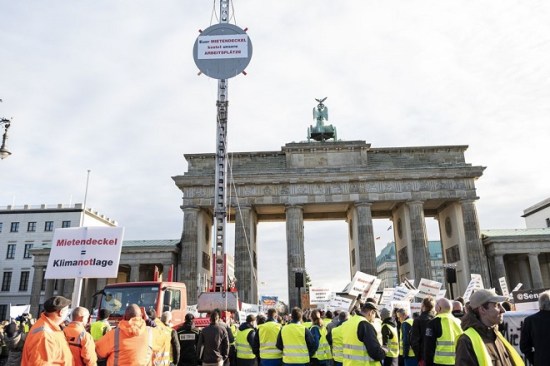
Berlin Builders Hit the Streets in Backlash Over Rent Freeze – The German capital’s government is trying to ease the burden on tenants after a property boom caused rents to double over the past decade. However, critics of the plan — including economists and large landlords — have said the only way to address growing demand for housing is to build more homes.

The rent-freeze legislation will start its passage through Berlin’s parliament this week and is expected to come into force in the first quarter of next year…

The city’s plans “threaten to cause considerable damage to both the housing market and Berlin as a whole,” IW institute economists wrote in a recent report for the Christian Democratic Union party, which is in opposition in Berlin and opposes the measures. Scrapping the plan is “urgently needed from an economic perspective to prevent wider damage to the Berlin economy,” they added.

German Of The Day: Eigentum

That means property. But property doesn’t mean much in Germany anymore. At least not in Berlin under its current “red-red-green” city government.

Property

Another word you might be interested in here is Enteignung.

German officials facing protests and endless complaints about threats to affordable housing in the nation’s capital have decided the solution may be a five-year ban on rent increases and fines as high as $550,000 for violators.

Officials in Berlin, a city of about 3.7 million residents long known for its affordable housing options, announced this week that they plan to temporarily freeze the rents charged on publicly and privately owned apartments in a bid to halt runaway gentrification.

“It will scare away investors who will find alternative markets with less regulation. It’s a socialist and populist attack on the free market and it’s not going to lead to a single new apartment being built.”


Redistribution Is Da Solution (Again)

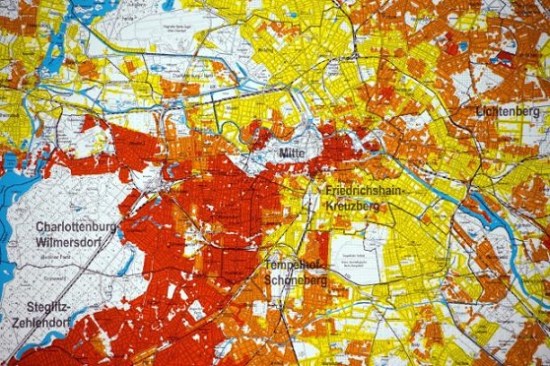
The next step backwards: Berlin has a new law prohibiting landlords from demanding rents that are more than 10 percent higher than the area average, in an attempt to keep housing affordable in a city that’s attracting 50,000 new residents a year. The rule relies on a disputed index — known as the Mietspiegel — that critics say is a statistical crapshoot.

Rents

“The rent brake is essentially a transfer of wealth from landlords to tenants. Berlin will become less of a destination for international investors because capital doesn’t like to be constrained.”