Germany’s economy is on shaky ground and glimmers of hope are few and far between – Good news has been sparse for the German economy. And the latest economic data has not done much to change this.
A few key 2023 data points, namely factory orders, exports and industrial production, were out last week and indicated a weak end to the year that saw questions about Germany being the “sick man of Europe” resurface.
But not as bad as “greatest real estate crisis since the financial crisis.”
The fun just never seems to end these days.
German bank alerts the market on exposure to commercial real estate – The troubles in the US commercial property market, which have already hit banks in New York and Japan, moved to Europe this week, elevating fears about broader contagion.
The latest victim was Germany’s Deutsche Pfandbriefbank AG, which saw its bonds slump on concern about its exposure to the sector. It responded by issuing an unscheduled statement Wednesday that it had increased provisions because of the “persistent weakness of the real estate markets.”
It described the current turmoil as the “greatest real estate crisis since the financial crisis.”
Into the brave new renewable energy future. The German government has announced it will spend €16 billion to build four major natural gas plants to meet the electricity demand their beloved renewable energy technology simply can’t meet.
A brilliant move, and long expected. Overdue, actually. You see, wind and solar power are so unreliable that you must always build a second “dirty” system (CO2 is a BAD “pollutant,” remember?) to back them up. This way you get to spend twice as much as you would have if you had only used the dirty system to begin with. Or, heavens forbid, if you had used nuclear energy to begin with (it doesn’t produce any CO2). This way, in other words, you can save the planet with one hand while you continue to pollute it with the other.
After scrapping nuclear reactors, Germany to spend billions on new gas power plants – The fossil fuel expansion is needed to ensure long-term energy security, according to industry and the government.
In a statement Monday, officials said the new strategy came “in addition to the consistent expansion of renewable energies,” and was key to ensuring steady power supplies “even in times where there is little sun and wind.”
Without you not being here – about 20 sick days a year.
A study says that in 2023, 5.5 percent of German employees were absent every day due to illness. Sickness-related absences caused 26 billion euros of damage in 2023. Without them, Germany would not be in recession.
“At least for 2023, Germany will be the ‘sick man’ in the truest sense of the word, whose economic performance will be significantly more affected by the wave of illness than in other countries.”
You know, like when a government can’t burn the money it wants to burn because it already turned it to ashes?
Shortfalls could challenge Germany’s generosity – Germany has been one of the biggest spenders in the world on everything from social welfare to foreign aid. But national income has fallen and Germany’s government is dealing with a budget shortfall.
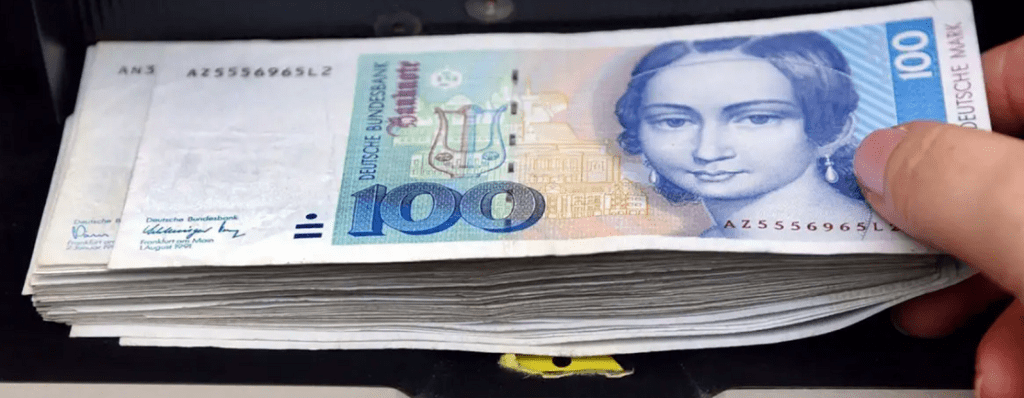
Why are Germans hoarding billions of useless deutsche marks?
As everything seems to be getting more expensive through inflation, many Germans have a secret stash of cash at home. They’re holding on to their long-expired currency instead of exchanging it. What are they waiting for? …
Though these marks can no longer be used, they can be traded for euros.
German industrial output drops unexpectedly in November – German industrial production fell unexpectedly in November by 0.7% compared to the previous month, the federal statistics office said on Tuesday.
As reported earlier, this only confirms that the Green plan to shut down Germany in order to save the planet is running like clockwork.
When it comes to record German weapons export recipients.
€11.7 billion ($12.8 billion) in 2023. Wow. Not bad for a pacifist country.
German weapons exports reached record high in 2023 – Germany’s government authorized more arms exports in 2023 than ever before, according to preliminary figures disclosed to lawmakers last month.
The war in Ukraine partly fueled this uptick, with exports to Kyiv more than doubling compared to 2022. The record-breaking volume follows the government’s commitment to placing tougher restrictions on arms sales, a promise from the campaign trail.
No way. Emission certificate fraud? For fraudulent emissions?
The Chinese would never do that.
German authority probes alleged Chinese emission certificate fraud – Listed project coordinates show only desert on Google Maps.
The German Emissions Trading Authority is looking into allegations of irregularities in an undisclosed upstream emission reduction project in China, the body told Nikkei Asia.
The move comes after allegations by German biofuel producers that upstream emission reduction (UER) certificates issued by the authority, known as DEHSt, to some international fossil fuel companies for their emission curtailment projects in China were based on fraudulent information.
I know! We’ll increase the sales tax so nobody comes to your restaurant at all anymore.
No need to thank us. We’re from the government and we’re here to help.
German budget woes trigger disaster warnings for restaurants – Owners who oppose return to higher pre-pandemic VAT rate are dismissed as scaremongers by economists.
Kemal Üres, owner of a tapas bar in Hamburg, has spent the past year telling his social media followers that thousands of businesses like his will be destroyed by a planned tax increase.
The man who calls himself the “Gastroflüsterer”, or restaurant whisperer, is campaigning to make the pandemic-era cut in value added tax on restaurant meals permanent. Otherwise, the German government’s decision to raise VAT from the 7 per cent rate in place since 2020 back up to 19 per cent in January would lead to higher prices, job cuts and as many as 30,000 bankruptcies, he said.





 Observing Hermann