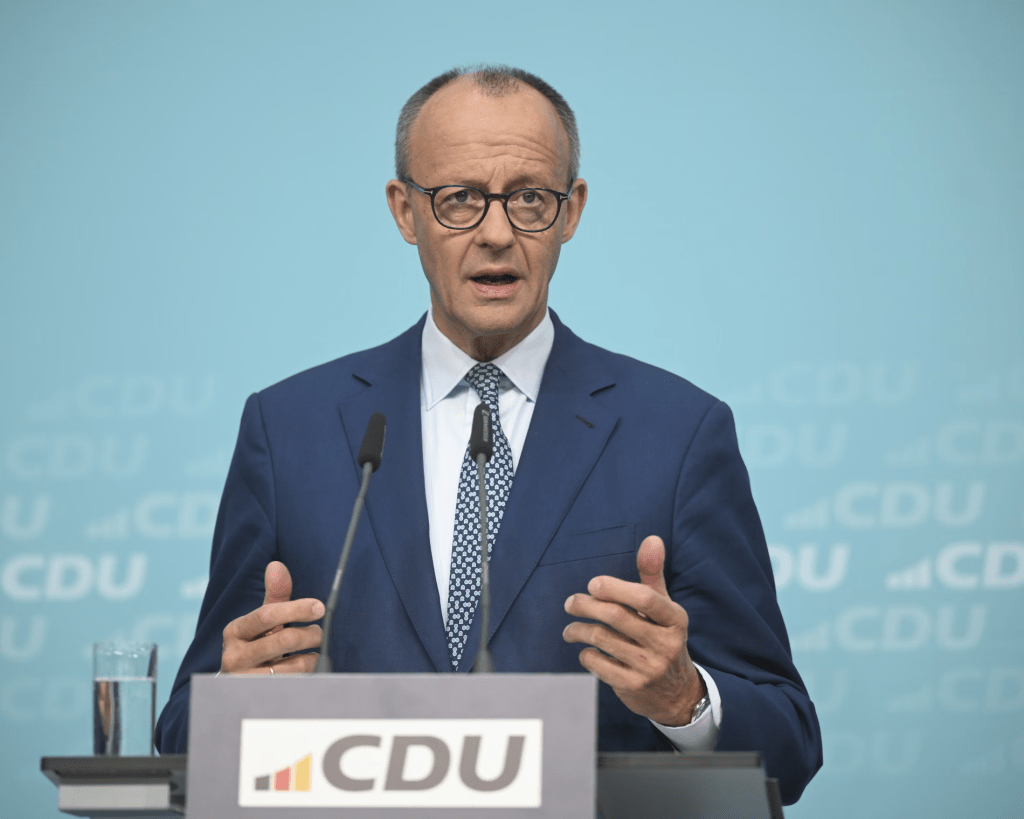
Germany’s Merz warns against ‘false nostalgia’ over US alliance – The chancellor’s comments show European leaders are girding for a future in which the transatlantic alliance is no longer the bedrock on which the continent’s defense and economy stand.
“We must face the fact that our relationship with the U.S. is changing, The U.S. is reassessing its interests — and not just since yesterday. And so we in Europe must also adjust our interests, without false nostalgia.”
Germany suffer shock World Cup qualifying loss to Slovakia – Germany’s 2026 World Cup qualifying campaign got off to a disastrous start as they suffered a deserved 2-0 defeat to Slovakia. Furious head coach Julian Nagelsmann questioned his team’s mentality.
Germany’s journey to the 2026 World Cup in the USA, Mexico and Canada got off to the worst possible start as Julian Nagelsmann’s team suffered a deserved 2-0 defeat to Slovakia in Bratislava.
Nearly three months after the disappointment of the Nations League, Germany looked out of shape and sorts. They had never lost a World Cup qualifier away from home before tonight. History had been made, but not the kind that Nagelsmann wanted.
As long as you can say you have the highest energy costs in Europe?
Or is it the highest energy costs in the world? I forget. Go, Greens!
Germany could see power supply gap in 2030, regulator says – Germany’s Federal Network Agency on Wednesday warned that rare electricity shortfalls could occur as early as 2030 if the country’s energy transition stalls, though supply is otherwise expected to remain secure through 2035.
The Security of Supply Report, approved by the federal cabinet on Wednesday, highlights the risks should renewable expansion slow, new gas-fired power plants fail to materialize, and electricity demand not become sufficiently flexible.
The influx of migrants has been out of control for ten years now and there’s no end in sight.
Germany updates: Merkel’s ‘Wir schaffen das!’ 10 years on – Today marks 10 years since Chancellor Angela Merkel said “we’ll manage it” as Germany welcomed hundreds of thousands of displaced people.
“Wir schaffen das” is now “wir sind geschafft.” We’re done. Exhausted.
German car industry sheds 51,500 jobs in a year – The dip equates to almost 7% of the total workforce in the German auto sector. Faltering exports to China and the US play a role, as new tariffs raise barriers to entry in both these core markets.
“The US and China are currently the cause of major concerns.”
As if the daily knife attacks don’t bother anyone.
As if the country didn’t start falling apart the moment she opened up the floodgates.
She regrets nothing and would make the same decision again today. What else is she going to say? Disgusting.
Germany updates: Merkel reflects on 2015 refugee policy – The former chancellor believes much has been achieved since allowing hundreds of thousands of refugees into Germany.
Germany updates: Economy shrinks more than expected – Europe’s largest economy has shrunk, with industrial production and construction weaker than first thought. Meanwhile, Berlin is being urged to recognize a Palestinian state.
The best part is that there are never any consequences… Right? Even when spending the money you don’t have is never actually spent.
Germany’s borrowing spree plans face a reality check – Investors would be wrong to overstate concerns about a debt surge by the country.
Germany has had an abrupt awakening on the need to increase defence spending. The country enjoyed an oversized peace dividend for years: before the Berlin Wall fell, west Germany spent almost 3 per cent of GDP on defence. In the three decades after 1993 that ratio dropped to around 1.2 per cent annually. Military capabilities fell commensurately.
Since Russia’s attack on Ukraine and the election of a US president given to venting misgivings about European allies, a hectic scramble has ensued to make up for lost time. As chancellor, Olaf Scholz declared a “Zeitenwende” (or historical turning point) and parliament approved a €100bn debt-financed special fund for defence spending…
Nevertheless, markets would be wrong to overstate the German debt surge. The government’s ambition will probably be thwarted when the plans get in contact with reality. Appropriating borrowing permission is much easier than actually spending it. Scholz’s military special fund is a case in point. Up to April, halfway through its life, only around a quarter of the money has been disbursed.
But we’re just stretched too thin at the moment for the past forty years.
Germany likely too stretched to provide troops for Ukraine, foreign minister says – Johann Wadephul’s comments come as the U.S. and European nations discuss security guarantees for Kyiv as a core element of any potential peace deal.
Country by country. There must be a good reason for this. Why are European voters voting for parties that promise to get European migrant madness under control? What’s wrong with them?
Far-right AfD tops German popularity ranking in bombshell new survey – Between Alternative for Germany and France’s National Rally, populists continue to rise in Europe’s most powerful countries.