Germans Just Love The ECB’s New Bond-Buying Program

Not.

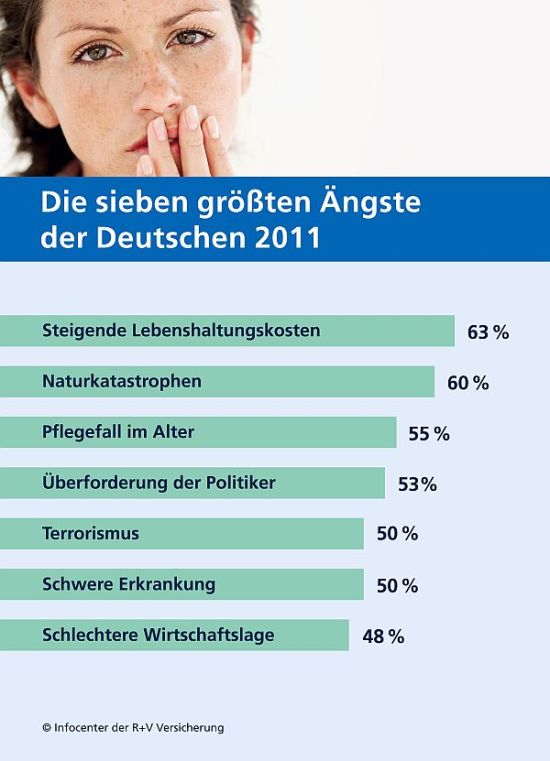
Which brings us to our next topic: The latest greatest German angst survey. A new study by R+V Versicherung (insurance) has just found out what Germans loved to be scared of most these days: The climbing cost of living (63 percent of those asked).

Außer den “Standard-Ängsten”, die die R+V Versicherung seit zwanzig Jahren bei 2500 Deutschen abfragt, stehen alljährlich auch aktuelle Themen zur Debatte.

Must See TV 4 Me

Finally, German TV for the rest of us. Hot diggity dog.

A new mini-series is starting on ZDFneo called “German Angst” and promises to finally and definitively answer a question that has been puzzling me for many years: “Are Germans really as neurotic as everybody thinks they are and just what is it that they are afraid of?” Actually, it’s the second part of that question I’m interested in. I already know the answer to the first part.

Of course if the show can actually hold that promise or not, that’s another thing. And how the hell are they going to find all this out in just 6 short episodes?

“Ich bin Autor und Reporter auf der Suche nach der Angst.”

Just Say No

As usual, I mean. Berliners in Kreuzberg (or at least that active, left-wing kind) aren’t interested in finding new solutions for urban living, thank you. And they’ll even threaten you with violence if you try to establish “temporary cultural space” to attempt to do so (go ask BMW Guggenheim Lab). Kreuzbergers don’t do culture. Temporary or otherwise.

And speaking of resistence… The rest of the country is pretty much Kreuzberg all over again (only on a much larger scale) when it comes to saying no to the Internet (some call it the Internetz).

This isn’t really a news item or anything, but now certain German businessmen types are actually starting to get worried about their country “sleeping through the Internet” age like it does.

They have come to discover that their fellow Germans provide “too few qualified professionals, suffer way too much from risk aversion and are caught up in a tightly structured regulation frenzy.” Like I said, this isn’t anything new. But the real question is: What are you going to be able to do about that? Not a damned thing, of course.

Das Internet ist ein globaler Treiber für die Wirtschaft. Doch in Deutschland bremsen Fachkräftemangel und hohe Anforderungen an den Datenschutz die Firmen aus.

Lots of Luck, Pal

He sure is an ambitious character, I’ll give him that much: Future German president Joachim Gauck “wants to rid Germany of angst.”

I’ll be the first to agree that what this nation needs is a good psychiatrist, but to actually rid Germany of angst?

That would be like ridding zebras of their stripes.

That would be like ridding muskrats of their musk.

That would be like ridding Americans of their apple pie.

No, no. I’ve just changed my mind. This not only can’t be done, I don’t believe it should even be tried. It would be immoral or something. And potentially dangerous. No, it would be absolutely positively dangerous. Let’s just let this sleeping, angst-ridden dog lie, el presidente.

Germany’s next president, wants to reinvigorate the nation with his passion for freedom and democracy. His emotional, at times unguarded rhetoric will liven up German politics — but could backfire if he isn’t careful.

Germans Still Scared Of The Internetz

Actually, it’s only the older, digital immigrant kind of Germans who are still scared of the Veb. You know, around 85 to 90 percent of the population?

And these are the folks who want politicians to introduce ever more stringent anti-Internet legislation (more is more here) and get all hysterical about data privacy for data that nobody’s interested in and ran Google Street View out of town and would never think of ever putting their faces (or anything else) on Facebook, provided they could even find the dad dern thing, and think that flash mobs are real mobsters with machine guns and stuff like that and on and on and on. And, oh yeah, these are also the folks who vote here. So there we have it. Old dogs, nix tricks. Tricks are for kids.

Sogenannte Digital Outsiders hält die Angst, die Kontrolle über ihre persönliche Daten zu verlieren, davon ab, überhaupt online zu gehen. Sie fürchten zudem, mit einem versehentlichen falschen Tastendruck das Internet zu löschen.

Crisis, Doomsday And The End Of The World As We Know It

I don’t usually tend to panic when reading newspapers, but when German journalists start writing articles critical of the media’s “eternal ramblings about doomsday,” I get very nervous indeed. This is news, in other words, primarily because this isn’t news to me.

Evelyn Finger’s main concern here is the German obsession with “the” Krise (crisis) in general (crises plural) and the latest so-called Krise der Demokratie (crisis of Democracy) in particular.

“In the meantime (it started out long ago with “the oil crisis,” she believes) we have become all too accustomed to terms like education crisis, energy crisis, climate crisis and, most recently, financial crisis, debt crisis and euro crisis. We have all hoped that these crises would not prove to become any more threatening than they already are, especially since our linguistic capacity to express more crisis seems to have been exhausted: World financial crisis! But a new threatening term has been spooking the debates as of late: A crisis of Democracy. Is there really such a crisis or is the chatter about it the real problem?”

We all know the answer to that question, of course. She rightly finds this obsessive German Angslust (passion for fear) ridiculous and has no trouble exposing it for what it is; mindless, self-indulgent, neurotic nonsense. But I do wish she would have had the decency to have warned me first. I don’t like stumbling accross articles like this in German newspapers, articles that make sense by expressing something we used to call “common sense.” If I had wanted to read articles like that I wouldn’t have bought a German newspaper in the first place.

But thanks anyway, Evelyn. You may have shaken me up a bit, but I really do hope you have a pleasant week.

Das Wort Krise hatte seinen Schrecken schon fast verloren. Es klang in den letzten Monaten auch bei dramatischer Nachrichtenlage etwas schwach und durch häufigen Gebrauch abgenutzt.

More Angst Underway

In a shocking new study or something, psychologist expert types have just discovered that up to 17 percent of German young people between the ages of 14 and 20 are currently suffering from the what is now to become the dreaded mass illness ailment sickness known as “social phobia” (formarly known as adolescence). No one has bothered to tell them about it yet, either.

These chronic sufferers, especially the girl ones, regularly avoid situations in which they must meet people they don’t know and do things that they don’t want to do. But there is good news, researchers say. This scourge of mankind (teenkind?) can be treated successfully. By finally growing up already.

“Die gute Nachricht ist, dass soziale Phobien erfolgreich behandelt werden können.”

New Angst Study Producing More New Angst

A new study from the R+V Insurance Company (hmmm, an insurance company) indicates that Germans have a whole new list of things to scare the Hosen off them that they didn’t have last year. Is there a pattern developing here or something?

Some of this year’s top favorites (so far) are ecological catastrophes (a perennial hit), the “super worst case scenario” that took place after the earthquake in Japan, the so-called EHEC scandal (go organic sprouts!) and those bloody and yucky revolts still going on down there in the Arabian World.

But what really scares them most is, well, their money. Or the thought of losing it, I should say. Along with their fear of rising energy costs (hmmm, where might those rising energy costs be coming from?), over 70 percent of Germans asked are scared to death of the imminent bankruptcy of a few of them there EU countries down south which will cost the German taxpayer dearly.

Hey. No angst, no fun.

70 Prozent der Deutschen befürchten, dass die drohende Pleite einiger EU-Länder den deutschen Steuerzahler teuer zu stehen kommt – keine Angst erreichte 2011 höhere Werte.

“Angst is the German lifeblood”

Die Zeit: How do you explain this (that Germans “like” to be afraid)?

Henryk M. Broder: I think the Germans have been waiting for their punishment since 1945. If the Allies had been at least a little bit more rigid with them, instead of tossing Mars bars from the sky, then maybe the Germans would be in a slightly better constitution today. They’re always thinking: Something’s still coming, and we deserve it.

He’s joking, of course. But maybe he’s not joking.

Man muss nicht 30.000 Kilometer durch Deutschland fahren, um festzustellen, dass die Deutschen gern Angst haben. Sie haben Angst vor Oberleitungen und unterirdischen Bahnhöfen, vor Dioxin im Frühstücksei und vor der Klimaerwärmung. Letztere ist bekanntlich ein globales Phänomen, aber niemand fürchtet sie so sehr wie die Deutschen. Angst ist das deutsche Lebenselixier.

Get your latest angst here!

Oh boy, another German angst study just came out. But nobody is brave enough to read it yet so I’ll have to give you a quick summary instead.

There is a certain logic to these studies, by the way. There always is, although it may not seem all that logical to you or to me.

For instance, after having patted themselves on the back over the past few weeks about how great the German economy is doing, it only stands to reason (here) that the latest number one German angst has to do with just that; the economy. Some 67 percent of Germans asked are shaking in their boots about it – and worry about the climbing cost of living at the same time. A mere 61 percent of those asked worry about becoming unemployed.

But it’s only going to get more frightening, folks. A group of economic experts has just revised their growth prediction for the Germany economy this year upwards fron 2.1 to 3.4 percent. Boo!

Wie andere Experten haben die Kieler ihre Schätzung für 2010 deutlich erhöht. Bisher hatten sie für 2010 nur 2,1 Prozent Wachstum veranschlagt, nun erwarten sie ein Plus von 3,4 Prozent.