Don’t Hold Your Breath, Tokyo

Two years after the Fukushima nuclear disaster, Japan is making a big push to win back German tourists, who are still avoiding the country because of concerns over radiation.  Visitor numbers from Germany, the world’s biggest spenders on foreign holidays in 2011, fell 35 percent between 2010 and 2011, and in 2012 did not recover as much as other markets, officials said in Frankfurt on Thursday.
Tokyo

It’s like this, folks: The level of radiation occurring naturally in Japan is much lower than that of Germany. The levels of naturally occurring radiation PLUS the radiation resulting from the accident at Fukushima are still within the range considered average for Germany.

None of this matters, of course. Hysteria bleibt (stays) hysteria.

Even at the dentist, Germans are often skeptical about the effects of x-rays and require reassurance over radiation levels.

PS: Speaking of hypochondria (sort of), Berliner Beamte (civil servants with disgustingly cushy benefits), police mostly, are off sick two months a year – on average.
The N-Word

You know, it starts with an n and ends with an r*? Do not even think about using it over here in Germany these days, people. Not that you would even want to or anything, even if you could. I’m just sayin’.

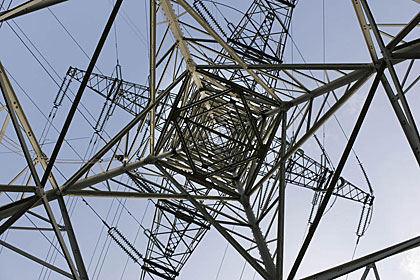
Why is this the case? I’ll tell you why. Because everybody’s all touchy these days. German power grids are less stable than they ought to be and nobody wants to address the reason why that is. Folks have gotten all sensitive and defensive because, well, because of that “power networks more unstable since n-word drop-out” thing.  And no, I didn’t think up that subtitle. I’m just quoting it, sort of. Civilized folks don’t use the n-word. And I ain’t a-gonna use it either.

Kritisch werden könnte es nach Auffassung von Fachleuten generell vor allem in Süddeutschland, wo der Strom der abgeschalteten Atomkraftwerke fehlt.

* “Nuclear”

Speaking Of Sinking Ships

EnbW Energie Baden-Wuerttemberg AG (EBK), Germany’s third-largest power supplier, postponed a decision to invest more than 1.5 billion euros ($1.9 billion) in a wind farm in the North Sea.

“We need legislative clarity and reliable conditions before we make an investment decision of considerably above 1.5 billion euros.”

Big Sister Assures Germans That 47-Percent Price Hike Actually Not Such A Bad Thing If You Think About It

Not.

Worried about grassroots unrest after Germany’s electrical grid operators announced they were nearly doubling the charge consumers will pay to finance subsidies for renewable energy as Germany phases out nuclear power, Big Sister herself has reacted boldly and decisively by going into hiding and pretending as if none of this were really happening.

Long used to this tactic, worried German consumers were assured, sort of, as they will now be paying an additional 60 euros per year, “taking overall add-on power taxes up to about 185 euros.” But that’s just the start, of course.

Sheesh. Why do Germans see everthing energy turnaround-related so negatively these days? You know, like as in black? Or like as in blackouts, I should say?

“The costs for consumers and industry of the electricity price charge for renewable energy has risen to an unbearable degree.”

What Are 20,000 Jobs?

If they are being offered for the sake of Germany’s beloved Energiewende (energy turnaround), I mean (and if you’re not one of the 20,000, of course)?

There is a certain logic here. I think. First you phase out German nuclear power plants because of the Fukushima disaster in Japan (I still haven’t figured out this part yet), then you phase out thousands of Japanese jobs due to the loses incurred by the energy companies due to this hasty (as in immediate) phase-out.

Oops, sorry. I just took a closer look at the article. Those are German jobs that are about to be phased-out, of course. Duh. Look folks, I’m not a German energy turnaround expert here you know. Forgive me for the confusion. Technically, it’s not even mine. I’m just trying to pass it on as best I can.

Branche verliert durch Atomausstieg Geld – Eine Reihe von Studien hatte in früheren Jahren bereist festgestellt, dass der Netto-Effekt der Ökostrom-Subventionen auf dem Arbeitsmarkt bestenfalls Null ist.

World’s Largest Brown Coal Power Plant Inaugurated In Germany To Help Save Environment

This German energy turnaround stuff can get really complicated, I find.

But as far as I can tell, dirty energy is clean energy here, too. As long as it’s German-made, that is.

“Dieser Neubau ist ein herausragender Beitrag zum Gelingen der Energiewende.” 

Germany Confused About Japan’s “Retreat” From A Nuclear-Free Future

And here we thought that Germans were good at math.

Until Fukushima, Japan satisfied about 30 percent of its electricity demands with nuclear power, while renewable energy made up about 10 percent of the power supply. If one leaves out hydroelectric power, renewables hardly make up more than 1 percent.

“Japan needs a vision.”

What’s 20 (30? 40?) Billion Euros These Days?

It’s peanuts, man. Renewable peanuts.

Damn. This gives power madness a whole new meaning.

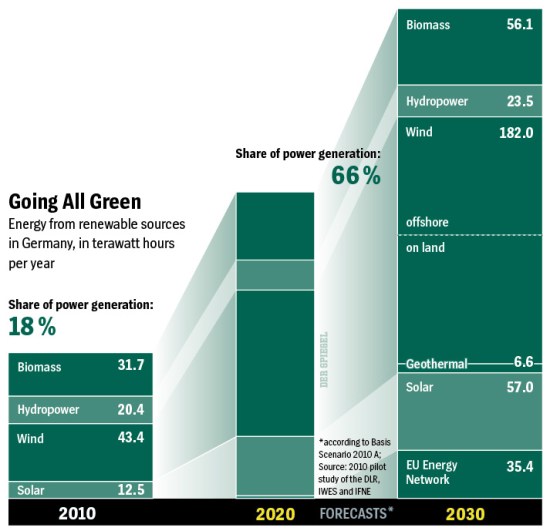
Germany mapped out a 20 billion euro ($25 billion) plan on Tuesday to expand its power grid and avoid a “power gap” as Europe’s largest economy switches away from nuclear to renewable energy.

Germany’s government, the federal energy network regulator and transmission grid firms unveiled joint plans for thousands of kilometres of new electricity lines to 2022, to help distribute volatile renewable energy.

Operators say some 3,800 kilometers of new power lines needed through 2022.

Energy Revolution Not Taking Place Quite Yet

German energy turnaround revolutionaries everywhere are turning around more than usual these days, burning more energy than planned trying to answer all the dumb questions those dumb energy reactionaries are always asking them.

Dumb questions like:
How come the energy turnaround isn’t making any progress?
How come the taxpayers continue to foot the bill?
How come all these renewable energy companies are going broke now that the subsidies are being cut?
How come made in Germany renewable energy technology is now being made in China these days (and German subsidies are actually helping the Chinese)?
How come Germany isn’t in the position to create the power-transmission lines needed to connect these new energy sources to the German power grid?
How come the energy-storage facilities needed for these new technologies are so extremely expensive and, well, just aren’t being built?
How was that again? How come Germany is in the process of turning off all its nuclear power plants?
How come the construction of dozens of new coal-burning power plants will therefore be necessary?

And how could ideology get the upper hand on reality (yet again) in a nation full of such sober, experienced thinkers?

And on and on and on these dumb questioners go. These reactionary types just don’t get it, you see. They don’t have visions like us revolutionary folks do. And they don’t hear the voices, either.

Germany Stalled on the Expressway to a Green Future

German Offshore Wind Farms More Deadly Than Fukushima

Nobody promised the Germans a rose garden when the so-called “energy turnaround” turned around the corner here last year.

So that’s why the three deaths and 80 serious accidents that have taken place so far while building Germany’s so badly needed offshore wind farms are being registered here with such stoic equanimity (or are being ignored altogether). Progress must march on or something. Keine Widerrede (no talking back)!

Do me a favor and wake me once this energy turnaround nonsense has finally turned around (as in over) and died itself.

Der Leiter des Havariekommandos in Cuxhaven, Hans-Werner Monsees, forderte gegenüber FOCUS ein „besseres und dichteres Rettungssystem“. Sonst drohe die Zahl der Toten und Schwerverletzten weiter zu steigen – in den nächsten Jahren werden bis zu 7000 Windräder vor der deutschen Küste installiert.